The Trump Trilemma

Dani Rodrik, the Turkish born Harvard Economist states that a nation may have two of the following three things: national sovereignty, democracy, or deep, global economic integration. It can have any combination of two. But it cannot have all three.

This is “Rodrik’s Trilemma.”

The logic behind why is somewhat complicated but can be reasonably explained as three forces pulling on one rope. Only two can pull at once to balance it. The third has nothing to grab on to.

One force, economic integration or, globalization as it’s called in the political world, is created when we reduce the barriers for trade of goods and flow of capital between nations. In order to have it, we reduce transaction costs; tariffs, import/export quotas, etc. When we do this, we inherently weaken some aspects of the control of the nation state and strengthen the input of global regulatory bodies in the sovereign affairs of the participating nations. The two sides pulling on the rope in this scenario are globalization and the sovereignty of a state.

If a nation desires globalization, it has to give up some power in determining its trade policy. If it wants more control over trade policy, it should be prepared to lose bargaining power in a globally integrated economy. The ebb and flow can be rationally managed and balanced to meet the best outcomes of the nation.

The trilemma comes in to play when that nation tries to do this while maintaining the accountability of democracy. In a deeply integrated global trade environment, an electorate has to have a focus beyond the nation’s own borders to ensure that it governs and makes policy in a way that effectively facilitates the global flow of goods and capital. In order to do this, the electorate must be willing to surrender, through democratic process, some sovereign power to global regulatory entities. They need to be able to do this in all circumstances even when, or especially when, the near-term outcomes of trade policy negatively impact the outcomes of the electorate.

Rodrik maintains that electorates don’t do this.

As a result, a nation wishing to maintain global trade integration and democracy must give up sovereign power to the global regulating entity lest the unwashed masses of democracy break the global economy with a tariff to protect their jobs. The tug of war then transitions between global trade outcomes and democracy. The more power the democracy has, the less integration we’ll receive. Sovereign control sits it out, surrendered to the electorate or the global regulatory entity.

We could continue the analogy through all the potential combinations but the one material to the Trump-ism discussion is where we’ve insisted that global economic integration sit out the contest and let democracy and sovereign control of trade policy have a go at it.

Let the people pick the leader. Let the leader pick the economy that delivers for the people. Everyone else get in line behind America.

America First.

This path is sold easily after hard times like the Great Recession. Trump and Brexit are textbook Rodrik’s Trilemma occurrences. Globalism is the casualty.

Most economists agree, if not in magnitude at least in direction, globalism is a net economic positive. It increases GDP, decreases the cost of goods, and makes the world an “overall” more stable place. The global margin increases.

People don’t vote on the global margin. In America today, they don’t vote much on their individual outcomes either. They vote on their culture. And that makes globalism an easy target.

Much of the Trump-ism message is about transitioning the economics of globalism into a cultural message of nationalism. One of the great tricks of Trump-ism has been to align the negative economic outcomes for its political base with the culture of toleration.

About halfway through the first quarter of the 2017 Super Bowl, I began to get the feeling that the American consumer, or at least the corporations that sell to the American consumer, were not big fans of the inward anti-globalism focus voted into office with the Trump administration.

The global cultural mindset was everywhere.

Coca-Cola ran an ad with people from all over the world singing America the Beautiful in their native tongues. Budweiser told the story of Adolphus Busch’s immigration. 84 Lumber showed the first half of a story that had to be cut off and shown on the internet because it actually showed Trump’s dubious great wall of America.

The message was loud and clear. Americans associate positive sentiment with a modern, compassionate, global perspective. We feel warm and fuzzy about the idea of diverse cultures all longing for and participating in the American dream. That message was market tested and executed by multi-national corporations who spent $160K a second on airtime to deliver it. It was not an unintentional endeavor.

The commercials we were fed were about people and culture and diversity. And tolerance. They filled Americans with the positive sentiment ad companies love to attach to the brands they represent. Inclusion sells. The sentiment, though, is a classic example of a problematic progressive globalism trap.

The progressive globalism trap pushes the notion that globalism is about people and tolerance. And if you’re about people and tolerance (I am), then you are a fan of globalism. In reality, globalism as we know it, the globalism that’s actually materially impacting Americans, has almost nothing to do with people and cultures and everything to do with trade and money. The standards enforced by the World Trade Organization and the outcomes that reducing barriers to free trade have coincided with an era of tremendous global growth. It’s drastically reduced economic inequality across nations.

But at a cost.

That cost has been the re-distribution of wealth and the increase of income inequality within already wealthy nations like America. It’s a firm reality of economics. We grow other place’s middle class at some difficult to quantify expense to our own.

Additionally, the opening up of the international flow of capital allows money to move seamlessly from country to country. But that’s come at a cost too. That cost has been a financial interdependence that fuels global recessions without alleviating the need for sovereign nations to bail out institutions deemed “too big to fail.” The global community didn’t bail out the American financial sector or our automakers. America did.

At the same time, the open flow of capital has also allowed open competition for corporate earnings to drive the corporate tax rate down globally almost 50% in just a few decades in a way that makes America less competitive for internal investment.

The fair point that Trump-ism makes is that global growth and stability hasn’t come without a cost to America. And the cost has fallen heavily on an American working class that hasn’t realized that we transitioned from a manufacturing and production economy to a services economy two generations ago. While the benefits of that global growth of the second half the 20th century exist, the costs are easier to point to in the wake of the recession.

By aligning the economics of anti-globalism with the cultural phenomenon of nativist nationalism, Trump-ism trapped their opposition in a reality where one is either for diversity, or one is for America. One can’t be for both and have the economic interests of Americans as a priority. The only counter Democrats found in 2016 was a departure from capitalism all together of Bernie Sanders.

And we know how that went.

Most Favored Nation

Last fall, economists Steven Levitt (of Freakonomics fame), Peter Cohen, Robert Han, Jonathan Hall and Robert Metcalfe published a paper on their findings of the analysis of the car service provider Uber X’s customer interactions from 2015. All 50 million of them. And they found something startling. Uber X’s ability to provide on demand transportation through flexible pricing and scheduling created $2.9 billion of economic surplus for Americans in 2015. Which means that because of how Uber X works, Americans spent $2.9 billion less on getting from point A to point B than they would have had Uber X not existed. And those Americans were therefore able to spend that money on something else, mostly in America so that other Americans could make more money.

That’s a hell of a finding. That’s roughly what it took to run the entire city of San Diego during the same period. But, it’s actually the second most interesting thing in the paper. What was more interesting than creating $2.9 billion out of thin air? It’s what actually told the team that bit of information—an actual demand curve, the first ever real demand curve ever seen.

Now, anyone who has taken introductory economics understands that the first day of class, the professor stands in front of the room and draws two curves. A supply curve. And a demand curve. And then he/she goes on to pontificate how perfectly they operate, all things being held constant. And if you’re lucky he/she might jump right into the power of comparative advantage and the magic it unlocks in free trade for mankind. So when I heard Steven Levitt say that they’d never actually seen a real live demand curve, in the history of mankind demanding things and supplying them, I nearly drove my car off the freeway and into a ditch, dooming me to contribute first hand to more economic Uber X surplus.

I recovered though. And I stayed on the road. And it started me off on a bit of a journey. I wanted to understand how the hell economists actually have a job.

Well, a little less than a year later after swimming in the work of people like Paul Krugman, Peter Thaler, Dani Rodrik, Jeffrey Sachs and Tyler Cowen, I’ve learned a few things. One is that I like economics. Who knew. The other is that there’s really two kinds of economics. There’s actually way more than two in real life. But for the sake of a reasonably short blog that someone might actually read, I’ve picked two that showed up as patterns in the work.

The first kind of is the one almost none of us actually encounter, unless we’re economists. It’s what I like to call, “academic economics.” Often delivered by a bearded gentlemen in a corduroy sport coat with those leather things on the elbows, academic economics believes in many things, but one thing absolutely. Context matters. When a professor stands up in front of a class and gives a lecture, two things are always present. A laundry list of assumptions. And a model. And it is common knowledge that assumptions change, as do the utility of the various as-sundry economic models. And if someone actually asks a question, like is free trade good? The answer is always, well that depends. And the things it depends on are about a billion situational factors about a time, place, culture, region that one could form an opinion out of. Very few things are answered absolutely and permanently about broad things like global trade or capital markets.  Lots of theories come about. All of them start with “it depends”.

That’s “academic economics”.

The other kind of economics is the kind that we all hear about all the time. It’s what I like to call “public policy” economics. And it’s ubiquitous. Public policy economics is usually is the less interesting economics elected official or a think tanks deal in. It rears its dismissive head when a bunch of economists who spend at least some of their time saying “it depends” in the classroom start saying something very different when asked questions like “is free trade good” in front of congress. They say things like, of course it is. Everyone agrees. And then they recommend policies in support of it.


Because, like just about anything, economics is not free from the risk of infection of politics. And “It depends on your assumptions” is really hard to put on a bumper sticker. Or a meme. And it’s even harder for stiff smiley politicians to talk about. Because most of them don’t have a ton of depth on the subject. Even the great Winston Churchill, once in charge of the British economic policy as Chancellor of the Exchequer was admittedly lost, claiming that his economic advisors were “speaking Persian”. And from a political perspective, those Persian speaking economists need to make sure that everyone understands that free markets rule and government intervention or protectionism is evil, lest we go and break the economy permanently with something draconian like a tariff. Never mind any of that thinking that economist Jeffrey Sachs calls, differential diagnosis. The considering of unique situational factors to be critical to an economic policy recommendation. All that thinking and considering nonsense is for the classroom. Politics renders it less useful in the light of day.

Something interesting is actually happening in economic politics right now though. When it comes to foreign trade specifically. Free trade appears to be the only thing anyone can agree on any more. Everyone hates it. Except economists that is. None of the politicians, at least the ones running for president, appeared to be big fans of our current trade agreements. Not the Republicans. Not the Democrats. And not whatever President Trump is. Bernie, Hillary and POTUS 45 all campaigned on pulling out of the Trans Pacific Partnership, the trade agreement that lowers barriers to trade for 12 Pacific nations not named China.

There’s another interesting thing too. None of the American people like our free trade agreements either. In fact, they never have. Survey after survey after survey of Americans and others all say they hate liberalization of free trade. They feel like it takes their jobs away. And forces them to do other things they weren’t trained to do. And lose money.

And they’re right. It often does. It’s not the only thing it does. It also gives us cheap goods that make that loss of income a little easier to bear. But the masses, this time, aren’t wrong about what’s happened to them over the last 40 years. How not wrong is up for debate of course.

Even your most ardent free trader admits, that though free trade creates overall economic growth, it comes with the cost of income redistribution and labor shifts that are big damn drag for a lot of people, particularly those at the lower end of the skill curve in the labor force. In fact the negative impact for those that lose out on the redistribution is about 50 times (also Rodrik’s number) more significant than the overall gain. Redistribution isn’t loss though. Someone else gains that fifty times. And even a little more because free trade does promote economic growth. But right now, in America, it’s really hard to ask the middle and working class to take more hits.

This is probably a good place to point out that two of the assumptions the “it depends” answer actually relies on is political climate and state of the workforce. Ours right now elected Donald Trump to be president. We may not have a model for that one yet…

Free trade didn’t create the loss of manufacturing jobs in America. Or the equality gap between low and high income Americans. Increased productivity that outpaced demand and a shiny new modern China over the last forty years are probably the main culprits, free trader or not. But it’s not helping fix our equality gap right now either. And when the executive action to scrap something like the TPP is wedged between building walls, deleting EPA data from government web sites or the wholesale repeal of healthcare, it’s easy to start to scream opposition to it as we develop a new political dynamic that says that Trump is bad=anything Trump does is bad. I think what we’re seeing though, is an interesting realignment.

The idea of free trade and the aim of reducing government intervention is an idea that really began to come to life under Reagan with the neo-liberalist movement. The free market fixes all ills and moves man forward. The government is bad and can only hurt things. The development of income inequality in the decades since and the certainty of its existence has thrust us into a different debate. The debate has shifted the argument from free trade vs. not free trade to how to deal with the fallout of free trade, without breaking the benefits of it. It sounds much less aspirational. But that’s where we are.

Right now, the developing party line for liberalization of trade is that free trade moves the world forward and helps global inequality, at some cost to inequality within nations of wealth. And the most appropriate action isn’t protectionism. It’s a stronger social safety net at home for the American worker. Which sounds like it evolves into a good old fashion conservative vs. liberal argument. But it’s really an argument about where government intervention is most appropriate. To protect our internal economic development through protectionism? Or to compensate the American worker through government social measures in return. You’ll note, keeping government out of it is no longer on the menu. And that’s new in America. Or at least new again.

So who’s right?  Well it depends…remember? It depends on about a billion different things. Things like exactly what the rest of Trump economic policy looks like. It depends on whether or not the election of an unknown agent leads to catastrophe of domestic or global proportions. It depends on whether or not Mexico breaks off diplomatic and economic relations with us. It depends on whether or not our commander in chief gets impeached for refusing to sell his businesses or fondling an unsuspecting intern. It depends on so many things that the only real thing you should be sure of is that if someone tells you pulling out of the TPP without certainty is a bad/good idea, than they are full of “fake news.”

Wait and see on this one. Keep a firm watch on the other stuff that is far more scary right now. Pulling out of that trade deal isn’t downright nuts. (there’s a bumper sticker for you) Not the way building a magical symbolic wall in 2017 is. Not the way pulling the plug on ACA without a plan is. So resist the urge to oppose for opposition sake. There’s plenty of meat still on the bone for that one.

Star Wars: A Social Commentary

If you’re going to make a prequel to the most iconic, imitated and merchandized movie in modern American culture, you’ve got some pretty heavy decisions to make before doing it.

If you decide to make that prequel end at pretty much the exact moment that the iconic movie begins, and 40 years have passed since you stopped filming the first one, then you’ve got some more decisions to make. And some problems to solve too. Like making people dead or 40 years since aged appear to be neither. Or making spaceships move and sound the same even though special effects technology has been reinvented several dozen times over. I’ll spare you the spoilers. They did just fine with both of those. And as a lunatic Star Wars geek since long before it was cool to be a lunatic Star Wars geek, I loved every minute of it.

I realized something about halfway through my second viewing of it though. Something that you would probably miss, unless you were sitting next to a curious seven year old who got his first WIFI enabled iPad when he was three. It occurred to me, when he leaned over and in his extra loud whisper voice asked, as the heros of the movie were hatching their plan to get their hands on a society saving piece of data, “why don’t they just download it from the cloud?” And there it was. Somewhere between a mouthful of popcorn and a draw on my 90 ounce diet coke, it occurred to me that the fantastic Star Wars drama Rogue One, was an accidental social commentary on the great stagnation of our times.

Chances are, you’re going to need me to unpack that one a bit.

One of the fun decisions that the makers of Rogue One made, very effectively so, is to cinematically keep true to the futuristic technology levels shown in the first Star Wars movie. In the 40 year old Star Wars, there were space ships and light speed travel and special reactors powering things. They had vehicles that levitated and machines that harvested moisture from the atmosphere. There were no wheels inefficiently conquering surface friction on just about anything. Nothing appeared to be burning anything to propel it. And there were robots everywhere with real artificial intelligence to the extent that they had their own limited free will and personalities. In almost every way, it was a glimpse into the far distant future. And what 1977 would have you believe, in a way that recreating it in 2016 makes painfully obvious, is that fantasy future is powered by computer technology that would have been nearly obsolete by about 1995. screen-shot-2016-12-28-at-7-59-36-am

About the same time that the original Star Wars was being filmed in the mid seventies, Gordon Moore, co-founder of Intel made his proclamation that would be referred to ever since as Moore’s Law. Moore claimed that computing capability would double every 18 months. Over the last few decades, his assessment has been correct. In the 60’s we sent men 240 thousand miles to the moon and back on a rocket designed to go even further, Mars perhaps, using a navigating computer with 265 thousand times less memory than my Iphone. screen-shot-2016-12-27-at-5-58-30-pmWhich means even a decade or so later when Star Wars came out, what we saw on the screen, cd ROMs with secret plans, buttons instead of touch screens, vacuum tube televisions and data ports you had to plug a giant robot phallus into to transfer info, looked futuristic. Because it was. But when we had to duplicate it and pretend it still was forty years later, it looked, well, kind of silly. 

So what right? Clearly I spend too much time thinking about what things say about us as a society. That’s entirely true. But consider this. In 1969, we were conducting space travel and flying super sonic passenger flights. We had no WIFI or even internet, almost no data storage or computing capacity and nothing that resembled the cloud. Today, my 11 year old operates an iPhone hundreds of thousands of times more powerful than anything we had then, and we haven’t flown super-sonic passenger flight in 13 years. And America is no longer capable of manned space flight. What space flight is happening, is limited to low earth orbit. Because over the last 40 years, the world of bits (computers) hasn’t just outpaced the world of atoms (everything else), they’re no longer even headed in the same direction.

But why?

There’s a few thousand pages you could put into that question alone. But I’ll hopefully leave you wanting more instead. You could take the path that Paypal founder, Facebook Board member and venture capital investor Peter Thiel takes. Thiel who famously critiqued Silicon Valley’s output by saying,”We wanted flying cars, instead we got 140 characters.” believes that the barriers to entry for industries like energy and automobiles are too high because of things like regulation and a failing education system and a lazy baby boomer generation that rode the coat tails of their parents to a comfy life with no problems to solve. Thiel believes that we have deep societal and government structure flaws that we could overcome, if we get it together to get it moving again. Which is probably why he spoke at the Republican National Convention.

Or you could listen to economist and author Tyler Cowen who takes another spin on it. He thinks we’re pretty much done innovating, for awhile, as an American species. We’ve picked all the “low hanging fruit” over the last 400 years or so, with free land, immigrant labor and technology, now it’s time for it to slow down. And it has.

So who’s right? Thiel? Cowen? I don’t know. As it tends to be with massive systems discussions like the economics of innovation, it’s complicated. But I like to put my mental energy into a space that it’s likely Cowen would find silly and optimistic. It sounds like this. There was a lot of money made in Silicon Valley over the last few decades connecting the world and creating a future that, from a consumer software and electronics perspective outpaced even the great creative mind of George Lucas. And now some of that money is going towards combining the first principles of Silicon Valley-lean agile start up aggression- with old dinosaur industries like automobiles and aerospace. Elon Musk is launching rockets at Space X, putting solar power on houses with Solar City and building electric cars and charging stations at Tesla. Amazon founder Jeff Bezos is stealing Musk’s employees to come work for his own space company Blue Origin. And Google is making cars that drive themselves.

The point is this. I don’t know if Cowen or Thiel are right. It doesn’t really matter. Because it’s moving again. And the types of people moving it appear to have the resources to get it moving for real. And our job, as a people, is to expect it to keep moving. And to see the value in progress and innovation beyond things that make our lives easier. It was easy when we had no choice, when we needed to make rockets and technology to keep up with Russia and stave off nuclear annihilation. Without that push we’ve lost a bit of the oomph though. But we need it back. And quickly. 2.7 billion industrialized Asians are going to happen over night. And if we do it with last century’s energy and transportation technology, it’s just another type of annihilation.

It’s time to start seeing the world like a seven year old who looks at a problem and asks with the great curiosity and wonder, “why don’t they just use the cloud?”  In 1977, that was a crazy idea, even for the future. But as Google founder Larry Page said, who was once told the idea of translating all the books in the world into data was crazy, “Good ideas are always crazy, until they’re not.”

And right now, that guy and his buddy Elon are building a zero emission car that drives itself. Which sounds crazy right?

Until the world needs it. Until it doesn’t.


American Vision: Revised Edition

My mother’s favorite poet was Robert Frost. She kept a book of his poems with illustrations on our old wooden bookshelf in the living room of our house in New Jersey. There were a handful of books on that bookshelf that I would pull down and thumb through from time to time. One was a compilation of photographs of Lincoln. Another was an illustrated account of the Kennedy assassination. Another was the story of our accomplishment of space flight. They were huge books, about half the size of me with colorful pictures, worn dust jackets and coffee stains. She’d gotten them in college in the 60’s. They sat on that shelf for decades. Some of them are still there, though she’s long since passed.

screen-shot-2016-12-24-at-6-29-00-am
Stopping by Woods On a Snowy Evening By Robert Frost

I remember the picture of a tree on the page with Frost’s Stopping by Woods on a Snowy Evening. It looked like the tree in my front yard. I would read that poem over and over again. There was something about the end of it that just stuck in my head. The part about the woods, “lovely dark and deep.” And the part about life, “miles to go before I sleep”, twice said.  There was beauty in that described moment of peace. And the realization that it was fragile and fleeting and that there was work ahead that made it more so. One last breath of fog in the cold night air while your feet stay still in the snow. And then it’s back to the business of life. Less beautiful. More permanent.

Life moves on. The future is our only constant. And no matter how beautiful or still or comfortable the peace of now might be, you cannot stay in it. The instant you realize it is the now you’re experiencing, it becomes the past. And you must move on. There’s work to be done.

Elections aren’t what make democracy great. They are a messy, imperfect means to an end. Accountability is what makes democracy great. And elections are the best measure of that accountability that we have to do that thing that is so hard to do. Since the days when we wandered out of the woods and onto the planes and further still over the horizon, the process of choosing who we allow to leads us has been hard, costly and not always for the best. The way we do it in America has yielded strong outcomes for centuries though. But it is not what makes us great. The greatness comes in between. After we choose. After we begin our journey again. We’ve got quite a bit of road ahead of us to cover. We’ve got miles to go. No sleep in sight.

There is a world beyond our current myopic focus. Our politics or the Jihad of a small group of foreign, hateful, religious zealots have distracted us. The world is about to remind us that those things weren’t quite the magnitude of threat we’ve faced in the past. What lies ahead, the rhetorical promise of a new arms race and the rise of an eastern power with enough resources to dominate the world for centuries, are far more serious threats. Threats that will force us to remember a time when Russian field commanders had nuclear weapons release authority for the payloads being placed in Cuba, 90 miles from our shores. Or when global imperial powers had the capacity to cripple our military with equal or greater military might of their own. And nothing the last president did, or the one before him or the next one is at fault. It’s the ebb and flow of a global species in which there is rarely a singular power that remains singular for very long.

It’s time to pick our heads up. There are sails on the horizon. And we’ve got work to do.

It’s been 45 days since the American people elected Donald J. Trump president. And it’s another 30 until he is sworn in as the 45th president of the United States of America. We’ve had enough time to reflect on what the election says about us. And what it says about the state of our political discourse. And what it says about our culture. We’ve taken our deep breath in the cold dark woods. And it’s time to move on. And it’s time to move past the what and why’s of what happened. It’s time to ask the better question. What do we want from a Donald  J. Trump presidency? What do we want for America? The answer is pretty straight forward.

I don’t want him to fail. I don’t want him to be the disaster that would prove secretly delightful to those of us who so strongly opposed his candidacy. That justification can only come with four years of failure. Four years of worse outcomes for the American people. Four years of a weaker country amidst the backdrop of a rising China and a belligerent Russia. I don’t want that and neither should you. What I want out of a Trump presidency is the same thing I would want out of any presidency. Success.

Success is a weak word. It hasn’t done the work. The work of success begins with a narrow vision of what right looks like in the end. And if you don’t have one for America, then you haven’t done the work.  And you don’t know anything about the effectiveness of her direction. And if your vision is 1950’s American, it’s a bad one. Success starts with a vision. So I’ll share with you mine. Because a great 21st century America needs to start moving forward in earnest. A great 21st Century America accomplishes the following, no matter who sits in the oval office or what ideas they have about America and her people:

  • 25 Million new jobs created over the next ten years. China is on the hook for ten million a year. They’re still in catch up mode. We can win with a quarter of that.
  • Balance the federal budget by 2030. If you refuse to accept any other outcome, it can be done. But you are going to have to re-define your reality of taxation and government services. If you can’t, your future is already decidedly less great.
  • Eliminate fossil fuels within 75 years. Not through regulation. Through innovation and a better way. 100 years from now people need to laugh at their grandparents for digging dead things up from the ground and burning them for power. Pay attention to what Elon Musk is doing. And root for him to succeed.
  • A complete overhaul to modernize American infrastructure by 2025. I don’t mean repair. I don’t mean upgrade. I mean build again. Better, more innovative, more American. We win with better things and a better way of life.
  • Manned space flight to Mars by 2035. If it sounds silly, then I’d ask you what happens when a people reach their ceiling? They atrophy, or they blast through it. I’m for the latter. Again, watch Musk.
  • Put science, treatment and doctors back at the center of American healthcare. Get shareholders out of the game. Do that in any sustainable way possible.

That’s not an exhaustive list. You could probably find other things. But it’s a start. And we have to start. That’s what a vision looks and sounds like. That’s what making 21st century America great looks like.  It’s more than a red hat and a snappy saying. It’s hard work.

There’s something refreshing about turning away from the messy footprints behind us that got us where we are and turning towards a goal. It’s cathartic. Because you spend time thinking about what you want. So much of American mind-space for the last 18 months has been focused on what we don’t want. It’s time to move on. And move forward.

If you’re one of the tens of millions of Americans who the president elect alienated with his campaign rhetoric or personal behavior, I’m not going to ask you to just get over it. But I am asking you to have a vision for what you want. Not simply what you don’t. And it’s entirely fair to assume that in order to realize that vision, it’s mandatory to build some foundation of unity where Americans aren’t living in fear of each other or the government. And if that can’t be done with Mr. Trump, then step one on the vision, is choosing a new leader. So be watchful. We are a nation of people. But we are a government of laws-laws that exist for the betterment of our people. No one is above them. We didn’t elect a king. Only a president.

It’s time to get going now. Feet moving over the snow again…miles to go before we sleep. Miles to go before we sleep.

The Mandatory Future

Once, I was the AUXO. That’s what people called me and that’s what I answered to. It’s one of the fun quirks of serving as a naval officer on a war ship. People just call you what you are instead of who you are. And I was the Auxiliaries Engineering Division Officer on a guided missile destroyer. The Auxiliaries Engineering Division-“A Gang” for short, owned just about every part of engineering equipment on the ship that didn’t actually turn the shaft. Which means my team had to know how to operate, maintain and repair just about anything from industrial grade maritime air conditioners to hydraulic steering units to the toasters in the galley. And they had to do it well, like people’s lives and the national interests of America depended on it. Because they did.

As the officer in charge, I never looked at my enlisted men, Enginemen by trade, as a bunch of people who wished they were me. They didn’t. I never thought that I had succeeded and they hadn’t and that’s why I was where I was, in charge, and they were where they were, doing damn hard work. It wasn’t because I was particularly enlightened as a 23 year old ensign. I simply understood an important truth. That their job mattered. And it was difficult. And that I probably couldn’t do it. I never told them how to fix something. I just made sure that they were resourced and focused enough to be the kind of group that fixed things right. That squared just fine with them. Because that’s all they ever wanted. No more. No less.

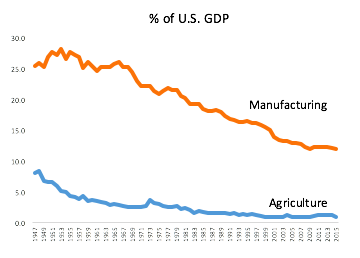
Working class America doesn’t want to be management class or professional class or any other class either. Like my team, they want to work. They’re not poor. And they’re not unsuccessful. And they want to continue to be the backbone of our country. They want to continue to be the most productive, efficient and effective group of humans that has ever gathered. They don’t wish they were me, peering out of my Silicon Valley tech firm office surrounded by walls of white boards with “big thoughts” on them. And they don’t want to be “in charge” either. We managers are stiffs. And we don’t know how to do anything useful. And we don’t have any value unless we’re supporting them in doing what they want to do-build and maintain and fix America. It is perhaps the purest, most honorable desire a human can have: to work hard at important work.

screen-shot-2016-12-04-at-6-49-19-am
Source: Bureau of Economic Analysis

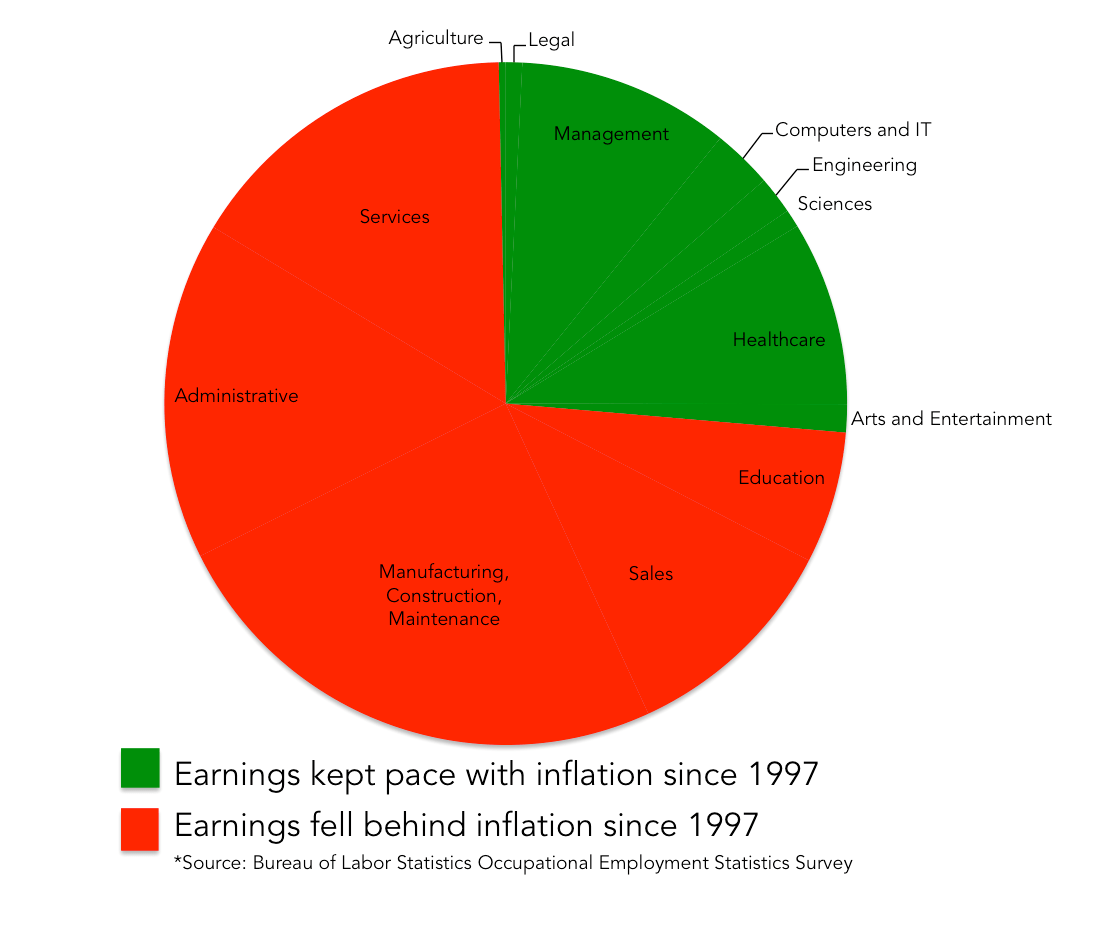
We’re not going back to making things the way we used to though. We’re not going to employ millions digging holes in the earth or sowing and reaping the harvest or rolling out the last century’s modes of transportation. Those days are gone. We’ve found other ways to make money. We’ve grown finance and healthcare and insurance and real estate and business. We’re about to retire an entire generation that saw their nation grow in strength and their economy boom for almost every year of their life. Their legacy will be fifty years where the only thing that was built was the computer technology industry, by a handful of men, in a small town in Northern California.

screen-shot-2016-12-04-at-6-52-08-am
Source: Bureau of Economic Analyis

There’s good news though, for those who want to work hard at important work again, even if it doesn’t sound like it. That good news is that we’re in a whole heap of trouble again. And by we, I mean planet Earth. China and India and the rest of the developing world are trying to make their world look like ours. And that’s a problem. That’s 2.5 billion people moving from 18th century American technology and resource needs to modern America. China appears to be interested in doing it overnight. That’s 2.5 billion people worth of cars burning gasoline, power plants burning coal and air conditioners busting power grids. It won’t work. And they don’t care because it won’t be them that runs out of the resources. And there’s only one way to stop it.

21st century America needs to look a lot more like what the people of 20th century America thought it would look like when we went from the first manned flight to leaving the planet and landing humans on the moon and flying back in a short enough span for one person to have seen both with their own eyes. From 1830, to 1930, we went from horseback and drawn carriage to flight sophisticated enough to use in war. Now, nearly 90 years later, most of mankind is still using some form of the same vehicles today that they used then, burning the same fuel. That life, won’t scale. And it’s not because I’m a tree hugging liberal who cares too much about the environment. It’s because of math. And because the nation that will win the next two hundred years is the one that figures out how make power without burning things. That’s the problem. And it’s not an optional one. That’s the good news.

Putting our strong working class men and women back at the center of what we do and who we are as a country means that we’re going to have to start building and making and maintaining things that don’t exist yet, not last century’s things or the things other places have figured out how to build at scale for low cost. When we do, America will once again be tangibly stronger, with better things and a more effective way to live than anyone else. That’s what makes a people great, what they do, not how they feel.

And if you can’t imagine a future where we aren’t burning things to make our power, than you can’t imagine the mandatory future. And if that’s because of your political or financial interests, then you need to go. That’s the swamp I want drained. Mr. Trump, if you’re listening, put your energy and your ego behind driving the change that wins the race for a different power source and you will be remembered for generations as the man who won the 21st century for America. History forgives quite a bit in exchange for outcomes like that.

If any of my three boys wants to throw on the blue coveralls and get to work turning wrenches and solving problems by fixing material things that actually exist, I’ll be damn proud. But if they choose to enter the professional life, the “management class” then I want them to understand that the life my generation chased, finance and law and computer innovation, won’t change the world the way our future needs it to. If they want to change the world, they need to get back to work in fields like engineering and science that enable greatness. Because if the best and brightest of our young leaders keep growing up thinking that they want to get into Wall Street or be a lawyer or even break into crowded Silicon Valley to figure out the next great app that makes our lives nominally easier, then we’re in trouble. Because we’ve decided once again, to stop trying to solve new problems and focused instead on making more money solving old ones.

Fifty years from now if we are a culture of bankers and business managers, then we’ve failed. Banking and management are enablers to greatness. They aren’t the greatness. The greatness that is America is the genius to understand how to solve real problems and the strong back to solve them. We are a nation that makes things.

Fierce

Leonard Zhukovsky / Shutterstock.com

It’s not close. Our women, American women, are better than yours. At least as far as international athletic competitions go they are. When the 2016 Olympic Summer Games in Rio concluded, American women had won more gold medals than anyone-as in more gold medals than any other country’s men and women combined. Actually, Great Britain’s combined men and women tied them. But you get the point. It was a thorough and complete domination. From the track, to the pool to the basketball court, their 27 gold medals were the best ever performance by any women’s team in history.

If you watched, Brianna Rollins, Nia Ali and Kristi Kaslin stand on all three tiers of the podium-three beautiful American women alone at the top of the world, having just swept the women’s 100 meter hurdles-something never done by any three American women in Olympic track and field history and you weren’t proud, then you don’t get proud. Something struck me when I saw them up there. It was a feeling that grew over the last few weeks as I watched strong American women of all shapes and colors and sizes drubbing their world class competition. It was something more than just the overwhelming emotional sense of pride. It was this: Title IX was one hell of a piece of legislation.

In 1972, Title IX was signed into law by President Nixon. It was a sweeping bill that prohibited gender discrimination in any education system that received public funding-which for the most part is all of them. The reason Title IX is significant to women’s performance in the Olympics is that the law’s most well known provision required equal opportunity for women in athletics.Which means that universities receiving public funding had to invest in women’s sports with things like facilities, equipment and scholarships at parity with their men’s sports. So if you’re the University of Texas, and you want to spend $25 million on your football program so that ticket sales, sponsorship and cable TV deals can make your university $101M (these are the real numbers from 2013 according to Forbes by the way), then you are going to have to find a way to proportionately invest in women’s sports as well.

Of course you won’t make $100M more. But you have to do it. It’s the law. This is one of those times where most agree, without the legislation, the free market isn’t getting us the same outcome. Women’s collegiate and high school sports have been climbing to amazing heights ever since. Like I said, Title IX is one hell of a piece of legislation.

Though the athletics portion gets most of the press, it’s actually just a small part of the law. The rest of it was aimed at eliminating gender discrimination within the entirety of the education system. Before title IX, it was legal to exclude women from the same classes men took. Pregnancy was grounds for expulsion. Most women professors were forced to teach at women’s schools. Title IX also made it the school’s responsibility to fight sexual harassment and discrimination within their classrooms and campuses. There’s more, but you could fill a book with it, or hundreds of pages of legislation. Like I said, it’s a hell of a law. It did more to create the modern educational dynamic of inclusion for women than any one thing over the last fifty years.

The outcomes fostered by the change have been clear in athletics-1 in 27 women participated in high school sports in 1970. Now it’s 1-2.5 and we’re pummeling the rest of the world in the Olympics on my television every four years. But what about the rest of it? Has it been as helpful?

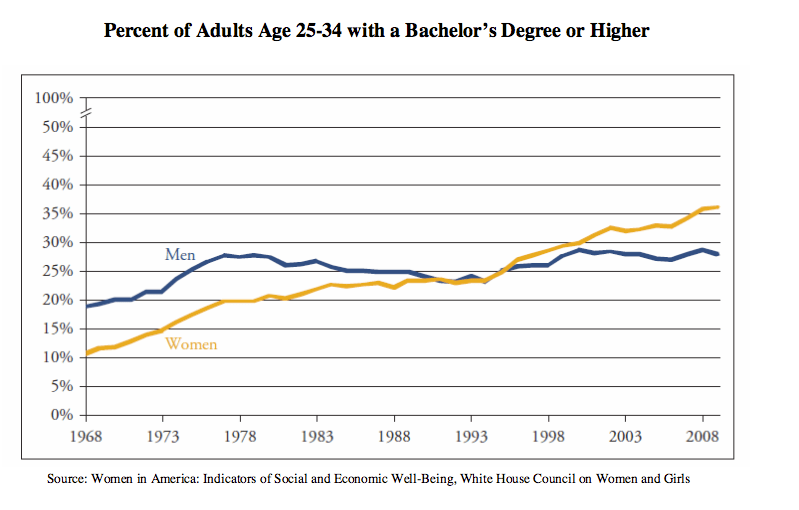
It’s hard to measure in its entirety but the quick answer is yes. According to the Department of Justice, women now graduate from college at a higher rate than men. And the trend pretty much keeps up at High School and post graduate education levels as well.

Screen Shot 2016-08-21 at 11.25.28 PM
Source: Equal Access to Education: U.S. Department of Justice Forty Years of Access to Title IX. February, 2012

Over the last forty years, education and athletics have drastically changed the horizons of American women. That much is clear. Which brings us to the real pay off issue here-women in the workplace. We’ve moved the needle in the early part of life for women in America-school and athletics-but what’s happened in the workplace?

There’s much to be said these days about gender inequality at work. There’s a commonly accepted notion of income disparity and an ongoing political debate about the status of American maternity leave relative to other industrialized countries.Those are the political debates. The ones where we try to figure out how our government or awareness and media pressure can solve this stuff by forcing change at the highest level-top down to right the wrongs. But if you do a little digging and study some of the research by people that actually approach this scientifically, you’ll see that there’s really more going on here then will be solved by laws or PR campaigns. There’s a real, moral issue here that lives much closer to the ground where moral issues tend to live-at the you and me level.

According to a paper published by Harvard economist and professor Claudia Goldin in 2014 in the American Economic review, women working full time in America earn about 30% less then men do on an annual basis. In 1980, it was 44%. Much of that difference actually has to do with the types of occupations women choose to enter into-and not straight favoritism towards men. If you normalize the wage gap to compare like experience, education levels and occupation type, that number narrows to 18%. And when you look at women who entered into the workforce more recently, within the last 20 years, the number drops even further to 10%. Which means that it’s getting better. Better, however, means women in the work force, are still valued at 90% of what a man is.

Goldin goes on to argue that there are two forces at work here in the gender wage gap. The first she refers to as the explained portion. The explained portion makes up the majority of that original 30% gap and has to do with occupation type, differences in education and job availability for women who entered the work force before today’s generation. That portion is the portion that decreases when we normalize the comparison by like occupations and education levels. It’s also the portion that’s decreased the most over the last 40 years.

The second portion of the gap is less clear. She calls it the residual portion. There’s less firmly understood or proven about that. But with women now more educated then men with decades of equal work experience behind them, it’s fair to say that there’s likely not an acceptable explanation for why a woman is 90% of a man.

The obvious place to look to explain the residual lag in compensation is just plain old sexism. There’s no doubt in my mind, that’s part of it. Not because I ever see it out in the open in the work place in 2016. I know about sexism the way I know about racism. I’m a 40 year old white guy. Which means a lot of other 40 something white guys casually assume I’m part of the racist misogynist club. So when it’s just us, it comes out enough that I know it’s still there. There’s only one reaction you can have if you care about the residual problem in workplace compensation equality, which you should. Stomp it out when you see it. People have enough pain and hardship in their lives to deal with stupid old white guys longing for the days of Mad Men. It’s not cool. It’s not funny. It needs to go away…for good.

The other part is a little more nuanced. There’s a story in the data that Goldin shares in her paper. There’s a pattern in how some employers compensate, especially in corporate America where they focus their highest compensation on management. Companies in corporate America tend to compensate workers willing to work longer hours with promotions and higher salaries. And by longer hours I mean over and above the normal 40 a week. Those of us in the corporate rat race know what I mean. 40 hours is a lie. And the higher you rise, the more it grows. 50, 60 hours is the norm.

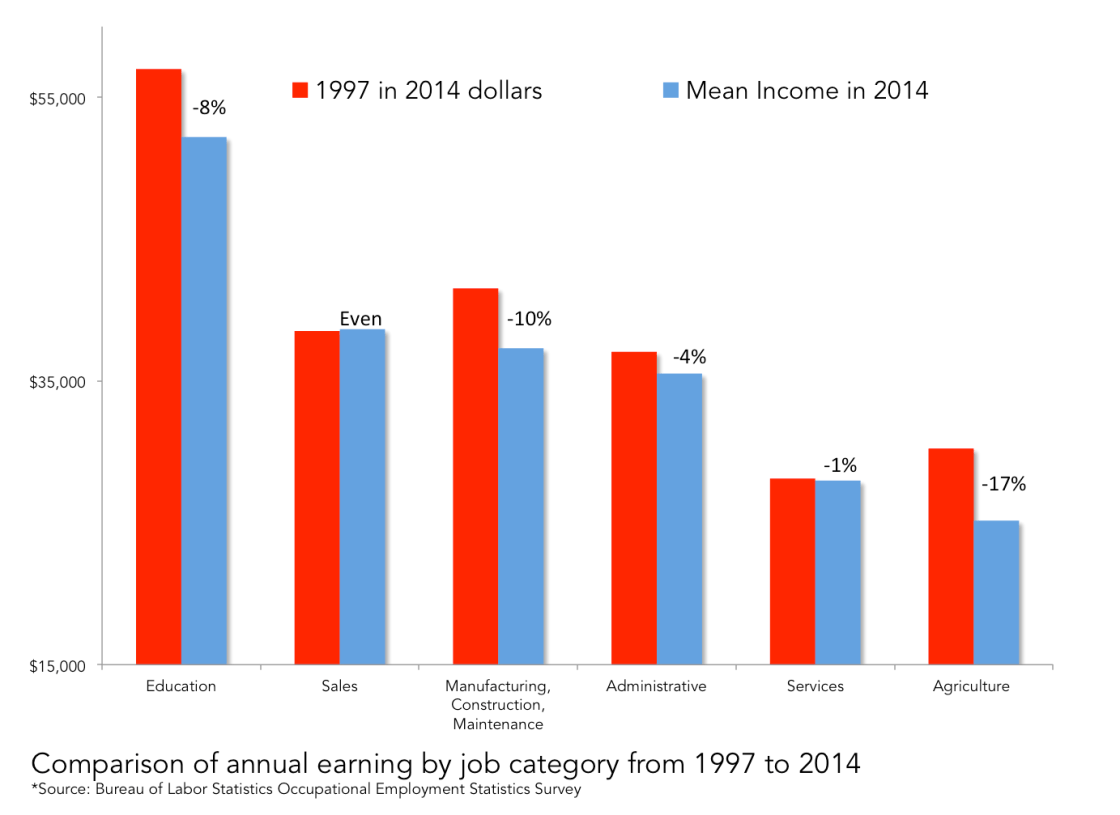
There’s another interesting thing thing that we can learn from the data. It’s actually what the data doesn’t show us. Those 60 hour weeks aren’t accounted for on any balance sheet anywhere. It’s the hidden expectations of success. We don’t get overtime. We get promotions and big bonuses when our outcomes warrant it. When they don’t, we don’t. So when you look at it, not actually putting in that extra time, doesn’t show up anywhere. There’s nothing to point to that’s absent. It’s silent evidence. Where we see it materialize though, is what happens to the pay gap between men and women as they progress through their career. It grows. And it bottoms out in the late 30’s and early 40’s, then starts to recover. And if you think about it, a strong hypothesis starts to materialize.

The longer a woman stays in the work force, the more likely she is to be disproportionately effected by the commitment of family.

Screen Shot 2016-08-23 at 9.31.38 AM
Source: American Economic Review, April 2014

Now, why that is or if it’s right is something you can’t explain in a two thousand word essay-or a any essay for that matter. Why having a family impacts a women disproportionately more than men is a facet of our society that has been thousands of years in the making. But I can tell you, it’s very real because I see it every day.

Sometimes, it’s a choice. I have female colleagues who willingly take reduced roles, work part time or even change to contractor status in order to reduce their commitment to their job. And in searching my memory, I can’t think of a single instance where a man did the same. Now, because of the industry I work in and the relative stage I am in my career, these women are unquestionably the primary breadwinners in their home. Yet, they still made that choice to cut back though. And I have to be clear, where I work is about as accommodating an environment as you are going to find in corporate America.

Just because some choose to cut back doesn’t mean there’s not a problem though. For every one of those women who have chosen to sacrifice career progression for family, there are several more who would not or could not make that choice. And that’s where we need help. And by we, I don’t just mean government or corporate leadership. Political pressure on high visibility issues like maternity leave and wage discrimination help. But it’s not all of it. The American working woman is an amazing asset. The bigger role they play in anything, the better we get. Just look at Rio. So if we want to rise, they have to rise with us. And it starts by realizing that one thing that has absolutely nothing to do with gender.

When I was on active duty in the Navy, I didn’t work with many women. I went to Annapolis for college which was a little less than 90% male. I served on one of the last all male ships for my first tour. And then I transferred into other units that were only open to male participants. By the time I got out, I’d spent most of 15 years working only with men. Of my three war-time deployments, only my last one had a woman attached to the unit I served in. It’s safe to say that by 2011, when I left that world, I had about as little exposure to women in the workplace as was possible in 21st century America.

That might seem like a problem when it comes to understanding women’s issues. But it’s not. I’ve been at it for a few years now and they haven’t killed me yet. Because what the military taught me, and what is lacking when we don’t stand by our colleagues when they’re doing the human see-saw act that is balancing being mom and a business leader, is that we’re all in this together. And when we can, we take care of each other. Which is something that has nothing to do with gender and everything to do with giving a crap about the other humans you work with.

My commanding officer sent me home from Iraq for a few weeks when my son was diagnosed with autism. And when I came back to finish the deployment, he made me leave on the first set of planes taking us home-even though I’d taken two weeks away, which no one else got to take and officers usually left last. He knew I was a wreck and so was my wife. And when he saw her at the post deployment banquet, he pulled her a side and told her that I did an amazing job. And that she should be proud of all I did. And that he was personally grateful for the strain she took that allowed me to do it. He knew we both felt guilty about it-irrational as that sounds.

He gave me what I asked for because he knew what I needed to stay a part of the team. And if he didn’t, and I had to choose between my family and the team, my family won. So he didn’t let me choose. He didn’t worry about setting a bad precedence or about how it would look. Or maybe he did, because it looked like he gave a crap about me and my family-which he did.

This whole thing-all of it-works better when we realize we’re all in this together. And we do what we have to, to keep each other in the fight. And remembering that is what we can do, to close the gap for gender equality in the workplace-not governments, not shareholders. Us.

So when one of your employees comes into your office and hesitantly tells you that she’s pregnant and her due date is smack in the middle of your peak business season, the only answer is congratulations. And if she tries to apologize-it happens- don’t you dare let her. And when one of your employees who’s just returned from maternity leave asks to work on a part time schedule, for part time pay, because three kids under four and two full time working parents is just about impossible, you say, of course. Because that’s the only answer-even if your company’s policy doesn’t clearly state you have to. Don’t you dare make her choose between her work and her family, if you can help it.

Being a tough leader doesn’t mean coming down on your people. It means finding ways to make those situations work, while making it look easy, up and down the management chain. You could wait for the law or for your corporate policy to catch up with what’s right. Or you could lead and take the strain yourself. If you can’t, maybe this leadership thing isn’t for you.

And if you’re reading this as a professional woman-or man- without a family by choice or otherwise and this treatment strikes you as unfair, you’re right. It is unfair. Just like getting pulled out of a presentation to your CEO as an executive at a software company because your 12 year old got in a fight at school is unfair. Mom is usually who you call for that-no matter who you are or what you’re doing. And yes, that mom has a choice. Leave and go get him, or walk back into the meeting and go about delivering her presentation while being mom gets de-prioritized. Whatever she chooses, and I’ve seen it go both ways, it won’t feel good-either way. And that’s not fair either.

Yes, having a family is a choice-usually. And it’s not your fault they chose it. Rest easy, you’re still getting the better end of that deal. At least at work that is. Even if it simply means never having to make that crappy choice that I’ve seen dozens of times. Because that choice sucks the way few things in life suck. So cut them some slack. The workplace and the world will be a better place for it.

The American woman is fierce. I have no better term for her. They showed the world their strength and grace and toughness these last two weeks at the Olympics. But they show it in super human ways every day, splitting the unfair load of mother, wife, and pro. It takes a fierce woman to choose to jump into it. Why in the world would we ever do anything to keep that kind of fight on the sidelines when we’ve got so much to gain from inclusion.

There’s a lot of this that’s on you and me. And we can do better.

City By the Sea

My people are an old Atlantic City people. We go back to the grand days of the boardwalk empire. My great-grandfather was a boat captain in the inlet basin. He drove the famed Miss America speedboats. My grandmother was a show girl in the Ice Capades. She performed on Steel Pier long before it burnt down and fell into the sea. My father worked over 30 years on the Atlantic City Beach Patrol. I put in 6 myself. It’s in my blood.

Gambling came to the city the year I was born. My mother, a schoolteacher, worked as a blackjack dealer in the summers and in the evenings. She wasn’t from there. She married into Atlantic City. And it wove itself into her. She died there.

I have aunts and uncles and brothers who all work in the casino industry today. And though I left to join the navy when I was 18, and spent most of my adult life in California, Atlantic City has stayed with me. It’s the kind of town that leaves a mark-for good or for bad.

Like I said. It’s in my blood.

Something’s gone horribly wrong with America’s Playground though. To be honest, something’s always been wrong. She’s never really been on the up and up. Even when she tried. And now it looks like it’s caught up to her in a way it never had before.

This past week, the municipal government of Atlantic City received permission to shift paying their employees-cops, firefighters, teachers, etc-to a monthly basis instead of bi-weekly. Had she not, the city would have been out of money by the end of the month. This new payment schedule buys them until May. Which means that unless something changes, the first and arguably grandest destination resort of 20th Century America will be unable to pay her employees, her debt obligations or any of her other financial commitments. In which case, under normal circumstances, she would declare bankruptcy.

Except she can’t.

Because there’s something else going on in New Jersey. Something that, fifty years from now, history and political science majors will be dissecting in case studies. If we’re lucky.  If we’re not, they’ll be teaching it to our grade school and high school students learning about it the way they learn about things like Tammany Hall or the Teapot Dome scandal.  It will be one of those otherwise obscure events we teach to generations for how teachably perfect it illustrates a massive societal problem of the time, and how it served as a warning-a canary in the coal mine if you will-that ushered in change. It’s a troubling compilations of civic catastrophe.

If you’re not paying attention to it, let me help.

If you are paying attention to what’s going on in New Jersey, you’ll see what appears to be a long series of governing through press conferences. You’ll see the mayor of Atlantic City, Don Guardian with his odd bow-tie, defiantly standing at city hall trading barbs with the imposing Governor Chris Christie, fresh off of his unsuccessful presidential bid having somehow been out bullied by Donald Trump before eventually endorsing him in a tragic race to the bottom that is the political despair of the Republican Party. The mayor and the governor are at an impasse.

But over what?

Hold on tight because this gets complicated. And you may begin to think I’m joking as I explain. Sadly, I’m not.

The municipal government of Atlantic City wants to receive state assistance that is on par with other municipalities. If they do, they will be able to pay the bills. If they don’t they will likely have to declare bankruptcy. But they can’t. Because bankruptcy would have to be approved by the governor. And he won’t. Because the governor believes that Atlantic City spends too much money on their government workforce and is incapable of self government. And he’s right. So he wants state takeover of the city as a condition of increased funding. Except he can’t do that because only the state legislature can pass that type of legislation and they won’t. Because a state take-over would void all public union contracts previously negotiated by the city of Atlantic City and open up state collective bargaining agreements that would no doubt be more austere.  And if there’s one thing you don’t do as a state legislator in New Jersey, it’s take on public unions. Which brings us back to three groups pulling on the same rope in three different directions. All while the meter is running in Atlantic City who is out of money. It’s a mess that’s hard to follow but that’s about 150 words that sums it up.

So who is right?

No one.

What I just said is a massive oversimplification of the issues. But that actually doesn’t matter because the level of detail required to form an opinion on their differences and take a side isn’t required. Because no one’s right. Which is good for me because if I actually had to take sides, family barbecues would be uncomfortable. It’s a remarkably small town and I’ve got family on both sides of this issue all the way to the top. Me glossing over the details isn’t for lack of information or understanding. It’s because it doesn’t matter.  Because what they actually can’t agree on, won’t be what is taught in history classes fifty years from now.  How they’ve gotten to this stand off and what it says about early 21st Century America, will be.

If you took the time to listen to what Governor Christie said in his press conference earlier this week, you would have heard him run through a litany of items showing a gross mismanagement of tax payer money by the Atlantic City government officials.  He called out the fact that police and fire department employees, allowed to retire in their 40’s are able to cash in unused sick pay and vacation time to walk away with $300K “boat checks” on retirement. And that health care plans divested by the state decades ago but still in use in Atlantic City were costing the government $4M more a year than they need to. And that there are over 100 municipal employees that make over $100K a year. And that the utilities managed by the city are inefficient and have needed to be reformed or privatized for decades. All of these things are clear and inarguable mismanagement for a city of 39,000 people. That’s right. There are only 39,000 people in Atlantic City. Hold that thought.  We’ll get back to it.  The list goes on and on to make the point:

Horrible greedy government workers are manipulating the system for personal gain while their city goes broke.

That’s the message.

Here’s the thing with those claims. They’re reasonably accurate. For the most part, these are indefensible positions for the municipal government to have. And they are in need of reform. And they probably don’t deserve to receive state assistance unless they fix them.  But here’s one other thing to consider.

None of it matters.

Not a bit of it.  Because the budget gap for Atlantic City is about $100M. Annually. You could fire every one of those high paid employees and save $10M. Great. Now you’re down to $90M. In fact, you could fire every police officer and fireman in the city-don’t worry this is hypothetical- and still only be about 2/3 of the way to solving your problem. And one other thing. It’s 2016. $100K isn’t really that much money in NJ where you’re going to pay 4% property tax on your highly valued home. So when it comes down to it, this massive over spending is wrong and it needs to be fixed. Because of principle and future impacts. But fixing it isn’t solving the problem. At least not on a material level. Let’s ask a better question.

How did a city with 39,000 people open up a budget deficit of $100M?

Here’s where this story actually starts to matter. Because on a microeconomic scale, it’s an extreme but accurate portrayal of what is happening in 21st century urban America.  The city has a massive infrastructure that is designed to support it’s singular industry, casino gaming. Over 30 million people a year visit the city. Another 40,000 are employed by the casinos. None of them live in Atlantic City. Because the city of Atlantic City has 39,000 people. 75% of those people own no property. Which means that the city’s lone source of income, property taxes, is funded almost entirely by the lone industry in the city-casinos. 80% of city revenue comes from the property taxes paid by the casinos.  Which is great. Until the economy takes a turn for the worse, and a neighboring state opens a few casinos and then the industry tanks.

In 2015, four of Atlantic City’s 11 casinos closed.  And the fifth, the Borgata, the largest tax payer in the city was awarded a $150M tax ruling that makes it so they don’t have to pay taxes to the city for years or until the debt is paid off. Which means that Atlantic City lost about half of its tax revenue, almost overnight.

That’s how 39,000 people get behind a $100M eight ball.

In Atlantic City it’s the casinos. In Detroit it was the auto industry. In Baltimore, it was the steel industry. Name the town and the outcomes are the same. High paying, working class jobs have left urban America because they’ve moved overseas, been automated or moved to the suburbs.  And those that do work in the cities live outside of it. That’s always been the case in Atlantic City. So those left behind, the urban poor, live in a city that quickly runs out of money during an economic downturn and the basic services, schools, police and safety and general infrastructure-see Flint, MI-break down. And the urban gap widens.

In the four decades that Atlantic City has had gambling, the revenue generated by that gambling is in the tens of billions of dollars. The property values have increased over 600%. But the people of Atlantic City haven’t benefited much. They have double the unemployment rate of the rest of the state. Their median income is a third of the rest of the state. Their crime rate is six times the rest of the state. 30% live under the poverty level. Beyond the gaming and tourist attractions-the ones still open are actually amazing-the city of Atlantic City is an urban wasteland. And in about a month, they’re about to stop paying their teachers…and their cops…and their firefighters. It’s a cycle of despair we don’t have a way out of.  And it’s bad for all of us, not just them.

Enter the State of New Jersey. The bow-tied mayor has a point. This is why municipalities organize into counties and why counties organize into states and states organize into a union. They do it to minimize risk. The state clearly benefited by the fact that South Jersey’s economy boomed in the last decade. And the city gets 0% of the gaming revenue, unlike the 2% being proposed for the cities hosting the development of proposed North Jersey Casinos-which will kill Atlantic City by the way. But in the mean time,  now that Atlantic City is suffering, it’s time to help them weather the storm. Right?

Here’s the second part of the discussion that actually matters. The governor can’t help.  Because the state is broke too. Not the same way that Atlantic City is broke. The state can pay its current bills. It just can’t pay it’s future ones. Here’s why.

When you look at New Jersey’s government spending on a macro level, it looks pretty unremarkable. New Jersey has the 8th largest budget in America for the 8th largest economy in America generated by the 11th largest population. New Jersey spends just over $11K per citizen, which is 12th highest in the country. As bad as taxes feel in New Jersey, the state collects about $10K in taxes per citizen which is the 17th most in the country.  Which means that the state runs about about a thousand dollars per citizen in the red each year. Which sounds bad but it’s actually better then neighboring Pennsylvania, New York, Connecticut and Massachusetts. Only 10 states run at a surplus. The others close the gap with planned federal funding or other assistance programs. So what’s wrong with New Jersey?

Well, the big one is this. For the last 20 years, the state government has decided not to fund it’s pension program.

If you listen to the governor talk about the issue, you’ll hear him speak  of a massive out of control pension program that has suffered mismanagement resulting from public unions having their way with the government contracts. Which there’s certainly truth to. But when you actually look at the numbers, it’s about on par with other states expenditures. New Jersey spends about $1,100 per citizen on pensions, the 8th most in the country, entirely aligned with the size of its economy-less than New York, about the same as Pennsylvania. There’s one difference though. New Jersey hasn’t fully funded its pension fund for the last 20 years. In fact, from 2001 to 2004, they didn’t fund it at all. And now, New Jersey has a $37B pension gap for a state with $100B budget.  Which means they can pay pensions to those currently retired, but unless something changes, those retiring in the future will have nothing.

Now, the details of how the Governor has handled the pension problem are a source of great frustration and anger for state and local employees in New Jersey. They claim that he’s  been a bully, called people names and gone back on his word. And they’re right. He has. Partly because of who he is. But mostly because he’s trying to jam reform down the throats of New Jersey citizens to close a gap that even draconian reform won’t solve.  Because the damage is done. The ship has already hit the ice berg. And the only thing that’s going to help New Jersey is massive increases in revenue-yes that means taxes. Or a complete scrapping of their pension system. Which means that people who have paid into a pension system that legally have the right to expect a return on it when they retire, will not get one. Which is wrong. And no one can tell anyone that it’s right. And telling them they are greedy and that the pension system is bloated is political crap designed to lubricate the populous for change. Just like calling out how many employees in Atlantic City make over $100 a year.  It’s the same thing.

You can ignore it all.

Because it’s detached from the real tragedy here. Which is this. Unfortunately, all the expectations that the citizens of New Jersey had for their retirement, assumed one thing.  That the public representatives that they elected to office, the legislature, the governors, all of them, would do their civic duty and responsibly manage the states finances. For 20 years they did not. So all bets are off.

Democracy has consequences.  Electing the wrong people has consequences.

So what does this have to do with Atlantic City?  It’s not a long leap. The governor can’t let them declare bankruptcy because places like Camden and Patterson and a list of other urban areas in New Jersey that are in similar boats would quickly follow suit. And if the governor capitulates and simply hands Atlantic City the funding, he has the same risk. So he’s using Atlantic City as an opportunity to drive reform because in the end, the state can’t pay its own bills and it can’t run the risk of paying municipal bills for the failing urban areas. So here’s the message. We can help. But it’s going to be painful for you. And any of you other places thinking about going this route, take notice.

In the end, both sides have valid arguments. And the men standing at the podiums trading political jabs aren’t the ones that put their respective organizations in this mess. And what will probably happen is some level of anti-climactic agreement that involves some state take over and assistance and both Atlantic City and New Jersey will live to fight another day, having successfully kicked the can down the road, the way American politics in 2016 does.

So why will they be teaching this in civics classes 50 years from now?  Because in one small package- 4.1 miles of build-able land to be exact-the Atlantic City crisis illustrates two of the most troubling issues about American society today. The first is urban decay that has resulted from the de-insdustrialization of America. The crumbling infrastructure and failing socioeconomic climates in our cities is a massive problem driving racial inequality and driving citizens in the most powerful country in the world down to a quality of life that is massively at odds with our national wealth. The second is that we have a cataclysmic entitlements problem in our country. At the state level, we are under funding our pensions by a trillion dollars collectively. That’s 20% underfunded. And if you think that’s bad, social security at a federal level is 32% underfunded, that’s a shade under 26 trillion dollars. Right now about 40% of our federal budget goes to social security and medical costs.

And it’s not enough.  Not by a long shot.

So, while we select the next leader of the free world, candidates from both sides are waving the shiny objects of traditional values, immigration and wars on women. But probably the only two things that really matter is that our economy can no longer support our urban inhabitants and we’re going to go broke because we can’t fund our entitlements without massive cuts in other areas or higher taxes. Those are hard problems. Give a listen for solutions in our national political debate. You won’t hear them. And as we plod forward on our path as we do, eventually we’ll fall over when the issue becomes so big that we have no choice. What Atlantic City is telling us is when we do fall, we’re left with men standing at podiums shouting bad options at each other. Because all the good ones went away when the tide of irresponsible governing receded.

I’m saying prayers for my friends and family back home that they make it through this difficult time as whole as they can. In the end, it’s the people that suffer. But it’s also the people who elect. So we’ve got a choice here.  Learn the lesson Atlantic City and New Jersey are teaching us. Or face the consequences.

I’ll mourn the canary. Those are my people. Everyone else, worry about the coal mine.

Democracy has it’s consequences.


The Unknowable

My life on Wall Street was short lived.  I had the good fortune of starting a money management career at a major firm in 2006. My particular species wouldn’t survive the extinction event that was the 2008 financial crisis though. Luckily, I think, I was recalled back to active duty in the navy six months before it all happened so to some degree, I was spared the pain of the death spiral that my colleagues suffered through. I had the simpler fate of getting sent to Iraq one more time instead.

I don’t remember many positive things about my brief time in the financial management world. There was one particular conversation, a one sided statement actually, that I’ve never really been able to shake. It was the beginning of an incomplete thought that has grown over the last decade. And it’s helped form the foundation for how I look at the world; most recently the 2016 presidential election.

A few days after I started at the firm, the site director who hired me was introducing me to the rest of the team. He walked me down to one of the corner offices in the high-rise that looked out over the city. We poked our heads in to see two of the oldest and most successful money managers at the firm. They were old school. No mutual funds, no synthetically structured investments-just straight buying and selling stocks.

Sitting at two desks facing each other, separated by three monitors strung together with a massive display of market prices, were two guys who looked like they should be sitting in the balcony at the Muppet Show. One of them broke his gaze on the screen just long enough to turn to me and say something.

“Sell insurance kid. You’ll live longer. A stock is good ’til it’s bad…”

We quickly ducked out of the office and I never spoke to either of them again. A year later, the firm, in business as a global financial powerhouse for over a century, was bankrupt.  A stock is good, ’til it’s bad right?

A few years later, stuck on an overnight layover when our plain broke down in Dubai, I found myself wandering the massive airport. After a few pints at an Irish Pub, (with real Irish people) I wandered into a bookstore and saw a book on the shelf that would complete that thought that old trader put in my head. It was called The Black Swan and it was written by a man named Nassim Talib. The first paragraph of prologue read:

“Before the discovery of Australia, people in the Old World were convinced that all swans were white, an unassailable belief as it seemed completely confirmed by empirical evidence. The sighting of the first black swan might have been an interesting surprise for a few ornithologists (and others extremely concerned with the coloring of birds) but that is not where the significance of the story lies. It illustrates a severe limitation to our learning from observations or experience and the fragility of our knowledge.  One single observation can invalidate a general statement derived from millennia of confirmatory sightings of millions of white swans.”

Translation: We don’t know anything about the future.  At least not anything that matters.

Nassim Talib built financial models for a living prior to writing the book.  And like the poor souls sitting in the corner office trading stocks, came to the realization that these models he was building were entirely based on historical information to make future decisions. And that was dangerously flawed. Because everything works fine, until it doesn’t.

Until something unexpected happens like Russia suddenly defaults on their debt,  which happened in 1996, sinking the hedge fund Long-Term Capital Management, triggering a massive government bail out and endless case studies for business school students for the next 20 years.

The best laid plans to manage the future are unprepared for the only things that require the most management, because those plans are entirely devoid of the one thing you need to know to plan-which thing that hasn’t happened before could possibly happen again. It’s broken logic.  The chances that a thing is going to happen are minimal.  The chances that something is going to happen is certain. And that’s the problem.

Talib continued with examples. The world was a safe place until someone flew a couple of 767’s into the World Trade Center on national television.

His home country of Lebanon was a tourist hub and beacon of the eastern Mediterranean until it suddenly descended into a horrible civil war in the 1980’s that is still being fought, in some lesser form today.  The civilization and society that existed was destroyed with little hope of ever returning.  No one was prepared. Because you can’t be prepared for the impossible. Because the possible in the human mind is a collection of those things we’ve observed in our past. But that’s really not the case.

Monte Python said it best. “No one expects the Spanish Inquisition.”

A stock is good, ’til it’s bad. The things that pivot the trajectory of mankind, are the ones we never see coming. That’s the thought…completed.

Let’s take that thought and apply it to the current political landscape in America.  We are sifting through what is happening in the 2016 presidential election as best we can, trying to figure out what is going to happen next, using what we’ve seen before. And it’s going horribly wrong. Donald Trump is a political black swan. And try as we might to find instances in the past that are similar enough to the present to help us chart a course for what lies ahead, we are failing miserably.

Donald Trump isn’t Barry Goldwater in 1964 running on an anti-civil rights legislation platform. He’s not George Wallace in 1968 running as an independent on a segregation platform. He’s not Ross Perot. And he’s not Hitler, or Mussolini. From time to time, he’ll look or sound like one of them, and the forces that move him into prominence in our political discourse may be similar, but it’s not something we’ve seen before. So, predicting the demise of the Republican party or the rise of a fascist state or a white supremacy motivated political movement isn’t really useful. Because as we’ve seen with black swans of the past, they are inherently impossible to prepare for. So I’d like to suggest another approach.

“Those who forget the past are doomed to repeat it.” said the Spanish born philosopher George Santayana. It’s a famous quote. But it’s flawed. Repeating the past isn’t really where the risk is.

Sure we can fail by not learning from our mistakes, but the planet killing asteroids are the ones we can’t remember. Because they haven’t happened. That doesn’t mean that history is useless. Quite the contrary. It’s critically important. But not for predicting things.

When you use the past to predict the future, you end up successfully predicting the past. And sometimes you get it right. But not on purpose. The real purpose of history is to provide context to understand the present. And it’s the understanding that starts to inform our opinions of what to do next. Which is really where we should start to spend a little more time.

I don’t know what’s going to happen next. If Donald Trump’s head split open and an alien popped out of it, I’d be a slightly more surprised than if he were elected president. Some may be hoping for the former. But that’s not the point.

So what’s the point?

It’s this-be wary of people telling you what’s going to happen. And be wary of arguments against ideas that may solve things that include warnings of catastrophic outcomes. Because when you get right down to it, we know very little about the future that actually matters. So try this instead. When it comes to selecting the next leader of the free world, go ahead and evaluate them on the things you actually can evaluate-their character, their past performance and the principles for how they approach problems.  Look at their capacity to serve others and compromise. How do they meet the three layered test of principle, compassion and pragmatism? These are much better questions to ask yourself then “what’s going to happen?”

So stay away from the unhelpful thought processes of predicting nebulous change.  Because a stock is good, ’til it’s bad. And all you’ve got left to lean on when it goes south, is the people you’ve selected to lead you through it. So choose wisely.

American Employment, 2016

The United States of America has reached full employment-that sought after term used by economists that describes an unemployment rate where all who are able and willing to work, are working.  Though the actual number that represents full employment varies based on who you ask, it’s around 5.5% or less.  That’s where we are.

This month, Americans attained a massive achievement.  In a long fought journey back from the depths of recession, we’ve traveled from 10% unemployment, a rate not measurably exceeded since the Great Depression, to full employment.  Every single day of reduction of unemployment since the Great Recession of 2008-9 has taken place under the Obama administration.  During this same time, our federal deficit spending, as a % of GDP has shrunk to its lowest point since 2005-lower than all but one year in the Reagan and first Bush administrations combined, lower than the first term of the Clinton Administration.  These are facts supported by raw data that has been collected by consistent, non-partisan means for decades.  These numbers of economic strength are hard to argue with, on a macro-economic scale.  But for some reason, most Americans don’t feel that good about the direction of the country-in economic perspectives. Even our most fervent optimists admit, it doesn’t really feel like full employment. But why?  You could dismiss the sentiment as a result of partisan bickering in an election year-one covered on an unprecedented scale by the largest media market in the history of mankind, accelerated by our current social media environment.  You could do that.  Or, you could take a deeper look at the data.  We did the latter.

That Data

There’s no shortage of data to be found on topics that people care about these days.  But you have to be careful with who is supplying it to you.  Political organizations, even those that don’t sound political but actually are-think tanks, policy centers etc., tend to start with a point and then find the data to confirm it.  If you’re serious about data though, and you are interested in understanding instead of confirming, you start with the data.  The confirmation comes later.

The Bureau of Labor Statistics is a virtual treasure trove of data.  And if you take a look at two massive surveys they collect, the Occupational Employment Statistics Survey (OES), and the Current Population Survey (CPS), you can see the detail on job categorization, population, pay and employment status in raw form.  That’s exactly what we did.  What we found was a very clear and compelling.

Unemployment

You’ve heard President Obama himself tout the massive reduction in unemployment on his watch.  If you’ve paid attention to the Republican presidential primary race, you’ve also heard the counter-point that the impressive number is a “fake” number.  And that behind it, hides significant problems with people who have quit looking for work or people under employed.  So which one is it?  The good news is, the CPS, which is a monthly survey consistently delivered since 1994 and scientifically managed to be statistically significant, actually tracks that stuff.  What does it say?  Well, it says that the President is right.  We have reduced unemployment significantly across all groups, to include marginally attached workers (those who want work and stopped looking) and part time workers.

It’s not 5.5% like the pure unemployment number, but it’s pretty much back within normal range of our pre-recession levels.  Unfortunately for the opposition, but fortunately for the country, people are finding jobs-full time jobs-again.  And the trend is continuing to improve every month.

Job Category

So if we’re getting jobs, clearly they’re not good ones any more.  That’s why people are upset.  Right?   That’s the voice of discontent from the middle class these days.  So we looked in the Occupational Employment Survey to see how things have changed, since the current form of survey started in 1997.  Terminology regularly changes here, so we had to do quite a bit of work to broaden it to get to an apples to apples comparison, but here’s what we found.
Screen Shot 2016-02-19 at 8.33.18 AMOur conclusion is that there has been a little shifting around.  But not much.  For the most part, over the last 20 years, Americans are consistently working in the same types of jobs.  There’s some uptick in management and computers,  some shrinkage in agriculture and science, but it’s mostly the same.  So what’s going on?  Well, when you start to look at income, the picture gets clearer.

Income

When you peal back the overall employment status, number and job type, you can see the income patterns.   At the highest level, the American worker is actually out-legging inflation over the last two decades.

Screen Shot 2016-02-19 at 8.33.43 AM

The graphic above shows that, as a whole, the American worker makes $626 more a year then they did in 1997 adjusted for inflation.  That’s a good thing.  So, unemployment is stable, we’re continuing the same types of work we used to do at a macro level, and we’re making more money then we used to.  What’s the problem?   It’s this.  The “we” in that statement above, is fantastically uneven when you move one click down on the income detail.

Screen Shot 2016-02-19 at 8.34.32 AM

If you are one of the higher paid job categories, things have been pretty rosy for you the last few decades.  White collar and professional jobs have seen their income increase relative to inflation since 1997 significantly.  When you look at the management bucket, the second highest paid group behind the much smaller legal industry, you see a massive 20% increase in income for people already making more money then just about everyone else.  Hold that thought.  Because it will start to help you understand some of the frustration being felt by the other group of American workers shown in the next graphic.

Screen Shot 2016-02-19 at 8.34.11 AM

Educators, blue collar workers and service providers are hurting.  If you look at manufacturing, construction and maintenance workers, you’ll see that group has seen a 10% pay cut since 1997, despite being the most productive manufacturing workforce in the world, per capita.   That group is the largest portion of the American workforce.  Roughly one-in-four Americans works there.  Our next biggest group, Administrative workers, is down 4%.  So when you start to look at that pie chart through the lens of income, the picture actually gets pretty bleak.

Screen Shot 2016-02-19 at 8.33.30 AM

There are a lot of Americans, most actually, that are in a worse condition now, then they were 20 years ago, from an employment perspective.  Which means there’s a lot of Americans who are justifiably dissatisfied. And the current political environment is quickly taking that appropriate dissatisfaction and throwing gas on it-urging us ever closer to a once inconceivable outcome of a Trump/Sanders presidential race.

People are angry.  And I think we’ve done a fair job at showing why they’re pissed.   But where should we aim that anger?  Which side has it right?  Is it Trump angry?  Is it Bernie angry?  Let’s start with some facts.

Some Facts brought to you by the good folks at Forbes Magazine, the Huffington Post and the United Nations.

  • In 2001, China joined the World Trade Organization.
  • The average annual salary for a manufacturing employee in China is $7,705.
  • The average annual salary for a manufacturing employee in the U.S. is $37,440.
  • 22% of the world’s manufacturing is done in China, more than any other country in the world.
  • 17% of the world’s manufacturing is done in America, more than any other country in the world except China.
  • In 1992, the United States manufactured more goods than any country in the world. China was 6th.
  • Companies in the S&P 500 reported over 30% profit growth in 2012.
  • During that same time, employment in those companies shrank by 1M jobs.
  • Over the last decade, corporations in America have increased employment in countries other than America 30%.
  • According to Moore’s Law, computer processing capacity doubles every year.

There’s a lot that goes into why the economic outlook has changed over the last two decades.  You’ll find most of your major culprits somewhere in that list though.  And though you could throw the catch all, “because that (insert political figurehead) has ruined America, we’re so unfriendly to business, all the jobs are leaving”, I’ll add one more graphic that shows that the business and taxation environment in America has never been greater and that investment in the American workforce during that time has been non-existent.

Screen Shot 2015-06-08 at 11.28.25 AM

So what?

Unfortunately for some potential office seekers, economically speaking, you don’t see immigration, the degradation of conservative family values, government spending, Obamacare, welfare or even taxation in that list above.  You could try to add taxes in there if you want to. Our corporate tax rates (35% max) have been the same since 1994, and haven’t been lower since 1941. So you would be wrong. So why are the people that are most impacted by this shift so angry at those things?  It’s a really hard thing to explain.  But I’ll give it a shot.

Most of the things that have driven a negative shift in the quality of life for middle class Americans are events driven by innovation and free market capitalism.  So we’re stuck with a choice between being angry at something we don’t know how to be angry at and being ok with our lives being worse then they used to be.  We do neither willingly.  So, like an unhappily married couple, working class Americans have taken to blaming their outcomes on the things we really know how to get angry with.  Things like inequality, racial injustice, immigrants, people who are different, whoever is in charge.  Did I say people who are different?  Burn the witches because the crops have failed.  We’re humans.  This is what we do. And it’s not new.  So we’re doing it in spades.  We can’t get mad at free market capitalism and innovation, but we can get mad at something.

What do we do about it?

This is where you have to be careful. Using the impacts of free market capitalism to explain a negative economic outcome and claiming that free market capitalism is bad are not the same things.  Capitalism is good.  Right now, though, it’s not good for the American middle class.  It’s improving the middle class of developing countries at an unprecedented rate.  And that’s good.  Because it promotes global societal health and stability.  And though people are screaming about how dangerous the world is today, coming off a century of near global nuclear war, multiple world wars and the spread and then failure of communism, ISIS is a relative lightweight compared to the demons of our past. We’ve never been safer. But we’ve still got a problem. Our middle class is hurting.  And the data shows it’s real pain.  And it has nothing to do with whatever party is in office.

So what do we do about it?  Well, unfortunately for most of the working middle class folks who identify as conservative, you’re not going to like the answer.  The types of things that tend to solve the problems of employment income and de-insdustrialization tend to look like government intervention in the economy.  And that’s a little scary.  But I’d like to start a discussion on solutions and outcomes. This is what that sounds like.  Here are three things I would like to see help the middle class.

  1. Increase in public works projects that will overhaul our deteriorating infrastructure (see Flint, MI) and create high paying jobs for skilled laborers that can’t be outsourced.
  2. Decrease the burden of healthcare costs for all Americans.
  3. Incentivize private sector investment in the American workforce or levy higher taxes on their record profits. Doing neither is bad for America.

Now, I assume that many people will object to these proposals.  Especially the #3.  That’s scary stuff.  But we’re in uncharted ground and it’s not going to fix itself.  I even assume that the very people who this will actually help will also object to them in the name of principal.  But what I’d ask of those who do is to demand that your candidate provide an alternative solution to the very real problems of the American middle class.  And don’t settle for the nonsense designed to channel your focus and frustration at things like immigration, rich people, Muslims, gay people, cops or the poor.  They have nothing to do with it, no matter how much you want them to.  If we’re going to get better than we are,  we have to be better than that.  And we’ve got real problems to solve.

Those Who Work

America’s history of political discourse has had its share of twists and turns.  Though our current debate may feel like it’s been going on forever, it hasn’t.  It was born in the middle of the last century. There were distinctly different debates that preceded it that political scientists refer to as party systems.  In America, we’ve had six.  Some have made more of an impact then others. We’ve chosen sides between the president and congress, slavery and abolition, business and workers.  The current struggle is between the need for government intervention and the preservation of civil liberties.  There are subsets of it.  But the core is summed up simply.  Mostly out of habit, the words that our politicians and prospective presidential candidates are using may make it feel like that debate is continuing.  It’s not. There’s something very different happening.

The 2016 presidential primary elections are not progressing the way most of us who pay attention to these things may have anticipated. The drastically different conservative representation in candidates is signaling something.  It’s a change.  During the last 80 years, two massive events have driven how we define our political affiliations. The first was the social safety net created by FDR’s New Deal. The second was the Civil Rights Act of 1964 and the movement that it represented. Both were instances where the federal government intervened to represent Americans who could not represent themselves. Both represented an infringement of some sort on civil liberties by those least in need of representation. And the resulting top level argument of most of the last century has been a battle between expanding government involvement in people’s lives and defending civil liberties.  What we’re seeing now is a signal.  That debate is dying out.

The Good Government

We’ve had the forces of political inertia colliding for generations now without shrinking government involvement in our lives. Why?  The truth isn’t as nefarious as our stale establishment conservative presidential candidates might want you to believe.   The reality is that the modern world has more problems that government is suited to solve then our founding father’s would likely have imagined-things like racial equality for instance. It took 600,000 American deaths to eliminate slavery. And for another 100 years there was still no significant move towards racial equality until the federal government intervened.

Let’s look at health care. Our first president was bled to death by his doctor because that was the medical treatment used for almost everything a full quarter century after the Declaration of Independence was signed.  Yet I’ve seen more than my share of founding father quotes to disparage the Affordable Care Act. Healthcare cost in America, left to private enterprise and driven by profit has been spiraling out of control since the dawn of modern medicine. And now we’re finally getting around to working our way out of it with a clumsy solution to a real problem.

We can point to retirement. We live 40 years longer than we did when we signed the Declaration of Independence. But unfortunately, our bodies can’t work 40 years longer. So we need some way to fund life after work. So the government helps where most can’t and never have.  The case is pretty easy to make. We need some level of government intervention in our lives. And though some of the sound bites from our conservative candidates still sound like the argument is still alive.  It’s not.

But conservatives shouldn’t be discouraged.  There’s righteous energy in the new debate.  And though the only people who have tapped into it are horribly unsuited for high office, which will almost certainly cost you any chance at a Republican president in 2016, you’ll probably get the message.  Which is progress, because your old argument is a loser.

The Bad Government

In March 2011, a team of sociogists and political scientists at Harvard, Vanessa Williamson, Theda Skocpol, and John Coggin released their findings from extensive research conducted on the Tea Party movement. Skocpol and Williamson later published The Tea Party and the Remaking of Republican Conservatism the following year expanding on their findings.   What they concluded about the core beliefs of what is considered to be a far right subset of the larger party is very different from the limited government views of core conservatives.

“Tea Party activists hold positive views about the government entitlement programs from which they personally benefit—including Social Security and Medicare, and also other entitlement programs they have used. ”

These programs have been in place for several generations now providing critical benefits to our society. They’re not hard to advocate for. And they’re equally difficult to oppose as a whole. Which starts to eliminate some portion of the “big government” debate. So it’s shifted to something else. The thread that’s becoming more and more prevalent within our conservative base is subtle but if you take the time to listen to it, it’s powerful.

“Tea Party activists view themselves in relation to other groups in society. Tea Party activists in Massachusetts, as well as nationally, define themselves as workers, in opposition to categories of non-workers they perceive as undeserving of government assistance. Concerns about freeloading underlie Tea Party opposition to government spending.”

Recently, Alec MacGillis wrote about the phenomenon of blue collar growth within the Republican Party in his New York Times article Who Turned My Red State Blue?

“The people in these communities who are voting Republican in larger proportions are those who are a notch or two up the economic ladder — the sheriff’s deputy, the teacher, the highway worker, the motel clerk, the gas station owner and the coal miner. And their growing allegiance to the Republicans is, in part, a reaction against what they perceive, among those below them on the economic ladder, as a growing dependency on the safety net, the most visible manifestation of downward mobility in their declining towns.”

The conservative movement that is growing is no longer a crusade to stop government infringement against personal liberties.  It’s those who work and contribute to society against those we believe do not. 

Those That Work

But is it a good movement?  Certainly it has attracted a certain zeal for hatred of groups like immigrants or minorities. Which is what most of us more moderate participants tend to find most disagreeable.  But if those of us who disapprove of the notion of an angry white mob driving the Republican primary can suspend our outrage for long enough to actually gather some perspective on the well intention-ed,  we can start to separate some signal from the noise.   Here’s the signal.

The basic fear of the conservative base and many other Americans that we’re talking about is that we’re afraid that we’re becoming a welfare state. It’s a simple, valid fear.  One that most independents and even progressives should have.  We should all be wary that our social safety net could be investing too many resources in areas that are ineffective and creating dependence in those it supports.  And that the resources we are forced to invest on this are becoming unmanageable.    So let’s ask the question.  Is that happening?

What the data says…

From a taxation perspective, we are not a welfare state.  If  you exclude what a nation’s people actually contribute directly to social security programs for the express purpose of receiving it in return during retirement, you can see a clear view of how much a government collects from it’s people for the express purpose of funding government activities and distributing wealth through welfare programs.   Looking at other G20 countries, the 20 largest economies in the world, only Japan, China and India collect less from their people as a percentage of their overall economy.

Screen Shot 2016-01-18 at 6.40.25 AM
-Data Source worldbank.org data tables.

So, at least at the highest level, we’re not in crisis. But just because we’re collecting less, doesn’t mean that we don’t have a welfare expense issue though.  But it does mean that we’re not over-run by tyrannical over bearing capitalist killing taxation.  The data doesn’t support that common sentiment.  But what does it say about welfare spending?  Clearly 10% of the American GDP is a massive amount of money to be taxing our people.  So it’s a fair question.  Here’s what the data tells us is reality.  In the grand scheme of things, welfare is significant but not dominant.  Nor is it spiraling out of control.

Screen Shot 2016-01-18 at 11.14.50 AM
-Data Source usgovernmentspending.com
Screen Shot 2016-01-18 at 11.26.08 AM
-Data source usgovernmentspending.com

What we see is that behind social security, health care, education and defense, we get around to welfare programs.  And though 8% of the U.S. federal, state and local spending is a lot of money, over $500 billion, it’s not spiraling out of control.  In fact, we see it as a straight line correlating with the health of the economy over the past 15 years.  Spending peaked in 2010 at the height of our measures to recover from the great recession and has dropped dramatically since.  Most of the delta over the last five years has been the variability of the unemployment benefits which peaked in 2010 and have rescinded as the economy has strengthened.  In short, the social safety net was doing exactly what it was supposed to do, for that period of time. That’s tough to put on a bumper sticker.  But it’s true.

So why are people so angry?  Well, part of it is the American culture of self determination.  Which, by the way, is an immensely powerful and positive aspect of who we are and we should protect it. But it doesn’t mean we get to be angry for nothing.  Well, the good news for the outrage and anger engines is that we actually do have something to be pissed at.  There’s something else in play here.  Something that feels more permanent. And it’s this.  There is a sinking feeling of dependency that starts to set in when you look at the massive cultural divide between those on government assistance and those that aren’t.  The data supports it.  And there’s clues in how we break down our welfare spending.

Here’s how we spend our welfare money in America.

Screen Shot 2016-01-18 at 11.45.19 AM
-Data source usgovernmentspending.com

About half is spent on things like unemployment, food programs for children and SSI. Things that most agree are a
fairly easy sell for all but your most ardent libertarian sects of America.  Though I’ve heard some people voice frustration about the easy availability of Special Supplemental Income (SSI), a little over 1% of Americans under 65 receive it.  Most have very real disabilities.  The real issue to focus on is how effective we’re being with the other half of what we spend on welfare.

There’s a lifetime of science and opinion that could go into what I’m going to put into a paragraph here.  Which is fine because the intent of this article is not to solve our welfare problem. The intent is to identify the issue in so much as it is relevant to what is driving our changing political debate.  So here goes. Focus on the areas in red on the pie chart above.  In those areas, we have too many people receiving benefits too long that do not have a sufficient criteria for work or education to qualify them for the means tested benefits.  Let’s be specific here though. The problem is not “people these days”  or “those people” or “that culture“.  The problem is how we administer the programs, most of which are federally funded but administratively delegated to state or local entities.   Those programs simply aren’t good enough at establishing and tracking consistent work requirements to deliver an effective, progressively helpful social safety net.  And the standards they are held to in order to receive funding are too low.

Having that opinion doesn’t mean that I hate the poor or that I am insensitive to the issue of racial segregation we suffer from today that we caused over the first three quarters of our existence as a country.  Having that opinion means that I’m looking at the data.  And I know we can do better.

What’s the point of a social safety net?

What should a social safety net do for a given society.  Well, it should do two things at a minimum.  For starters, it needs to get people out of poverty.  This is actually where we do well.  It’s not coincidence that prior to the existence of government assistance in America, our poverty level was about one in four.  Now it’s a little lesser than one in six.  And if there’s one thing that I’ve learned from the years I’ve spent in undeveloped countries, high levels of poverty are bad for everyone.  Not just for the poor.  It’s bad for national security, bad for the economy and bad all around.  It should be avoided at all costs.    The second thing that a social safety net needs to do is lift people out of poverty by mandating development.  That is what we don’t do well at all.  It’s a problem.  One worth some level of dissatisfaction or even outrage. Unfortunately, the political debate we’re having isn’t really scratching the pragmatic itch for America though.

Why not?

Because it’s not focused on solving anything.   It’s focused on stoking the outrage of a base of people frustrated by the party line that they’re being fed.  Here it is: America has become a welfare state spiraling out of control at the expense of all the hard working Americans.  The data and facts don’t support that.  Which is the great thing about good data and facts.  They’re right whether you believe them or not.   That doesn’t mean that we don’t have a problem though.  And it’s a big one that is using a quarter trillion dollars a year less effectively than it could.  So how do we start to hold our government accountable for the required change?  That change by the way, is not reducing taxes.  So stop it.  We’ve got more problems to solve than ever before and we haven’t been this little taxed for generations.  Don’t believe it?  Look at our historical tax files at the IRS.com.  So how do we start the dialogue?

It starts with an exercise in focus.  Focus starts with ignoring what isn’t important.  So what isn’t important? Here’s a list to start with.

  • The fact that there’s no way to guarantee that some people are not  going to get over on the system.
  • The fact that many of the people on government assistance look different than many not on it.(there’s a reason for that…and it’s called the first 180 years of our 240 years as a country)
  • The fact that some people on government assistance may buy something nice.
  • The fact that you know a guy who’s not really hurt getting disability.
  • The fact that we have 12M undocumented immigrants in our country not contributing to the revenue required to fund the system.  (it’s a problem but if you actually cared about the welfare portion of that issue, you’d just make them legal tomorrow so you could tax them and the problem would be smaller)
  • The fact that you have never been on government assistance because you work hard and have personal accountability.

This list isn’t exhaustive.  But it’s the flavor of rhetoric that is getting in the way of actually fixing the problem.  And though these things aren’t fair and can be frustrating, if you fill your thought space and debate with them, you don’t leave anything left for fixing the problem.  And that’s really the point.  Unless the point is just to have something to be perpetually dissatisfied about.  The rest of us are on to that by the way.  The 42% of the electorate that identifies as independent- we see it coming a mile away.  So do what we do.  Learn to tune it out and we may actually change something. Or don’t.  And stay angry.