Dwight Eisenhower usually didn’t vote. When he did, he never told anyone about what or who he voted for. For years, people speculated about his political leanings. He was old school Army. His didn’t lean- he served. In 1947, Harry Truman, a Democrat, offered him a crack at the vice presidency. Ike declined. In 1952, 18,000 people filled Madison Square Garden for a rally organized by a citizen’s committee for Ike. The event included messages from Humphrey Bogart, Lauren Bacall and Clark Gable, all urging him to run for office. It ended in Irving Berlin leading a rendition of God Bless America. In his book Ike’s Bluff, author Evan Thomas detailed his response. To a friend, he wrote “I can’t tell you what an emotional upset it is for one to realize suddenly that he himself may be the symbol of that longing and hope.”
The next day, General Dwight D. Eisenhower (retired), tentatively accepted the invitation to run for the office of president-as a Republican.
Less than a decade after he led the largest invasion in the history of mankind to defeat the most dangerous enemy in the history of mankind, Ike was sworn in as our 34th president. He assumed office during the war with Korea and ended it within a hundred days.
Ike hated politicians-Democrats and Republicans alike. He disliked the military brass at the Pentagon too. “I know better than any of you fellows about waste at the Pentagon and about how much fat there is to be cut-because I’ve seen those boys operate for a long time” he told an adviser. He hated grand-standers and “desk pounders”-having once worked for General Douglas MacArthur, the great grand-stander and desk pounder of American military history. He knew them when he saw them and he had no patience for it.
Ironically, Ike hated war. Not the way someone who didn’t know war hates war-out of fear or misunderstanding. He hated it because of his familiarity with it. As president, he avoided small military conflicts because he understood that whether or not a small conflict became a big one was really just a matter of chance. In the new world of nuclear power, our greatest adversary was taking territory and building ballistic missiles, launching polished satellites that flew over America, reflecting the sun’s light down for naked American eyes to see as they passed over head. Peace wasn’t just a goal. It was survival.
In his farewell speech, he warned of our industrial military complex, growing at an unsustainable rate-yet sadly, he understood why. “I wish I could say tonight that a lasting peace is in sight. Happily, I can say that war has been avoided.” he finished. He suffered the burden of the insurmountable stress of keeping the peace during the first time in the history of mankind when a failure to do so would have resulted in the end of civilization. It took it’s toll. He suffered a heart attack in 1955. And a stroke in 1957. He labored through constant, severe gastrointestinal pain. By the end, when he left office, escorted by a lone secret service car back to his home in Gettysburg, he was a shadow of the man he once was. He had given more to his country than anyone really knew. He was duty bound to hide it-the servant leader and soldier to the end.
Not since George Washington, had a president been demanded into office by the American people the way Ike was. And not since Washington, was a president’s greatest accomplishment navigating the catastrophically delicate waters of global piece the way Ike had. Ike’s resolve to maintain peace was the fulcrum that lifted the world from the edge of destruction. And he knew it.
Today, a day after another terrorist attack has successfully evoked a response from those seeking to fill the office Ike once filled, it’s fair to ask, which of them is worthy of his role. Is it the one that urges us to use religion as a means to identify areas for proactive policing? Is it the one that tells us that we need to wall America off from the outside and torture our enemies to keep us safe. Is it any of them that didn’t serve-not one day collectively-in uniform. When we look back through history at our truly great presidential behavior, it’s fair to be disappointed with our options. Because we’ve lost something in our search for our next leader-the notion of service.
There’s a generation just over the horizon with different values formed by different burdens though. One, like Ike’s, defined by war and conflict-less sensitive to the populous demagoguery common to those not grounded by the selfless principles of service. One that understands that the pursuit of power should be tempered by its purpose to aid our fellow man. One that has seen up close and personal the toll that torture, authoritarianism and reckless hate have on the human soul. Something happens to you when you see it. The way Ike did. The way we did.
This too will pass. And quietly if we’re smart. We’re struggling through the death spasms of a tired time where people who haven’t experienced the problems of today’s world are arguing the principles of a political debate that’s been dead for a generation. But change will come. Until then, heed Ike’s warning. “We must not fail to comprehend its grave implications….The potential for the disastrous rise of misplaced power exists and will persist.” Wherever this goes, be wary and watchful of where we place our power. If you can’t get it right, it’s best not to get it too wrong.
My life on Wall Street was short lived. I had the good fortune of starting a money management career at a major firm in 2006. My particular species wouldn’t survive the extinction event that was the 2008 financial crisis though. Luckily, I think, I was recalled back to active duty in the navy six months before it all happened so to some degree, I was spared the pain of the death spiral that my colleagues suffered through. I had the simpler fate of getting sent to Iraq one more time instead.
I don’t remember many positive things about my brief time in the financial management world. There was one particular conversation, a one sided statement actually, that I’ve never really been able to shake. It was the beginning of an incomplete thought that has grown over the last decade. And it’s helped form the foundation for how I look at the world; most recently the 2016 presidential election.
A few days after I started at the firm, the site director who hired me was introducing me to the rest of the team. He walked me down to one of the corner offices in the high-rise that looked out over the city. We poked our heads in to see two of the oldest and most successful money managers at the firm. They were old school. No mutual funds, no synthetically structured investments-just straight buying and selling stocks.
Sitting at two desks facing each other, separated by three monitors strung together with a massive display of market prices, were two guys who looked like they should be sitting in the balcony at the Muppet Show. One of them broke his gaze on the screen just long enough to turn to me and say something.
“Sell insurance kid. You’ll live longer. A stock is good ’til it’s bad…”
We quickly ducked out of the office and I never spoke to either of them again. A year later, the firm, in business as a global financial powerhouse for over a century, was bankrupt. A stock is good, ’til it’s bad right?
A few years later, stuck on an overnight layover when our plain broke down in Dubai, I found myself wandering the massive airport. After a few pints at an Irish Pub, (with real Irish people) I wandered into a bookstore and saw a book on the shelf that would complete that thought that old trader put in my head. It was called The Black Swan and it was written by a man named Nassim Talib. The first paragraph of prologue read:
“Before the discovery of Australia, people in the Old World were convinced that all swans were white, an unassailable belief as it seemed completely confirmed by empirical evidence. The sighting of the first black swan might have been an interesting surprise for a few ornithologists (and others extremely concerned with the coloring of birds) but that is not where the significance of the story lies. It illustrates a severe limitation to our learning from observations or experience and the fragility of our knowledge. One single observation can invalidate a general statement derived from millennia of confirmatory sightings of millions of white swans.”
Translation: We don’t know anything about the future. At least not anything that matters.
Nassim Talib built financial models for a living prior to writing the book. And like the poor souls sitting in the corner office trading stocks, came to the realization that these models he was building were entirely based on historical information to make future decisions. And that was dangerously flawed. Because everything works fine, until it doesn’t.
Until something unexpected happens like Russia suddenly defaults on their debt, which happened in 1996, sinking the hedge fund Long-Term Capital Management, triggering a massive government bail out and endless case studies for business school students for the next 20 years.
The best laid plans to manage the future are unprepared for the only things that require the most management, because those plans are entirely devoid of the one thing you need to know to plan-which thing that hasn’t happened before could possibly happen again. It’s broken logic. The chances that a thing is going to happen are minimal. The chances that something is going to happen is certain. And that’s the problem.
Talib continued with examples. The world was a safe place until someone flew a couple of 767’s into the World Trade Center on national television.
His home country of Lebanon was a tourist hub and beacon of the eastern Mediterranean until it suddenly descended into a horrible civil war in the 1980’s that is still being fought, in some lesser form today. The civilization and society that existed was destroyed with little hope of ever returning. No one was prepared. Because you can’t be prepared for the impossible. Because the possible in the human mind is a collection of those things we’ve observed in our past. But that’s really not the case.
Monte Python said it best. “No one expects the Spanish Inquisition.”
A stock is good, ’til it’s bad. The things that pivot the trajectory of mankind, are the ones we never see coming. That’s the thought…completed.
Let’s take that thought and apply it to the current political landscape in America. We are sifting through what is happening in the 2016 presidential election as best we can, trying to figure out what is going to happen next, using what we’ve seen before. And it’s going horribly wrong. Donald Trump is a political black swan. And try as we might to find instances in the past that are similar enough to the present to help us chart a course for what lies ahead, we are failing miserably.
Donald Trump isn’t Barry Goldwater in 1964 running on an anti-civil rights legislation platform. He’s not George Wallace in 1968 running as an independent on a segregation platform. He’s not Ross Perot. And he’s not Hitler, or Mussolini. From time to time, he’ll look or sound like one of them, and the forces that move him into prominence in our political discourse may be similar, but it’s not something we’ve seen before. So, predicting the demise of the Republican party or the rise of a fascist state or a white supremacy motivated political movement isn’t really useful. Because as we’ve seen with black swans of the past, they are inherently impossible to prepare for. So I’d like to suggest another approach.
“Those who forget the past are doomed to repeat it.” said the Spanish born philosopher George Santayana. It’s a famous quote. But it’s flawed. Repeating the past isn’t really where the risk is.
Sure we can fail by not learning from our mistakes, but the planet killing asteroids are the ones we can’t remember. Because they haven’t happened. That doesn’t mean that history is useless. Quite the contrary. It’s critically important. But not for predicting things.
When you use the past to predict the future, you end up successfully predicting the past. And sometimes you get it right. But not on purpose. The real purpose of history is to provide context to understand the present. And it’s the understanding that starts to inform our opinions of what to do next. Which is really where we should start to spend a little more time.
I don’t know what’s going to happen next. If Donald Trump’s head split open and an alien popped out of it, I’d be a slightly more surprised than if he were elected president. Some may be hoping for the former. But that’s not the point.
So what’s the point?
It’s this-be wary of people telling you what’s going to happen. And be wary of arguments against ideas that may solve things that include warnings of catastrophic outcomes. Because when you get right down to it, we know very little about the future that actually matters. So try this instead. When it comes to selecting the next leader of the free world, go ahead and evaluate them on the things you actually can evaluate-their character, their past performance and the principles for how they approach problems. Look at their capacity to serve others and compromise. How do they meet the three layered test of principle, compassion and pragmatism? These are much better questions to ask yourself then “what’s going to happen?”
So stay away from the unhelpful thought processes of predicting nebulous change. Because a stock is good, ’til it’s bad. And all you’ve got left to lean on when it goes south, is the people you’ve selected to lead you through it. So choose wisely.
A little over a year ago, we launched this website to give people a safe place to gain some background and context for things that were happening in the world around them-a place free from political spin where we didn’t tell people what to think. Instead we told them the why behind things and challenged them to come to their own conclusions. The last two publications on chartwellwest.com have been intentional departures from that practice. They were opinion pieces motivated by a political end-to encourage opposition to the candidacy of Donald Trump. Though focused on Trump, he was not actually the greater end to our intent. Instead, the focus was defeating something larger-authoritarianism. For such an important message, I’m fine with the purposeful hypocrisy we’ve indulged. There’s more at risk here than most people appear to be grasping. But we’re going to get back to talking about the why anyway. Because when you shine a light on what is behind the political rise of Donald Trump, opposition grows a strong and graspable handle. Whether or not you grab it, is up to you.
This past weekend, Amanda Taub wrote a thorough and appropriately candid review of several research projects conducted by PhD candidate Mathew MacWilliams at University of Massachusetts Amherst, Professor Jonathan Weiler at Vanderbilt and Professor Marc Hethrington at the University of North Carolina. Taub’s article is magnificently detailed and long. But it can be effectively summed up by three insights and a conclusion that will help paint the why behind my vitriol opposition to Mr. Trump.
These insights are based on the assumption that there are people who, as a function of their personality, are predisposed to gravitate towards authoritarian ideology. This assumption is backed up by data and research in the field. Authoritarian ideology being formally defined as favoring or enforcing strict obedience to authority, especially that of the government, at the expense of personal freedom.
Here’s the big story of their findings highlighted in Taub’s article, in her words.
“In the 1960s, the Republican Party had reinvented itself as the party of law, order, and traditional values — a position that naturally appealed to order- and tradition-focused authoritarians.”
“many authoritarians might be latent — that they might not necessarily support authoritarian leaders or policies until their authoritarianism had been activated. This activation could come from feeling threatened by social changes such as evolving social norms or increasing diversity, or any other change that they believe will profoundly alter the social order they want to protect.”
“when non-authoritarians feel sufficiently scared, they also start to behave, politically, like authoritarians.”
It’s fair to point out that not all Republicans are authoritarian. But it is also fair to imply that if you were of authoritarian disposition, and you were inclined to choose a political party over the last 50 years, it would be Republican. Which leads to the compelling conclusion that explains the phenomenon that has culminated in the symptom of our national political sickness-Donald Trump:
“… if social change and physical threats coincided at the same time, it could awaken a potentially enormous population of American authoritarians, who would demand a strongman leader and the extreme policies necessary, in their view, to meet the rising threats.”
Pretty straight forward. Now consider this timeline:
1964-The Civil Rights Act
1973-Roe V. Wade
1984-The First Woman Vice Presidential Candidate
2008-The First African American President
2015-Same Sex Marriage Equality
2016-The First Female Presidential Candidate
These represent a half dozen landmark social progress milestones that, at the time, the Republican party opposed in some way. Which tells us that we’ve been marching forward with social progress for 50 years and the Republican Party, as is it’s function as our conservative voice, opposed it. I’m not bashing them. It’s their job. But we haven’t had Donald Trump until now. Why did it change?
There’s another critically important event that’s missing. On September 11, 2001, foreign born, Muslim terrorists hijacked and flew four planes into two skyscrapers, the Pentagon and a field in Pennsylvania, killing over three thousand Americans, live on national television. There was no state to defeat in order to declare an end to this threat. The broadly amorphous entity that did execute it and other attacks since, still exists. The slow warming pot of fear and social progress had been brought to a roaring boil over the last 15 years. Social progress and physical threats are happening at the same time. And now, we’re facing the fallout.
But why is it that some of us, more than others, are so concerned with the rise of an authoritarian sounding candidate? Why don’t we just take it in stride and surrender to the “he’s gonna tell it like it is and show those guys who’s boss” mentality? Why do we refuse to say the words “at all costs” when it comes to protecting our sovereignty and our traditional culture? I can’t speak for everyone, but I know for me, the reason is clear. I’ve actually seen it and experienced it first hand. And most of the people I know who have at the level I have, are shouting right along side me.
I’ll start with a not too unique experience of mine. The first time I actually felt it was when I was on a trip to the National Holocaust Museum in Washington, DC. I was a freshmen at the Naval Academy, there on a trip for one of my classes. If you’ve ever been there, you probably know where this is going. I walked into the “shoe” room. The room where thousands of shoes from the people murdered by the Nazi’s were piled four feet deep in a display. They were all shapes and sizes and styles-womens shoes, kids shoes, baby shoes- representing the horrible, indiscriminate massacre of Europe’s Jews. For the first time in my life, I was in the room with the human toll of authoritarian rule. It was one of a handful of times where I have been overcome with grief and was unable to contain my emotion. It would not be the last time I would see it though.
A few years later as a lieutenant in the Navy, I was a part of a humanitarian mission to East Timor, a small Pacific Island nation north of Australia. After decades of occupation, the Indonesian military had pulled out two years earlier. I was on my way to an orphanage to supervise a construction project. Our driver suddenly veered off course and into a back alley. Just about the time that I was about to hit the panic button, we emerged from the alley and onto a loading dock next to a seawall in the harbor. The driver got out and stood on the sea wall and started to shout. Our guide translated. He was telling us that the children we were going to see lost their parents on that sea wall. They were lined up and shot there about 18 months before we arrived, by the authoritarian forces leaving the island. The driver’s brother was one of them. As he stood there, screaming at us, that feeling, the one you get when you are in the presence of true, avoidable human tragedy, grabbed me and wouldn’t let go. You know it when you feel it. If you haven’t you won’t understand.
Later in Sub-Saharan Africa I witnessed a land forgotten by time and progress as resources funneled from the people to the government to sustain their own power. Later in Iraq, I saw the dysfunction of a society that had lived for so long under authoritarian rule that it had lost its ability to self regulate decency and good will towards their fellow man. Like an abused child, you could not undo overnight what took decades of abuse to cause. The problems in all three of those areas rage on. Some are getting better-too slowly. Others are falling back into darkness.
When I hear Americans, most who by virtue of living in this great land have been entirely sheltered from the true destruction of authoritarian rule, calling for a leader who embodies it to rescue them from their deepest darkest fears, I feel compelled to shout back as loudly as I can, because they know not the evils of the cure they seek. So I’m going to keep shouting. And I’m not going to stop.
In the spirit of fairness, this isn’t really Donald Trump’s fault. He is a symptom of our disease, one fifty years in the making. And maybe it’s not as dire as I think. About a third of Americans are registered Republicans. And less than half of them are actually supporting Donald Trump. They are those vocal few who subscribe, perhaps even subconsciously to the “at all costs” authoritarian mentality. That means that about 80% of Americans do not. So maybe this goes quietly away after the general election.
But maybe it doesn’t. I’ve seen what the end of the path looks like-in the eyes of those whose lives have been destroyed by it. And I know how few off-ramps that path offers. So I’ll shout as long and as loud as I have to in order to keep us from taking it. Because there is no fear great enough, no tradition strong enough worth abandoning our true founding principle to be a more perfect union built by our people, for our people-all of our people. No one ever promised us safe. No one ever promised us traditional. They promised us freedom and liberty-two inherently unstable, unpredictable and delicate things. Be wary of who you entrust with their preservation.
It finally happened. While I sat in my car during one of my soul crushing Southern California commutes, jammed into the I-15 freeway, paying my morning penance for living in the suburbs, it happened. On the radio, pundits were worked into a lather, clambering about the latest runaway victory of candidate Trump. Their tone was acceptance. Gone was the harsh warnings of the danger of nominee Trump or President Trump, dare we say. Gone was the disbelief or predictions of failure. Acceptance had seeped into their consciousness. And for the first time, I felt myself starting to normalize a Trump general election candidate-then a President Trump. I could feel myself preparing for what that might be like. Because that’s what we do.
We humans are capable of normalizing amazing things. We can put up with a lot, if we choose to. Years ago, deployed as a Naval Officer to Africa, my team built a camp in a remote location. Within days, a massive hive of killer bees infested the showers and stung us to death whenever we wanted to get clean. I remember one time in particular after I’d showered and endured a half dozen bee stings to the face, mumbling to a buddy heading the other direction, “At least I’m clean”. I was willing to deal with quite a bit of downside-repeated bee stings to the face, because I was so dirty. I felt it was a fair trade off. Get clean, or don’t get stung by bees. I had no third option. Now I was normalizing President Trump, because I felt like I had not other choice.
So there I was, sitting in my car, stuck in traffic, suffering through the bee stings to the face that was candidate Trump’s victory speech in Nevada. I started thinking, “maybe it wouldn’t be too bad to have that ass hole stick it to the Chinese…maybe he might finally strike a deal between Israel and Palestine…maybe he could bully congress into doing something for once” and then I caught myself. I was surrendering. And I’m not the only one. We have entered into dangerous territory.
Here’s some background. I grew up in Atlantic City. Donald Trump has been a part of my life for my entire life. My family has worked in his casinos. I used to watch his helicopter land on the pier on the beach that I worked on as an ocean rescue lifeguard in high school. He ran those businesses into the ground and got out, in the nick of time, Trump style. Atlantic City is for losers is likely what he would say. I don’t know him. I’ve never been in the same room as him. But I know plenty who have. And they all say mostly the same thing about their personal encounters with him. He seems like a nice guy. He makes you feel important. And he’s very gracious with his attention. That’s about all I really know about him aside from the cartoon character he’s been playing in the media the last few decades. As a guy, he sounds lovely. Of course, that’s also what people said about Saddam Hussein. About Joseph Stalin…about Hitler. Which brings us to the problem.
Trump isn’t Hitler. He’s not Stalin. He’s probably not even Putin. But people haven’t really figured out how to articulate why he shouldn’t be president. They scream louder and louder that he can’t or won’t win and like a cosmic sci-fi movie villain, he absorbs the negative energy and grows stronger with each word of malice. I’m done predicting that he won’t win. I’m done predicting anything because I’m sick of being wrong. I won’t tell you why he can’t be president. Because he certainly can be president. And if we’re not careful, he will. Instead, I’ll try another approach. I’ll tell you why he shouldn’t be president. But I’m going to do it in a way besides pointing to the fact that he’s Donald Trump. That’s clearly not working.
Here’s how we’ve tried so far.
He’s a chauvinist bigot.
He might be. He might not be. I don’t believe anything he says is sincere so it could all be an act-hold that thought. He’s a 70 year old white guy from New York who was born with a lot of money so he’s probably got a little of the old white guy thing going on that we white folks know many of our dad’s generation struggle with-prejudice and sexism. Sorry folks, that may be a little uncomfortable truth for some of us. The people who like Trump-angry white people-don’t care.
He’s a dishonest demagogue that will say anything to make you support him.
Congratulations, welcome to politics.
He’s a bully.
See last item.
He’s a manipulator.
See last two items.
He is a lousy businessman who has filed for bankruptcy four times.
That’s actually a lot of bankruptcies. But it’s a pretty normal practice and it was chapter 11, the type where you do it so the business lives to see another day. It’s not a smoking gun.
He’s a rich kid who got all his money from his father.
Ever hear of the Roosevelts? JFK?
He’s a draft dodger.
We’ve had one president in the last 50 years serve in combat. Thank you George H.W. Bush for your service.
You get the point. You can play this game all day long. It doesn’t work. Trump’s most brilliant talent is staying relevant in our ever shifting culture. He started with real estate and then moved into our consciousness as someone synonymous with simply being rich in the 80’s and 90’s. Then he morphed into a reality TV star and invaded social media and now he’s impregnated our political machine with the Trump brand.
When someone becomes that ubiquitous, they become a walking talking, tweeting, insulting, bullying, Rorschac test. People start to see in him what they want. For those feeling left behind by a changing economy, he’s a business man who will solve it. For those feeling marginalized by our changing culture, he’s going to kick out all the foreigners. For those scared of terrorists, he’s going to bomb the hell out of ISIS. For those of us who want to shout down inequality and bigotry, he’s someone to hate. He is different things to different people. Like scripture, if you stare at candidate Trump for long enough, he will tell you whatever you want. And there’s one thing you can’t argue about with someone. It’s their religion.
But that doesn’t mean we should get baptized by him. Here’s why.
There are three critically important dimensions to useful political thought. Effective political thinkers need be equally principled, empathetic and pragmatic. Looking back at candidate Trump’s public and private life experiences, he fails this test in an extremely dangerous and troubling way. More so than any person seeking the office of President of the United States in a long time, maybe ever. After 40 years in the public eye, it’s almost impossible to point to areas where he has been a part of something bigger than himself, built on a guiding principle that made other people’s lives-people he didn’t know or wouldn’t be in a position to receive something in return from-better.
He appears to be entirely devoid of anything that mimics empathy. Heads of government need to be able to feel the pain of the people they govern as if it were their own. That doesn’t mean that they have to be selfless or even charitable. It means that they have to have the capacity to care about the outcomes of other people. Candidate Trump fails.
He does have one thing in abundance-pragmatism. Unfortunately, pragmatism without empathy towards those you govern and not grounded in principle other than self promotion is powerfully dangerous. It’s that thing that the truly dark rulers of history seem to have in common- the ability to get things done without the troublesome headwinds of principle and care for others. It’s the recipe for how the governing of man has gone horribly wrong for thousands of years.
This is usually where supporters of one candidate start to throw out the flaws of the other candidates in response. But here is where that doesn’t really work for candidate Trump. Every other candidate, on some level, does better at the standards explained above. Here’s how you can tell. Take a look at how they’ve spent their life and then look at candidate Trump. Candidate Trump was named the president of his father’s $200M real estate firm in 1974, when he was 28, six years after he graduated from Wharton. What he’s done since, is on display for the public to see. At no point has he even appeared to serve someone else. And that’s hard to find, even for someone not running for president.
If you run the other candidates and recent presidents through that test, the difference is staggering. Hillary Clinton was one of 27 women in her graduating class from Yale Law School. She had a wealth of opportunity and chose the Children’s Defense Fund as her first professional role. Ted Cruz is the son of a Cuban immigrant who graduated from Harvard, was the editor of the Harvard Law Review and then served as a clerk for several federal judges including Supreme Court Justice Rehnquist. He’s horribly unlikable but he appears to actually believe in something other then himself. Bernie Sanders chooses to call himself a democratic socialist, something that has limited him his entire career until recently, because he believes in it. John Kasich has answered to the people of his state as the Governor of Ohio. Some are supporters. Some are not. But at a minimum, he appears to have governed with benevolent intent. President Obama, same a Cruz, son of an immigrant, Harvard graduate, became a community organizer. Reagan was the president of the Screen Actors Guild and then governor of California. JFK was a decorated war hero as the commander of PT-109. You can go down the list and point to times, whether you agree with them or not, that other candidates have served someone other than themselves.
But you can’t for Trump.
And this is what that means. If candidate Trump were to be President Trump, the first group of people that he will be responsible for serving, above his own interests, will be the entirety of the American people and by virtue of our standing as a global power, mankind. And that is as strong a case as anyone can make against anyone doing anything. There’s a lot at stake here. It’s not the time to get comfortable with candidate Trump. And if he is nominated by the Republican Party to run for office in the 2016 Presidential Election, it’s not because he’s right. It’s the death spasm of a scared, angry ideology that has poisoned the conservative mind of our country. And we should think that it’s as ridiculous now as we ever have. Because it is. It’s just a lot more dangerous.
213 year ago, a simple dispute over the appointment of a justice of the peace changed the way our government, and the government of countless nations to follow, worked. The Supreme Court, in its infant stage, ruled that Secretary of State James Madison broke a law by refusing to deliver an appointment by President Adams of William Marbury to the position of Justice of the Peace of Washington DC. The court then did something very different. Instead of ordering the appointment, it declared the law that was broken, The Judiciary Act of 1789, was in fact, unconstitutional-a word no one had really ever used before. And since, the idea of judicial review, the doctrine in which an un-elected, independent body has the power to interpret and eliminate the laws passed and signed by democratically elected officials, if they deem them unconstitutional, has bound our government to our governing documents.
There are nine of these men and women-mostly men. They vote on cases. They debate. They hear arguments. They ask questions-some ask questions. Justice Clarence Thomas has not asked one during a hearing in 10 years-not a joke. They decide, first individually, then as a body. And since the idea of judicial review has existed, the debate on how to interpret our great document has broken along the same lines just about any interpretive debate must-conservative, or liberal. Some believe that the Constitution requires strict interpretation, “constructionism” as it’s called. Others believe that a new law must be proven unconstitutional, instead of assumed so because it wasn’t written into it’s original articles or subsequent amendments. If it sounds like a debate about religion, it’s because it is.
So how does history view these justices when they pass? After all, they’re appointed for life, so they often do pass, while in office. Well, for the most part, history doesn’t view them. Except for a few-the first woman, the first black man etc.- we forget them. We remember their massively important opinions that shape the trajectory of our social progress. We remember the cases, not the men. Brown V. the Board of Education, Plessy V. Furgeson, Dred Sott V. Sandford-these are the cases we learn in civics and American history classes. They decide existentially important issues like slavery, voting rights, segregation…gay marriage.
Besides the names of the cases, there is one thing we do remember though. When we look back, through the generations at the conduct of our court, we remember when someone put pen to paper for all history to remember, in service to excluding others. We remember Justice Henry Brown in Plessy V. Ferguson, writing an opinion in favor segregation.
“If one race be inferior to the other socially, the Constitution of the United States cannot put them upon the same plane.”
We remember Chief Justice Roger Taney’s words in his majority opinion in Scott V. Sandford.
“But it is too clear for dispute that the enslaved African race were not intended to be included, and formed no part of the people who framed and adopted this declaration (of Independence)…”
History is not kind to them. Nor should it be. Because these men have made the fatal mistake of valuing the document that governs the people, over the people. We do this when we hide behind the Constitution to exclude people from society. And so, generations from now, history will remember Justice Antonin Scalia’s words. Words in a dissenting opinion that would ask that we exclude gay’s from the society of family life. Words that would weaken the hand of citizens in the democratic process and strengthen the hand of the wealthy and corporations, in service to a strict interpretation of a document. His words will be his memory. I can’t tell you a single thing about Justice Taney or Justice Brown, other than their words of exclusion. Because history remembers what they stood for. And so it will be with Justice Scalia.
History also remembers another man, whose ideals changed the trajectory of how man is governed on earth. As a man, he was a flawed, slave owning aristocrat. His words though, unlocked the potential of mankind in the name of equality. And when it comes to how we ought to interpret the intention of those who crafted our governing document, I take my lead from him. In 1816, Thomas Jefferson wrote:
“But I know also, that laws and institutions must go hand in hand with the progress of the human mind. As that becomes more developed, more enlightened, as new discoveries are made, new truths disclosed, and manners and opinions change with the change of circumstances, institutions must advance also, and keep pace with the times. We might as well require a man to wear still the coat which fitted him when a boy, as civilized society to remain ever under the regimen of their barbarous ancestors.”
I have no knowledge of the late Justice Scalia as a man other than what I’ve read in his opinions and brief anecdotes from the media. He served his country as a conservative voice. And conservative voices are important. They require that progress is organized and thoughtful. They demand consensus from progressives and moderates to move off their pedestals together. Conservatives are good. But you can’t hide behind conservatism when you try to exclude people. Eventually, the world moves past you. And your words endure. History has a knack for shining a light on your message. Generations from now, someone somewhere will be digging up Antonin Scalia’s words, and wondering how we saw the intent of our founders in them. History, like Justice Scalia, is a harsh and demanding judge.
The United States of America has reached full employment-that sought after term used by economists that describes an unemployment rate where all who are able and willing to work, are working. Though the actual number that represents full employment varies based on who you ask, it’s around 5.5% or less. That’s where we are.
This month, Americans attained a massive achievement. In a long fought journey back from the depths of recession, we’ve traveled from 10% unemployment, a rate not measurably exceeded since the Great Depression, to full employment. Every single day of reduction of unemployment since the Great Recession of 2008-9 has taken place under the Obama administration. During this same time, our federal deficit spending, as a % of GDP has shrunk to its lowest point since 2005-lower than all but one year in the Reagan and first Bush administrations combined, lower than the first term of the Clinton Administration. These are facts supported by raw data that has been collected by consistent, non-partisan means for decades. These numbers of economic strength are hard to argue with, on a macro-economic scale. But for some reason, most Americans don’t feel that good about the direction of the country-in economic perspectives. Even our most fervent optimists admit, it doesn’t really feel like full employment. But why? You could dismiss the sentiment as a result of partisan bickering in an election year-one covered on an unprecedented scale by the largest media market in the history of mankind, accelerated by our current social media environment. You could do that. Or, you could take a deeper look at the data. We did the latter.
That Data
There’s no shortage of data to be found on topics that people care about these days. But you have to be careful with who is supplying it to you. Political organizations, even those that don’t sound political but actually are-think tanks, policy centers etc., tend to start with a point and then find the data to confirm it. If you’re serious about data though, and you are interested in understanding instead of confirming, you start with the data. The confirmation comes later.
The Bureau of Labor Statistics is a virtual treasure trove of data. And if you take a look at two massive surveys they collect, the Occupational Employment Statistics Survey (OES), and the Current Population Survey (CPS), you can see the detail on job categorization, population, pay and employment status in raw form. That’s exactly what we did. What we found was a very clear and compelling.
Unemployment
You’ve heard President Obama himself tout the massive reduction in unemployment on his watch. If you’ve paid attention to the Republican presidential primary race, you’ve also heard the counter-point that the impressive number is a “fake” number. And that behind it, hides significant problems with people who have quit looking for work or people under employed. So which one is it? The good news is, the CPS, which is a monthly survey consistently delivered since 1994 and scientifically managed to be statistically significant, actually tracks that stuff. What does it say? Well, it says that the President is right. We have reduced unemployment significantly across all groups, to include marginally attached workers (those who want work and stopped looking) and part time workers.
It’s not 5.5% like the pure unemployment number, but it’s pretty much back within normal range of our pre-recession levels. Unfortunately for the opposition, but fortunately for the country, people are finding jobs-full time jobs-again. And the trend is continuing to improve every month.
Job Category
So if we’re getting jobs, clearly they’re not good ones any more. That’s why people are upset. Right? That’s the voice of discontent from the middle class these days. So we looked in the Occupational Employment Survey to see how things have changed, since the current form of survey started in 1997. Terminology regularly changes here, so we had to do quite a bit of work to broaden it to get to an apples to apples comparison, but here’s what we found. Our conclusion is that there has been a little shifting around. But not much. For the most part, over the last 20 years, Americans are consistently working in the same types of jobs. There’s some uptick in management and computers, some shrinkage in agriculture and science, but it’s mostly the same. So what’s going on? Well, when you start to look at income, the picture gets clearer.
Income
When you peal back the overall employment status, number and job type, you can see the income patterns. At the highest level, the American worker is actually out-legging inflation over the last two decades.
The graphic above shows that, as a whole, the American worker makes $626 more a year then they did in 1997 adjusted for inflation. That’s a good thing. So, unemployment is stable, we’re continuing the same types of work we used to do at a macro level, and we’re making more money then we used to. What’s the problem? It’s this. The “we” in that statement above, is fantastically uneven when you move one click down on the income detail.
If you are one of the higher paid job categories, things have been pretty rosy for you the last few decades. White collar and professional jobs have seen their income increase relative to inflation since 1997 significantly. When you look at the management bucket, the second highest paid group behind the much smaller legal industry, you see a massive 20% increase in income for people already making more money then just about everyone else. Hold that thought. Because it will start to help you understand some of the frustration being felt by the other group of American workers shown in the next graphic.
Educators, blue collar workers and service providers are hurting. If you look at manufacturing, construction and maintenance workers, you’ll see that group has seen a 10% pay cut since 1997, despite being the most productive manufacturing workforce in the world, per capita. That group is the largest portion of the American workforce. Roughly one-in-four Americans works there. Our next biggest group, Administrative workers, is down 4%. So when you start to look at that pie chart through the lens of income, the picture actually gets pretty bleak.
There are a lot of Americans, most actually, that are in a worse condition now, then they were 20 years ago, from an employment perspective. Which means there’s a lot of Americans who are justifiably dissatisfied. And the current political environment is quickly taking that appropriate dissatisfaction and throwing gas on it-urging us ever closer to a once inconceivable outcome of a Trump/Sanders presidential race.
People are angry. And I think we’ve done a fair job at showing why they’re pissed. But where should we aim that anger? Which side has it right? Is it Trump angry? Is it Bernie angry? Let’s start with some facts.
Some Facts brought to you by the good folks at Forbes Magazine, the Huffington Post and the United Nations.
In 2001, China joined the World Trade Organization.
The average annual salary for a manufacturing employee in China is $7,705.
The average annual salary for a manufacturing employee in the U.S. is $37,440.
22% of the world’s manufacturing is done in China, more than any other country in the world.
17% of the world’s manufacturing is done in America, more than any other country in the world except China.
In 1992, the United States manufactured more goods than any country in the world. China was 6th.
Companies in the S&P 500 reported over 30% profit growth in 2012.
During that same time, employment in those companies shrank by 1M jobs.
Over the last decade, corporations in America have increased employment in countries other than America 30%.
According to Moore’s Law, computer processing capacity doubles every year.
There’s a lot that goes into why the economic outlook has changed over the last two decades. You’ll find most of your major culprits somewhere in that list though. And though you could throw the catch all, “because that (insert political figurehead) has ruined America, we’re so unfriendly to business, all the jobs are leaving”, I’ll add one more graphic that shows that the business and taxation environment in America has never been greater and that investment in the American workforce during that time has been non-existent.
So what?
Unfortunately for some potential office seekers, economically speaking, you don’t see immigration, the degradation of conservative family values, government spending, Obamacare, welfare or even taxation in that list above. You could try to add taxes in there if you want to. Our corporate tax rates (35% max) have been the same since 1994, and haven’t been lower since 1941. So you would be wrong. So why are the people that are most impacted by this shift so angry at those things? It’s a really hard thing to explain. But I’ll give it a shot.
Most of the things that have driven a negative shift in the quality of life for middle class Americans are events driven by innovation and free market capitalism. So we’re stuck with a choice between being angry at something we don’t know how to be angry at and being ok with our lives being worse then they used to be. We do neither willingly. So, like an unhappily married couple, working class Americans have taken to blaming their outcomes on the things we really know how to get angry with. Things like inequality, racial injustice, immigrants, people who are different, whoever is in charge. Did I say people who are different? Burn the witches because the crops have failed. We’re humans. This is what we do. And it’s not new. So we’re doing it in spades. We can’t get mad at free market capitalism and innovation, but we can get mad at something.
What do we do about it?
This is where you have to be careful. Using the impacts of free market capitalism to explain a negative economic outcome and claiming that free market capitalism is bad are not the same things. Capitalism is good. Right now, though, it’s not good for the American middle class. It’s improving the middle class of developing countries at an unprecedented rate. And that’s good. Because it promotes global societal health and stability. And though people are screaming about how dangerous the world is today, coming off a century of near global nuclear war, multiple world wars and the spread and then failure of communism, ISIS is a relative lightweight compared to the demons of our past. We’ve never been safer. But we’ve still got a problem. Our middle class is hurting. And the data shows it’s real pain. And it has nothing to do with whatever party is in office.
So what do we do about it? Well, unfortunately for most of the working middle class folks who identify as conservative, you’re not going to like the answer. The types of things that tend to solve the problems of employment income and de-insdustrialization tend to look like government intervention in the economy. And that’s a little scary. But I’d like to start a discussion on solutions and outcomes. This is what that sounds like. Here are three things I would like to see help the middle class.
Increase in public works projects that will overhaul our deteriorating infrastructure (see Flint, MI) and create high paying jobs for skilled laborers that can’t be outsourced.
Decrease the burden of healthcare costs for all Americans.
Incentivize private sector investment in the American workforce or levy higher taxes on their record profits. Doing neither is bad for America.
Now, I assume that many people will object to these proposals. Especially the #3. That’s scary stuff. But we’re in uncharted ground and it’s not going to fix itself. I even assume that the very people who this will actually help will also object to them in the name of principal. But what I’d ask of those who do is to demand that your candidate provide an alternative solution to the very real problems of the American middle class. And don’t settle for the nonsense designed to channel your focus and frustration at things like immigration, rich people, Muslims, gay people, cops or the poor. They have nothing to do with it, no matter how much you want them to. If we’re going to get better than we are, we have to be better than that. And we’ve got real problems to solve.
It feels like I’ve been watching Peyton Manning play football for my whole life. I have really; at least the parts of my life that have mattered most.
I was in my last year at the Naval Academy in Annapolis when he was a rookie. I remember watching him in the ward room with my roommate on restriction. He beat the Bengals with three touchdown passes that day.
A few years later, I was on a ship halfway around the world on my first deployment. He threw two touchdowns in a season opening win in New York against the Jets. A few miles away, the towers fell two days later. The next month, the Colts had a bye the day the war started when my ship launched the first strikes into Afghanistan. Our picture was on the front page of every paper in the world the next day.
Maybe he was watching us for a change.
In 2004, I didn’t see any football until November. I was deployed to a remote location with no television and no internet. The week I returned he threw four touchdowns and beat the Vikings.
He won his only Super Bowl, in the rain, in 2006, the year my mom died. She loved Peyton. She was the mother of boys. And she loved that he still played with his brother.
A few years later I returned home from Iraq on emergency leave to be with my family after my son was diagnosed with autism. It was the first game I’d watched at home for what seemed like forever. We watched football together; my wife, my boys and me.
It’s what we did. It’s what we do.
Peyton threw three touchdown passes and beat the Texans.
A few months later, from a dusty mess hall in western Iraq I watched him throw a pick six that lost his team the Super Bowl.
Last year, a few years after I left the military world, I finally got to see him play in person. I sat with my wife on a beautiful day in Qualcomm Stadium in San Diego. His Broncos played my wife’s beloved Chargers. We watched him throw ugly, wobbly balloon ball passes that floated and fluttered right into the hands of his receiver. Most of the life was gone from his once strong arm.
He limped off the field and into the locker room right before half time having injured his leg. He came back in the second half as he always did. His Broncos would win.
Tomorrow, Peyton is probably playing his last game.
The wreckage is bad; four neck surgeries, a bum leg, a bad foot and nerve damage in his arm that makes it hard to grip a football. There’s been a lot of mileage on him the last 18 years. I guess you could say the same thing for me.
For all of us.
For many, none of this matters. Football is just a game after all. But for some of us, sometimes it feels like a lot more. I’m sure tomorrow, as I sit down with my wife and my boys one last time to watch Peyton play, it’s going to be one of those times.
Tomorrow would by my mother’s 70th Birthday. She’s been gone for ten years but I remember when the end began as if it were yesterday. I was far away, leading my team in some crappy corner of the globe talking to her on a satellite phone. It was cancer. They’d caught it early and were able to operate and contain it. She dodged a bullet. Cancer alone, wouldn’t do it.
Shortly after I returned from that deployment I remember noticing her speech slowing considerably more each time I would call. The doctors thought it may have been related to the cancer medications she was taking. It wasn’t. It was ALS. ALS, as it does in every person who ever suffers from it, killed her. It killed her in a slow, methodical painful horrible way.
This isn’t a story about losing a parent. We all expect to lose them at some time. I was fortunate enough to have both of mine well into adulthood, after I crossed the bridge of financial stability-after I started a family of my own. This isn’t a story about ALS either. It’s a horrible disease. But it’s very rare. It touches less than one tenth of one tenth of one percent of Americans annually. Chances are, it won’t matter to you. This is a story of what happens in 21st century America when someone you are obligated to care for, gets sick.
My mother lived less than two years after she was diagnosed with ALS. For most of the second year, she was reduced to a completely motionless state as her nervous system rapidly shut down. There are a few things I will remember for the rest of my life that happened during that time. I’ll remember the long drive she asked me to take her on shortly before her speech completely failed. She slowly told me the story of how she met my father and how happy they were, for a brief time, when they were married. They split when I was too young to remember any of it. We’d never talked about it. She wanted me to know that I came from something good. It was the type of thing you tell your son when you know its the last thing you’ll tell him.
I remember the trip to the specialist’s office in Philadelphia. When the doctor told her that her lungs were soon going to lose the ability to draw air. And when he asked her if she wanted a respirator, because without it, she would be dead in months. She looked at me for permission to say no. Then she pointed to my wife’s stomach. We were pregnant. She wanted to live to see him. But the pain was too much. With a silent hug, I let her know it was ok. I understood. She was done.
I remember the afternoon, a few months later, alone in the house I grew up in with her. I dozed off in the comfortable yellow fabric chair I spent my childhood watching TV in. Something startled me. I realize now it was the gasp of her last breath that woke me up. She was gone. The last thing I remember was the feeling of relief.
Surely you can forgive yourself for feeling relief when someone comes to the end of such a hard, painful journey. It’s only natural. But there’s a part of that relief that I haven’t been able to shake. One that wasn’t linked to the pain and suffering of my mother. One that wasn’t linked to the emotional marathon that is a long terminal illness. One I will feel guilty about for the rest of my life; the relief that my mother’s passing had given me from the ever growing certainty that we were all going broke caring for her.
My mother did everything right. She graduated from college and became a teacher. She spent 35 years teaching kids how to read in some of the lowest income school districts in South Jersey. She saved her money and put her kids through college. She even bought a long term disability insurance policy. But when she fell ill after she retired, and before she was eligible for social security, the financial burden was unavoidable.
ALS patients live an average of three to five years after diagnosis. She lived two. Had she lived longer, my family, including myself, also providing for a family of my own, would have gone bankrupt caring for her. Ten years later, I still bear financial burdens that I had to assume in order to relocate my family to provide care for her. Because we, in America, do something with medical care that we don’t do with anything else this important. We let profit drive the outcomes.
The single most common reason for bankruptcy in America is medical cost. Whether it be injury, illness or terminal diagnosis, nothing drives us into financial failure like medical issues. More than one in four bankruptcies in America are caused by medical reasons. And that’s just for people who have issues. The happy path is no better.
The average cost of healthcare in America for a family of four is just over $25k annually. Employers pay about 60% of that. Employees, you and me that is, pay the other 40%. Which means that a family of four, in a good year, pays $10k out of pocket annually to provide basic health care. In 2001 that cost was a about a third of what it is today as it has increased at two to three times the rate of inflation over the last 15 years. If you’re interested in politicizing the issue and blaming the Affordable Care Act (Obamacare) look elsewhere. Since it’s inception in 2014 the annual increases in cost have slowed to the lowest point since the good folks at the Milliman Group started publishing the Milliman Medical Index in 2001. If you’ve got an opinion and you haven’t yet read their 2015 issue, read it. If you can’t take the ten minutes to do that, save your breath. This issue is too important for uninformed rhetoric.
What the data shows is massive, uncontrollable cost growth in almost every area for decades. Why? Because there’s something wrong with private medical care. It’s called profit. Take a pause here before you start with the anti-capitalist rhetoric. I’m a corporate stooge in my private life. I love profit and make a living growing it. But there’s one thing that my MBA and my years of corporate leadership experience has taught me. Corporations are addicted to growth. And in industries like medical care, where you can’t and shouldn’t aim to grow it by increasing customers and massive efficiency gains aren’t really appropriate, you’re stuck with two options. Increase price by increasing demand or increasing services. There’s a reason why there’s more pharmaceutical ads on TV than beer commercials these days. They’ve become a consumer product. Which is a uniquely American thing. Advertising drugs is actually illegal in other countries
So what should do we be doing? It’s a dirty thing to say in America. But I’ve got worse scars than most because of this so I will. Forget about profits. Which means one thing. Yes-government run health care.
By now. it’s possible that you’ve stopped reading, posted something in the comments section of this article that screams angrily about communism or that “damn Obama”. If you’ve made it back, perhaps it’s because you’ve realized that we do this all the time in areas that no one objects to. If we need to bring our founding father’s into this one, people who were raised a generation removed from when we were burning witches and still regularly bled people to death to get the “bad spirits” out of them, we can do that. Long ago those brilliant men set out to create a society in which “life, liberty and the pursuit of happiness” was a right, and in as much as government existed, it existed to enable the provision of these “self-evident” aspects of the human existence. Since then we’ve deemed things like education, police and fire, utilities, national defense and even space exploration to be so basic to our ability to pursue happiness, that we’ve invested our pooled resources to enable it. How basic health care does not fit into that group is simply a function of how recent the gap of having it and not having it has widened as a result of technology and the regrettable outcome of our current political paralysis.
Right now, there is a senseless debate going on relative to the Affordable Care Act. The schism in American views on healthcare runs right down party lines. Here’s the truth though. The Affordable Care Act is a miserable solution to a serious problem. But it’s what we have because the real solution is a single-payer system. Until we all cross that bridge of acceptance, which I am aware we probably never will, we all need to realize that the Affordable Care Act is the only solution to date that gives more people healthcare insurance than if it weren’t in place. And though that’s a massively low bar, and it will one day collapse under the spiraling costs of profit driven health care, it’s better than what anyone else is willing to do. Which is nothing in the name of liberty.
Doing nothing means that people every day make decisions about health care based on cost. People with families decide against the best health interest of their children because they can’t afford it. People with special needs children have to choose between working to receive benefits that provide their children with care, and participating in the care that only they can provide because someone else providing it is cost prohibitive. My family is one of those last ones. I’ll be transparent for the sake of making this point. I have an autistic son. And I make choices for his care based on cost. I still have to choose. And I’m a “one percenter.”
You see it on your Facebook feed regularly. Someone’s gofundme.com page asking for help for their family who did nothing other then get sick. If your thought when you see one is that those folks “ought to have prepared better” then you have no idea how much catastrophic medical care costs, and how high the out of pocket limits are for standard medical plans.
Nothing in the name of liberty is the solution that my family dealt with in our painful journey with my mother. It was a journey that still haunts me to this day. Every day, millions of Americans, even ones with healthcare insurance, are forced to make decisions about medical care because of cost. The idea that politics and profit are the two dominant forces in how we care for our American citizens is tremendously painful for those of us who have suffered under the current system. The counter-point playbook to public healthcare usually involves the argument that American healthcare is better than any of the other countries that have public health care. And that’s true. It is. But not because it’s private. Like our military, our space program, our police officers and fireman, it’s better because it’s American.
American public programs put a man on the moon before color TV existed. American public programs sent the largest invasion force in the history of mankind over the beach in Normandy. American public programs created nuclear energy and the internet. These are the things we can do when we all agree they need to be done. Comparatively speaking, administrating and funding a public health care system-not really that hard. Unless of course you want nothing, in the name of liberty. I pray you have a different outcome then my family did. Because nothing is what you’ll get.
America’s history of political discourse has had its share of twists and turns. Though our current debate may feel like it’s been going on forever, it hasn’t. It was born in the middle of the last century. There were distinctly different debates that preceded it that political scientists refer to as party systems. In America, we’ve had six. Some have made more of an impact then others. We’ve chosen sides between the president and congress, slavery and abolition, business and workers. The current struggle is between the need for government intervention and the preservation of civil liberties. There are subsets of it. But the core is summed up simply. Mostly out of habit, the words that our politicians and prospective presidential candidates are using may make it feel like that debate is continuing. It’s not. There’s something very different happening.
The 2016 presidential primary elections are not progressing the way most of us who pay attention to these things may have anticipated. The drastically different conservative representation in candidates is signaling something. It’s a change. During the last 80 years, two massive events have driven how we define our political affiliations. The first was the social safety net created by FDR’s New Deal. The second was the Civil Rights Act of 1964 and the movement that it represented. Both were instances where the federal government intervened to represent Americans who could not represent themselves. Both represented an infringement of some sort on civil liberties by those least in need of representation. And the resulting top level argument of most of the last century has been a battle between expanding government involvement in people’s lives and defending civil liberties. What we’re seeing now is a signal. That debate is dying out.
The Good Government
We’ve had the forces of political inertia colliding for generations now without shrinking government involvement in our lives. Why? The truth isn’t as nefarious as our stale establishment conservative presidential candidates might want you to believe. The reality is that the modern world has more problems that government is suited to solve then our founding father’s would likely have imagined-things like racial equality for instance. It took 600,000 American deaths to eliminate slavery. And for another 100 years there was still no significant move towards racial equality until the federal government intervened.
Let’s look at health care. Our first president was bled to death by his doctor because that was the medical treatment used for almost everything a full quarter century after the Declaration of Independence was signed. Yet I’ve seen more than my share of founding father quotes to disparage the Affordable Care Act. Healthcare cost in America, left to private enterprise and driven by profit has been spiraling out of control since the dawn of modern medicine. And now we’re finally getting around to working our way out of it with a clumsy solution to a real problem.
We can point to retirement. We live 40 years longer than we did when we signed the Declaration of Independence. But unfortunately, our bodies can’t work 40 years longer. So we need some way to fund life after work. So the government helps where most can’t and never have. The case is pretty easy to make. We need some level of government intervention in our lives. And though some of the sound bites from our conservative candidates still sound like the argument is still alive. It’s not.
But conservatives shouldn’t be discouraged. There’s righteous energy in the new debate. And though the only people who have tapped into it are horribly unsuited for high office, which will almost certainly cost you any chance at a Republican president in 2016, you’ll probably get the message. Which is progress, because your old argument is a loser.
The Bad Government
In March 2011, a team of sociogists and political scientists at Harvard, Vanessa Williamson, Theda Skocpol, and John Coggin released their findings from extensive research conducted on the Tea Party movement. Skocpol and Williamson later published The Tea Party and the Remaking of Republican Conservatism the following year expanding on their findings. What they concluded about the core beliefs of what is considered to be a far right subset of the larger party is very different from the limited government views of core conservatives.
“Tea Party activists hold positive views about the government entitlement programs from which they personally benefit—including Social Security and Medicare, and also other entitlement programs they have used. ”
These programs have been in place for several generations now providing critical benefits to our society. They’re not hard to advocate for. And they’re equally difficult to oppose as a whole. Which starts to eliminate some portion of the “big government” debate. So it’s shifted to something else. The thread that’s becoming more and more prevalent within our conservative base is subtle but if you take the time to listen to it, it’s powerful.
“Tea Party activists view themselves in relation to other groups in society. Tea Party activists in Massachusetts, as well as nationally, define themselves as workers, in opposition to categories of non-workers they perceive as undeserving of government assistance. Concerns about freeloading underlie Tea Party opposition to government spending.”
Recently, Alec MacGillis wrote about the phenomenon of blue collar growth within the Republican Party in his New York Times article Who Turned My Red State Blue?
“The people in these communities who are voting Republican in larger proportions are those who are a notch or two up the economic ladder — the sheriff’s deputy, the teacher, the highway worker, the motel clerk, the gas station owner and the coal miner. And their growing allegiance to the Republicans is, in part, a reaction against what they perceive, among those below them on the economic ladder, as a growing dependency on the safety net, the most visible manifestation of downward mobility in their declining towns.”
The conservative movement that is growing is no longer a crusade to stop government infringement against personal liberties. It’s those who work and contribute to society against those we believe do not.
Those That Work
But is it a good movement? Certainly it has attracted a certain zeal for hatred of groups like immigrants or minorities. Which is what most of us more moderate participants tend to find most disagreeable. But if those of us who disapprove of the notion of an angry white mob driving the Republican primary can suspend our outrage for long enough to actually gather some perspective on the well intention-ed, we can start to separate some signal from the noise. Here’s the signal.
The basic fear of the conservative base and many other Americans that we’re talking about is that we’re afraid that we’re becoming a welfare state. It’s a simple, valid fear. One that most independents and even progressives should have. We should all be wary that our social safety net could be investing too many resources in areas that are ineffective and creating dependence in those it supports. And that the resources we are forced to invest on this are becoming unmanageable. So let’s ask the question. Is that happening?
What the data says…
From a taxation perspective, we are not a welfare state. If you exclude what a nation’s people actually contribute directly to social security programs for the express purpose of receiving it in return during retirement, you can see a clear view of how much a government collects from it’s people for the express purpose of funding government activities and distributing wealth through welfare programs. Looking at other G20 countries, the 20 largest economies in the world, only Japan, China and India collect less from their people as a percentage of their overall economy.
-Data Source worldbank.org data tables.
So, at least at the highest level, we’re not in crisis. But just because we’re collecting less, doesn’t mean that we don’t have a welfare expense issue though. But it does mean that we’re not over-run by tyrannical over bearing capitalist killing taxation. The data doesn’t support that common sentiment. But what does it say about welfare spending? Clearly 10% of the American GDP is a massive amount of money to be taxing our people. So it’s a fair question. Here’s what the data tells us is reality. In the grand scheme of things, welfare is significant but not dominant. Nor is it spiraling out of control.
What we see is that behind social security, health care, education and defense, we get around to welfare programs. And though 8% of the U.S. federal, state and local spending is a lot of money, over $500 billion, it’s not spiraling out of control. In fact, we see it as a straight line correlating with the health of the economy over the past 15 years. Spending peaked in 2010 at the height of our measures to recover from the great recession and has dropped dramatically since. Most of the delta over the last five years has been the variability of the unemployment benefits which peaked in 2010 and have rescinded as the economy has strengthened. In short, the social safety net was doing exactly what it was supposed to do, for that period of time. That’s tough to put on a bumper sticker. But it’s true.
So why are people so angry? Well, part of it is the American culture of self determination. Which, by the way, is an immensely powerful and positive aspect of who we are and we should protect it. But it doesn’t mean we get to be angry for nothing. Well, the good news for the outrage and anger engines is that we actually do have something to be pissed at. There’s something else in play here. Something that feels more permanent. And it’s this. There is a sinking feeling of dependency that starts to set in when you look at the massive cultural divide between those on government assistance and those that aren’t. The data supports it. And there’s clues in how we break down our welfare spending.
Here’s how we spend our welfare money in America.
-Data source usgovernmentspending.com
About half is spent on things like unemployment, food programs for children and SSI. Things that most agree are a
fairly easy sell for all but your most ardent libertarian sects of America. Though I’ve heard some people voice frustration about the easy availability of Special Supplemental Income (SSI), a little over 1% of Americans under 65 receive it. Most have very real disabilities. The real issue to focus on is how effective we’re being with the other half of what we spend on welfare.
There’s a lifetime of science and opinion that could go into what I’m going to put into a paragraph here. Which is fine because the intent of this article is not to solve our welfare problem. The intent is to identify the issue in so much as it is relevant to what is driving our changing political debate. So here goes. Focus on the areas in red on the pie chart above. In those areas, we have too many people receiving benefits too long that do not have a sufficient criteria for work or education to qualify them for the means tested benefits. Let’s be specific here though. The problem is not “people these days” or “those people” or “that culture“. The problem is how we administer the programs, most of which are federally funded but administratively delegated to state or local entities. Those programs simply aren’t good enough at establishing and tracking consistent work requirements to deliver an effective, progressively helpful social safety net. And the standards they are held to in order to receive funding are too low.
Having that opinion doesn’t mean that I hate the poor or that I am insensitive to the issue of racial segregation we suffer from today that we caused over the first three quarters of our existence as a country. Having that opinion means that I’m looking at the data. And I know we can do better.
What’s the point of a social safety net?
What should a social safety net do for a given society. Well, it should do two things at a minimum. For starters, it needs to get people out of poverty. This is actually where we do well. It’s not coincidence that prior to the existence of government assistance in America, our poverty level was about one in four. Now it’s a little lesser than one in six. And if there’s one thing that I’ve learned from the years I’ve spent in undeveloped countries, high levels of poverty are bad for everyone. Not just for the poor. It’s bad for national security, bad for the economy and bad all around. It should be avoided at all costs. The second thing that a social safety net needs to do is lift people out of poverty by mandating development. That is what we don’t do well at all. It’s a problem. One worth some level of dissatisfaction or even outrage. Unfortunately, the political debate we’re having isn’t really scratching the pragmatic itch for America though.
Why not?
Because it’s not focused on solving anything. It’s focused on stoking the outrage of a base of people frustrated by the party line that they’re being fed. Here it is: America has become a welfare state spiraling out of control at the expense of all the hard working Americans. The data and facts don’t support that. Which is the great thing about good data and facts. They’re right whether you believe them or not. That doesn’t mean that we don’t have a problem though. And it’s a big one that is using a quarter trillion dollars a year less effectively than it could. So how do we start to hold our government accountable for the required change? That change by the way, is not reducing taxes. So stop it. We’ve got more problems to solve than ever before and we haven’t been this little taxed for generations. Don’t believe it? Look at our historical tax files at the IRS.com. So how do we start the dialogue?
It starts with an exercise in focus. Focus starts with ignoring what isn’t important. So what isn’t important? Here’s a list to start with.
The fact that there’s no way to guarantee that some people are not going to get over on the system.
The fact that many of the people on government assistance look different than many not on it.(there’s a reason for that…and it’s called the first 180 years of our 240 years as a country)
The fact that some people on government assistance may buy something nice.
The fact that you know a guy who’s not really hurt getting disability.
The fact that we have 12M undocumented immigrants in our country not contributing to the revenue required to fund the system. (it’s a problem but if you actually cared about the welfare portion of that issue, you’d just make them legal tomorrow so you could tax them and the problem would be smaller)
The fact that you have never been on government assistance because you work hard and have personal accountability.
This list isn’t exhaustive. But it’s the flavor of rhetoric that is getting in the way of actually fixing the problem. And though these things aren’t fair and can be frustrating, if you fill your thought space and debate with them, you don’t leave anything left for fixing the problem. And that’s really the point. Unless the point is just to have something to be perpetually dissatisfied about. The rest of us are on to that by the way. The 42% of the electorate that identifies as independent- we see it coming a mile away. So do what we do. Learn to tune it out and we may actually change something. Or don’t. And stay angry.
In February of 2004, Eli Manning, the younger brother of NFL star quarterback Peyton Manning and son of All Pro New Orleans Saints Quarterback Archie Manning, was poised to be the number one pick in the NFL’s draft after a record breaking college career at his father’s Alma-mater, Ole Miss. The San Diego Chargers, coming off of a dismal season, their 10th losing season in the previous 11, had the first pick in the draft.
Eli was to be their savior, just like his brother was to the good people of Indianapolis.
There was one problem though.
His dad.
Archie had a very clear message for his son. The Manning’s were too good for San Diego football. He was right.
Looking back on the last 11 years of football in the NFL, it’s hard to point to a more prophetic piece of advice than Archie’s to his son. Even beyond football, his guidance has proven to be one of the great “listen to your dad, son” moments in history.
Let’s review:
In 2004, the Chargers already had a quarterback, Drew Brees. They went ahead and drafted Eli anyway only to trade him to the Giants for their first pick that would ultimately land the Chargers their current quarterback Philip Rivers. Which means that during one calendar day, April 24th, 2004 the San Diego Chargers had Drew Brees, Eli Manning and Philip Rivers on their roster. Two of those three are on their way to the hall of fame. The other presently plays for the Chargers.
It’s not Philip River’s fault though. And he may make it to the Hall. Besides Warren Moon, he’s thrown more touchdown passes than any other quarterback never to play in a Super Bowl. Which appears to be a very Charger thing to do. There are only five players in NFL history to throw over 250 touchdown passes and never play in a Super Bowl. Two of them, Rivers and hall of famer Dan Fouts, played for the Chargers. Which means that if your goal is to have your son be the best quarterback of his generation never to win anything, then the Chargers are your team.
Archie, who played 15 years in the NFL, made the Pro-Bowl and was widely regarded as one of the best quarterbacks of his era, never had a winning season. He knew the tune being played in San Diego well. And he didn’t like it.
Besides never really winning anything, as that’s not quite enough, there’s one other thing that is hard to put your finger on about San Diego and football that perhaps is even more damning. One that Archie probably sensed when evaluating his son’s opportunity. One that no one who loves football in San Diego is really willing to admit.
San Diego just doesn’t care that much about the Chargers.
Today the Chargers might be playing their last game as the San Diego Chargers. Because they are leaving. If not this year, soon.
For decades, the Chargers have been in a battle with the city of San Diego over the construction of a new stadium that deep down inside, most doubt was ever going to be built. Because it takes tax payer money.
On average, the 20 or so NFL stadiums built over the last 20 years have averaged about 65% public funding. Which means at a price tag of 1.5 Billion dollars, the city would have to come up with about a billion dollars.
Last year the city of San Diego paid their entire police and fire departments about $650M. Starting to see the problem?
You really need to care about football, more specifically about your team, in order to make that kind of investment. You need to care about football in a way that your football team is synonymous with your city. In a way that you feel like this type of investment and re-development will turn you city around. In a way where you believe that the existence of your football team is going to make your city more “livable” over the next 30 years.
If this is you, chances are, San Diego isn’t your town. .
There’s an interesting thing that happens when you look at the demographic data of any given NFL city and the surrounding areas. If you take a look at how many people in a city are native to the area and expand that to the state as a whole, something interesting happens. It gets even more interesting when you factor in a team’s historic winning percentage, how long that city has had NFL football and the proximity of other established NFL teams. You can create what I like to call, a cultural significance index for any given NFL team. It’s not a fan support index as any team’s current performance is the indicator for that. It’s an index of how ingrained in the culture of the population of a given city a specific team is; how much they identify with the team.
Here’s what the data says:
Top 10 most culturally significant NFL teams for their current city:
Green Bay Packers
Pittsburgh Steelers
Chicago Bears
Cleveleand Browns
Detroit Lions
Philadelphia Eagles
New England Patriots
Minnesota Vikings
New York Giants
Buffalo Bills
Top 10 least least culturally significant NFL teams for their current city:
Arizona Cardinals
Tampa Bay Buccaneers
Miami Dolphins
Jacksonville Jaguars
San Diego Chargers
Seattle Seahawks
New York Jets
Houston Texans
Oakland Raiders
Atlanta Falcons
There’s some culturally insignificant teams that are filling the stands with lots of energy these days.
Seattle and Arizona come to mind.
Remember, this isn’t an index of how happy a city is with their team. It’s how much their city identifies with that team as part of their culture. If the Seattle Seahawks rattled off three or four losing seasons in a row, chances are the city would be significantly less energized. If the team left, life would go on.
If the Green Bay Packers or Pittsburgh Steeler’s left, people would wander around in the empty parking lot crying tears of despair for decades, largely unsure of their purpose as a community.
The Chargers are the 5th least culturally relevant team in the NFL. Of the four less significant then the Chargers to their respective area, only the Arizona Cardinals have had less winning seasons over the last 20 years. Of those five teams the Chargers play in the oldest stadium, 50 year old Qualcomm, ranked 30th out of 31 by Athlon Sports and Life Magazine’s stadium quality index.
So, you get it.
If the San Diego Chargers were a stock, you’d sell them. Because they’re in San Diego. And now they’re leaving. Because they should.
The billion dollars that San Diego tax payers would have to shell out to build a new stadium is something almost all San Diegans will realize no financial return on. Some local businesses may. Corporations may gain access to box suites. They might get a Super Bowl every 15 years. But your average San Diegan will get nothing, except the satisfaction of knowing their beloved Chargers are still here.
Here for the 29% of San Diegans over 25 who are actually from San Diego.
If San Diego is smart, they’ll never build it. They’ll move up the road to Los Angeles. Which by the way, doesn’t care about football either. They haven’t had a team in 20 years. But they will have a stadium. Because they’re big enough for two teams.
Look a little further down the list of culturally irrelevant teams and you’ll see the Raiders. They’re #9. And their stadium is #31. Get ready for 16 weeks of home games in Los Angeles. Because anything else doesn’t make any sense.
As for Eli, he’s got two Super Bowl rings, playing in a brand new stadium the the Giants and Jets self funded without any tax payer money for a team that is hugely culturally relevant in the largest market in the country. He’s played for the same head coach his whole career and he’s got a new contract worth $84 million.
The Manning’s won this debate. It’s not close.
Something about the “awe shucks” delivery of Archie Manning makes me feel like he didn’t take the time to do the data dive that I’ve done to validate his guidance though. But like legendary tennis coach Vic Braden, highlighted in Malcolm Gladwell’s Blink, who can predict a fault on a serve over 85% of the time before the ball is even hit because he’s simply seen that many of them, Archie Manning has seen enough bad football to know it when he sees it.
It’s likely the people of San Diego will see the last of theirs today.





 Our conclusion is that there has been a little shifting around. But not much. For the most part, over the last 20 years, Americans are consistently working in the same types of jobs. There’s some uptick in management and computers, some shrinkage in agriculture and science, but it’s mostly the same. So what’s going on? Well, when you start to look at income, the picture gets clearer.

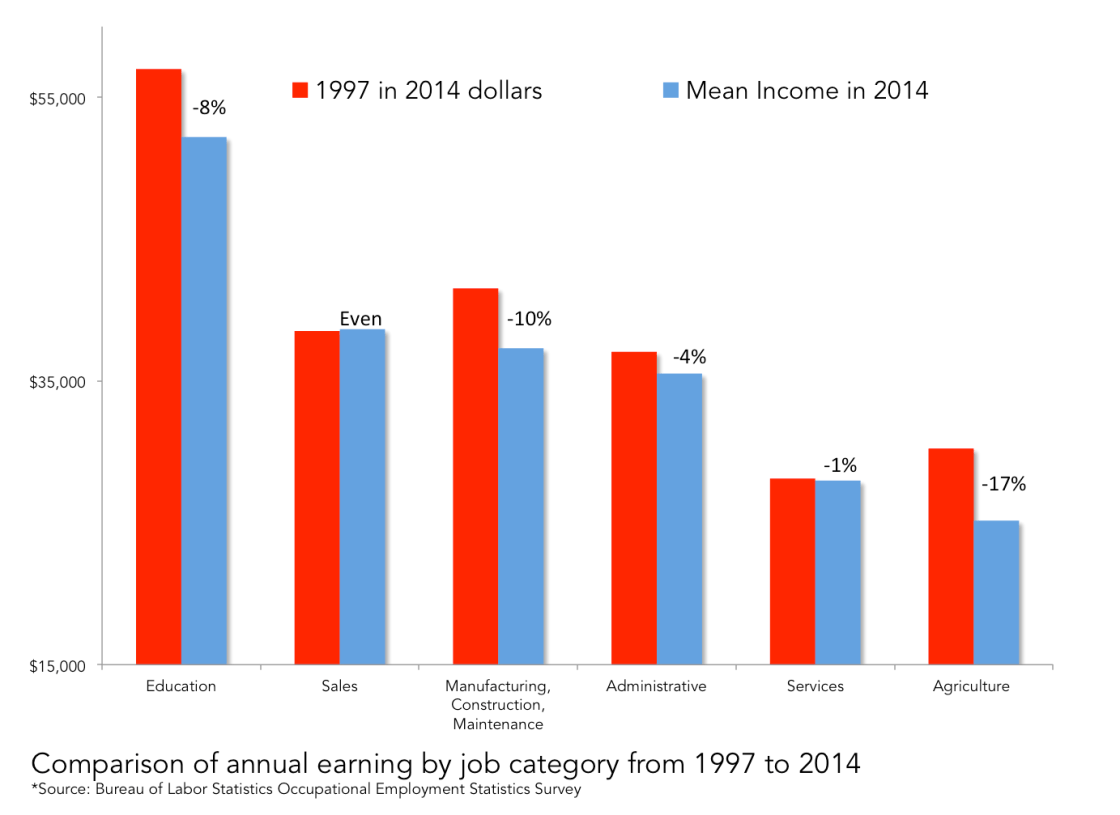
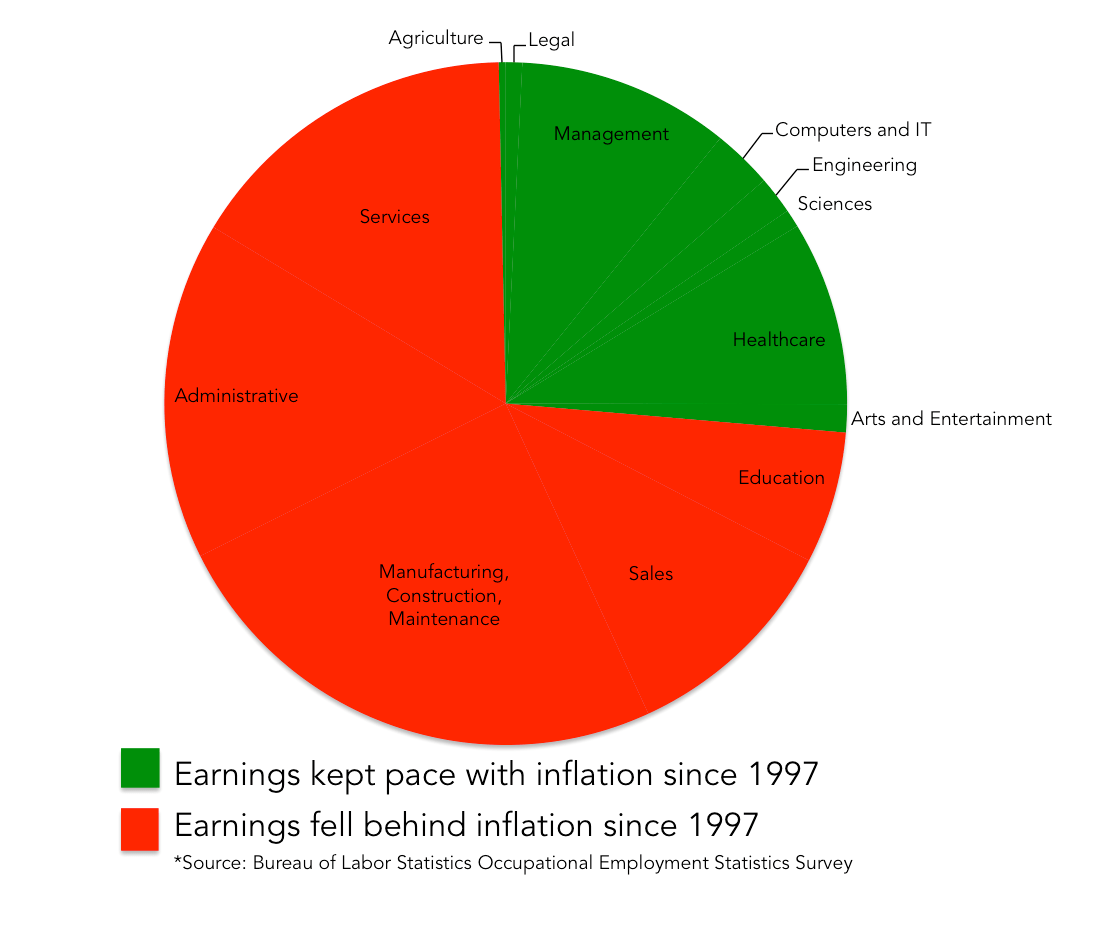
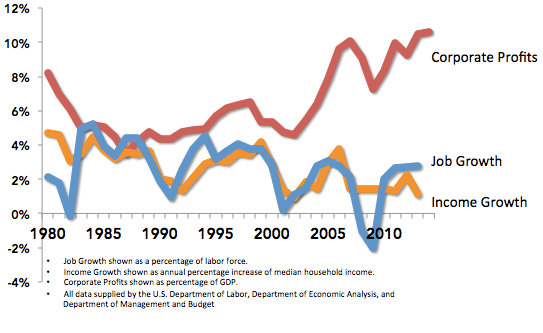

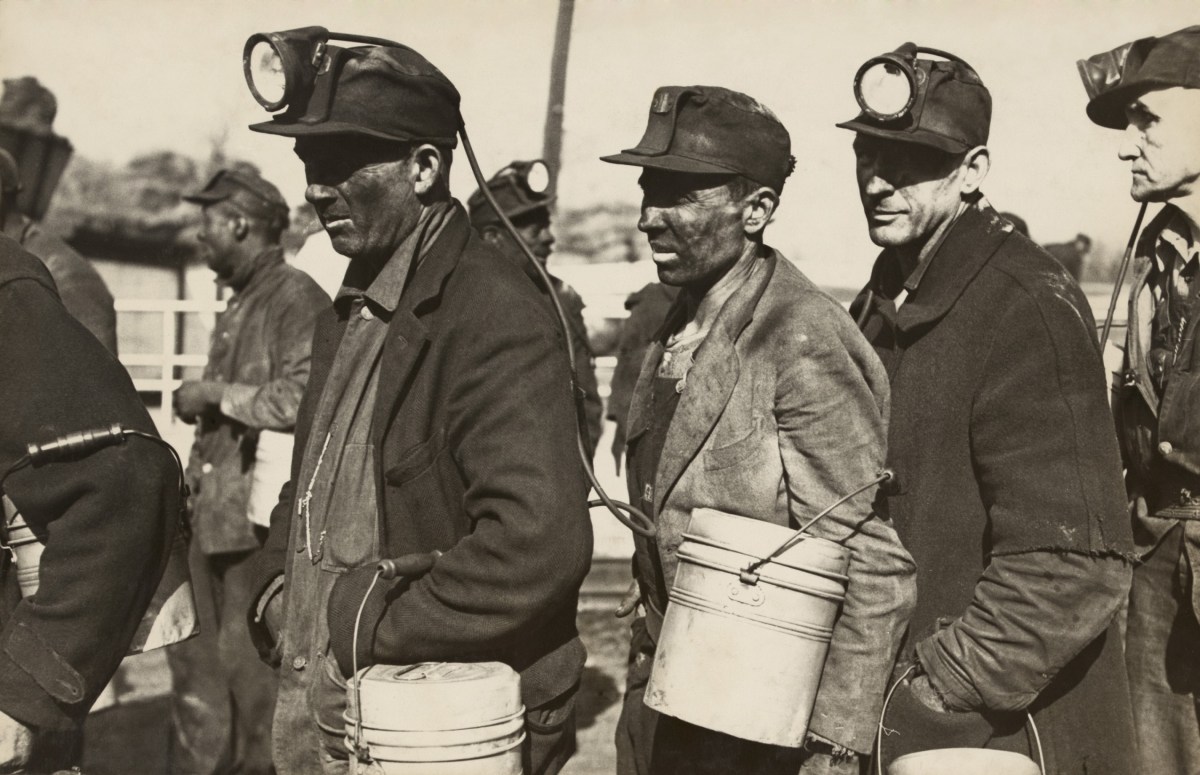

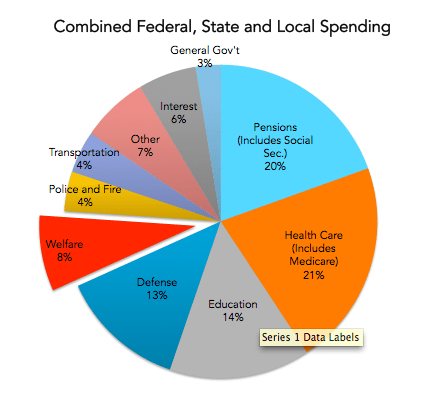


 Chartwell West