When You’re a Hammer…

I few months ago I wandered into the Tucson airport bookstore, the victim of the dreaded and constant Tucson to San Diego delay, and saw four books on the “non-fiction” shelf by men I’d once worked with. They were war books. They were books on how to lead people differently, based on lessons learned in war. Or ways to live your life better, based on lessons learned in war. These men weren’t distant acquaintances. They were men I knew well. Men at periods in my life that I spent more time with than my family. They were my friends. And when I saw their work, and their stories in majestic hardcover form on the shelf, it made me happy. They deserved to tell their story. And others owed them a listen.

If there’s an upside to war, it’s the character that comes with the sacrifice of the generation that fights it.

You can’t turn on the television or scan your Facebook feed without a lead in that doesn’t say something like “A former Navy SEAL does X” or “this veteran has a message for Y”. There’s much to be learned from us and the experiences that less than 1% of America had fighting a never-ending war that took up all of the most productive portions of many of our lives.

So when we talk, you should listen. When we tell you about what it’s like to sacrifice years of our life to be a part of something bigger and more important than ourselves, then you should listen. And when we tell you what it’s like to serve in combat and fear for our lives and then pull ourselves past that fear to do things only we could do, you should listen. And when we tell you what it’s like to leave our family for years on end to go serve at the leisure of our national interests, you should listen. You should listen when we tell you what it’s like to watch our friends die to protect us. Or what it’s like to sift through body parts after a suicide bomb at a funeral. Or see dead children. You should listen. You should listen to us tell you what it feels like to slam a “Rip It” plug a wad of Copenhagen in our jaw and get your gear ready to go out the door on a raid with Titus Andronicus blaring in your ears.

You should listen to all of it. Because there’s power and wisdom in the lessons that life at war can teach you. Some of my friends have even written them down. I write them here.

When it comes to our opinions on things like politics or how the United States of America should behave towards other nations and other peoples, you should listen to us too. But you should also remember two critically important things.

First, the service of arms, in an all volunteer force, tends to attract a certain type of person. Good bad or indifferent, those that sign up and choose the path to stay against all available options tend to value certain things above others. And those things tend to align with a strong, conservative world view. And for we vets, that world view weaves itself into the fabric of our identity deeply. And sometimes, if we’re not careful, we’ll wrap ourselves in and wear it as a shield against realities that perhaps weaken the narrative we’ve told ourselves to help us live with the pain and sacrifice of our life of service.

It’s neither a good nor a bad thing. It simply is the way it is. And you shouldn’t discount what we say. But you should remember the things that shaped our perspectives.

The second is this. When you’ve been a hammer your whole life, the world starts to look like a nail. And the call of the one who promises to swing it, is the one you’re more likely to answer. So take what we say seriously, but also make sure it’s not the only voice your listening to.  If you try to build your house with just a hammer, you get a lousy house.

I’ve gotten asked a few times about the zeal that members of the military are showing for the new Commander in Chief. And whether or not it worried me. It doesn’t. In fact, it’s a good thing. Our military enthusiastically carrying out the legal orders of their Commander is a good thing. If you were looking to them to serve as opposition, look elsewhere. It won’t happen. And it’s not their job. That’s a problem for a different group to solve-the rest of us.

And if you’re worried about the uneven nature of the POTUS coupled with this new found enthusiasm for their leader resulting in the military becoming unhinged and sweeping the nation of the enemies of their leader, rest easy. I don’t have a ton of faith in Congress to do the right thing. I have a little more in the judiciary. And you may see some misguided junior military members doing stupid things like flying Trump flags from military vehicles, which is in fact against the rules, but don’t worry. They’ll be taken care of. Because the men and woman who lead them are perhaps the one group you can bet your ass, has the courage to stand up to the boss, when he’s out of line.

We all raised our hands and swore an oath to defend something for which  we were willing to sacrifice all we’ve had or all we were ever going to have. And it’s not a man. And that’s not changing anytime soon. No matter who’s sitting in that office.

The Trump Trilemma

Dani Rodrik, the Turkish born Harvard Economist states that a nation may have two of the following three things: national sovereignty, democracy, or deep, global economic integration. It can have any combination of two. But it cannot have all three.

This is “Rodrik’s Trilemma.”

The logic behind why is somewhat complicated but can be reasonably explained as three forces pulling on one rope. Only two can pull at once to balance it. The third has nothing to grab on to.

One force, economic integration or, globalization as it’s called in the political world, is created when we reduce the barriers for trade of goods and flow of capital between nations. In order to have it, we reduce transaction costs; tariffs, import/export quotas, etc. When we do this, we inherently weaken some aspects of the control of the nation state and strengthen the input of global regulatory bodies in the sovereign affairs of the participating nations. The two sides pulling on the rope in this scenario are globalization and the sovereignty of a state.

If a nation desires globalization, it has to give up some power in determining its trade policy. If it wants more control over trade policy, it should be prepared to lose bargaining power in a globally integrated economy. The ebb and flow can be rationally managed and balanced to meet the best outcomes of the nation.

The trilemma comes in to play when that nation tries to do this while maintaining the accountability of democracy. In a deeply integrated global trade environment, an electorate has to have a focus beyond the nation’s own borders to ensure that it governs and makes policy in a way that effectively facilitates the global flow of goods and capital. In order to do this, the electorate must be willing to surrender, through democratic process, some sovereign power to global regulatory entities. They need to be able to do this in all circumstances even when, or especially when, the near-term outcomes of trade policy negatively impact the outcomes of the electorate.

Rodrik maintains that electorates don’t do this.

As a result, a nation wishing to maintain global trade integration and democracy must give up sovereign power to the global regulating entity lest the unwashed masses of democracy break the global economy with a tariff to protect their jobs. The tug of war then transitions between global trade outcomes and democracy. The more power the democracy has, the less integration we’ll receive. Sovereign control sits it out, surrendered to the electorate or the global regulatory entity.

We could continue the analogy through all the potential combinations but the one material to the Trump-ism discussion is where we’ve insisted that global economic integration sit out the contest and let democracy and sovereign control of trade policy have a go at it.

Let the people pick the leader. Let the leader pick the economy that delivers for the people. Everyone else get in line behind America.

America First.

This path is sold easily after hard times like the Great Recession. Trump and Brexit are textbook Rodrik’s Trilemma occurrences. Globalism is the casualty.

Most economists agree, if not in magnitude at least in direction, globalism is a net economic positive. It increases GDP, decreases the cost of goods, and makes the world an “overall” more stable place. The global margin increases.

People don’t vote on the global margin. In America today, they don’t vote much on their individual outcomes either. They vote on their culture. And that makes globalism an easy target.

Much of the Trump-ism message is about transitioning the economics of globalism into a cultural message of nationalism. One of the great tricks of Trump-ism has been to align the negative economic outcomes for its political base with the culture of toleration.

About halfway through the first quarter of the 2017 Super Bowl, I began to get the feeling that the American consumer, or at least the corporations that sell to the American consumer, were not big fans of the inward anti-globalism focus voted into office with the Trump administration.

The global cultural mindset was everywhere.

Coca-Cola ran an ad with people from all over the world singing America the Beautiful in their native tongues. Budweiser told the story of Adolphus Busch’s immigration. 84 Lumber showed the first half of a story that had to be cut off and shown on the internet because it actually showed Trump’s dubious great wall of America.

The message was loud and clear. Americans associate positive sentiment with a modern, compassionate, global perspective. We feel warm and fuzzy about the idea of diverse cultures all longing for and participating in the American dream. That message was market tested and executed by multi-national corporations who spent $160K a second on airtime to deliver it. It was not an unintentional endeavor.

The commercials we were fed were about people and culture and diversity. And tolerance. They filled Americans with the positive sentiment ad companies love to attach to the brands they represent. Inclusion sells. The sentiment, though, is a classic example of a problematic progressive globalism trap.

The progressive globalism trap pushes the notion that globalism is about people and tolerance. And if you’re about people and tolerance (I am), then you are a fan of globalism. In reality, globalism as we know it, the globalism that’s actually materially impacting Americans, has almost nothing to do with people and cultures and everything to do with trade and money. The standards enforced by the World Trade Organization and the outcomes that reducing barriers to free trade have coincided with an era of tremendous global growth. It’s drastically reduced economic inequality across nations.

But at a cost.

That cost has been the re-distribution of wealth and the increase of income inequality within already wealthy nations like America. It’s a firm reality of economics. We grow other place’s middle class at some difficult to quantify expense to our own.

Additionally, the opening up of the international flow of capital allows money to move seamlessly from country to country. But that’s come at a cost too. That cost has been a financial interdependence that fuels global recessions without alleviating the need for sovereign nations to bail out institutions deemed “too big to fail.” The global community didn’t bail out the American financial sector or our automakers. America did.

At the same time, the open flow of capital has also allowed open competition for corporate earnings to drive the corporate tax rate down globally almost 50% in just a few decades in a way that makes America less competitive for internal investment.

The fair point that Trump-ism makes is that global growth and stability hasn’t come without a cost to America. And the cost has fallen heavily on an American working class that hasn’t realized that we transitioned from a manufacturing and production economy to a services economy two generations ago. While the benefits of that global growth of the second half the 20th century exist, the costs are easier to point to in the wake of the recession.

By aligning the economics of anti-globalism with the cultural phenomenon of nativist nationalism, Trump-ism trapped their opposition in a reality where one is either for diversity, or one is for America. One can’t be for both and have the economic interests of Americans as a priority. The only counter Democrats found in 2016 was a departure from capitalism all together of Bernie Sanders.

And we know how that went.

What Now?

I’m not a liberal. I’m not a safe space, social crusader.

I’m not a sore loser who can’t get over the fact that Hillary Clinton wasn’t elected president. The notion that I had to put what lukewarm support I had for a candidate behind her was a source of great frustration for me.

I am, at my very core, someone with conservative foundations.

I believe that men and women, whenever possible, should be free to live their lives without government intervention. My family and my Christian faith are the center of my life. I like my guns. Chances are, I’m better than you at using them.

I’ve worked with and for the toughest most dangerous men on the planet. Men you’ve read books about. Men you’ve seen movies about. I’ll never claim to be one. But I’ve proven myself useful in their presence. I share this with you so you understand where and who the message I’m about to deliver comes from.

I’ve been all over this planet. And there’s a troubling observation that I’ve made on my way. It’s that mankind, when left to our own devices, does not naturally accept different people. Whether I saw Sunni and Shia in Iraq refusing to recognize the humanity of the other because of relatively nuanced differences in their common faith, or tribal warfare and genocide in sub-Saharan Africa or racial oppression and modern slavery of East Asia, the ingrained need to divide and subjugate others is ever present. In mankind’s darkest moments, the most common culprit has been that division.

For most of the last seventy thousand years, since the cognitive revolution of man drove us to organize, we’ve programmed ourselves to trust and support those that are similar to us. The result is that there have been frighteningly few societies in the history of mankind which have not been separated by either race, class or gender.

Where there is one race, we make caste systems.

Where lack of structure provides no castes, we subjugate gender.

It’s as consistent across time and region as the number of our limbs or the shape of our organs.

Fifty years ago in America, we made the first real effort, at scale, in the history of man, to change it in a society as diverse as ours. And since then, we’ve made great but imperfect progress. The work isn’t done. But we’re further than where we were 50 years ago. When we get there and make good on the promise penned by our forefathers, it will be the greatest, rarest accomplishment in our history.

On Tuesday, we took one giant leap backward on the arc of our journey to one people. And over the last four days, I’ve been bombarded by explanations of why Donald J. Trump was just elected president. I don’t need any more. I didn’t need them in the first place.

I know why he was elected.

He was elected because the only message that matters for the American government in 2016 is a need for change. And when the alternative to that change was someone who moved into the White House when I was fifteen, (I’m 40 now) that choice was clear for some.

But it was a choice.

And the ultimate choice that was made, the one people will remember a hundred years from now, was a willingness to ignore personal decency and fair treatment towards people who are different in service to that change. That was the choice that the minority of the American electorate made. That was the choice that about a quarter of eligible American voters made.

I’m not here to argue the legitimacy of the results. And I don’t get to pick and choose whether I support democracy because of the outcomes. I won’t tell you that you are a racist or a bigot if you voted for Donald Trump. I won’t even tell you that you personally are indecent. But I will tell you what you just bought with your choice.

You bought a very vigilant, sensitive and loud American majority who will cry foul at the drop of a hat for anything that resembles attacks on those we have fought so hard for these last fifty years.

Because what you showed us with his nomination and your vote in the election, is that you can’t be trusted to do it without us.

Many of my devout conservative friends were remarkably quiet when their candidate trashed their personal values. And they were remarkably quiet when their candidate made inexcusable first hand remarks about minorities, women and disabled Americans. And they were remarkably quiet when the dark forces of white supremacists aligned themselves in support of their candidate.

I understand why. You couldn’t live with the alternative. So you rationalized out of fear that speaking up would enable it. Well, that risk is gone now. You avoided the end you couldn’t live with.

That excuse is gone.

And now it’s fair to say that tolerance of that behavior from here on can only be seen as an endorsement of it. So when there’s a KKK rally in North Carolina to celebrate the election of the candidate you support, you no longer have any excuse not to condemn it with the same uncompromising vigor that you condemned Hillary. Let’s see the memes. Let’s see the Facebook posts. Let’s see the outrage.

Perhaps the rest of America can trust you to hold the leader of our government to the change you so uncompromisingly sought. But we won’t trust you to look out for our fellow Americans who are different.

So, get ready for four years of vocal, loud, peaceful I pray, dissent. If you thought the core Trump supporters would be loud if Hillary Clinton won, what do you think is going to happen now that you’ve  marginalized a group that has much more to lose than freedom from background checks for guns and a ten percent lag in wage growth?

At stake for them, is participation in our society. And if their vocal insistence on it is something you aren’t willing to tolerate, then perhaps you might consider a different path in thirty months when you get to choose your next leader without the looming evil of Hillary excusing your choice.

You can’t point to her any more as cause.

If insistence on decent treatment of all Americans makes me a liberal in the eyes of conservatives, then maybe we should take some time to reflect on who our modern conservatives actually are. The world is watching.

So What Did We Learn?

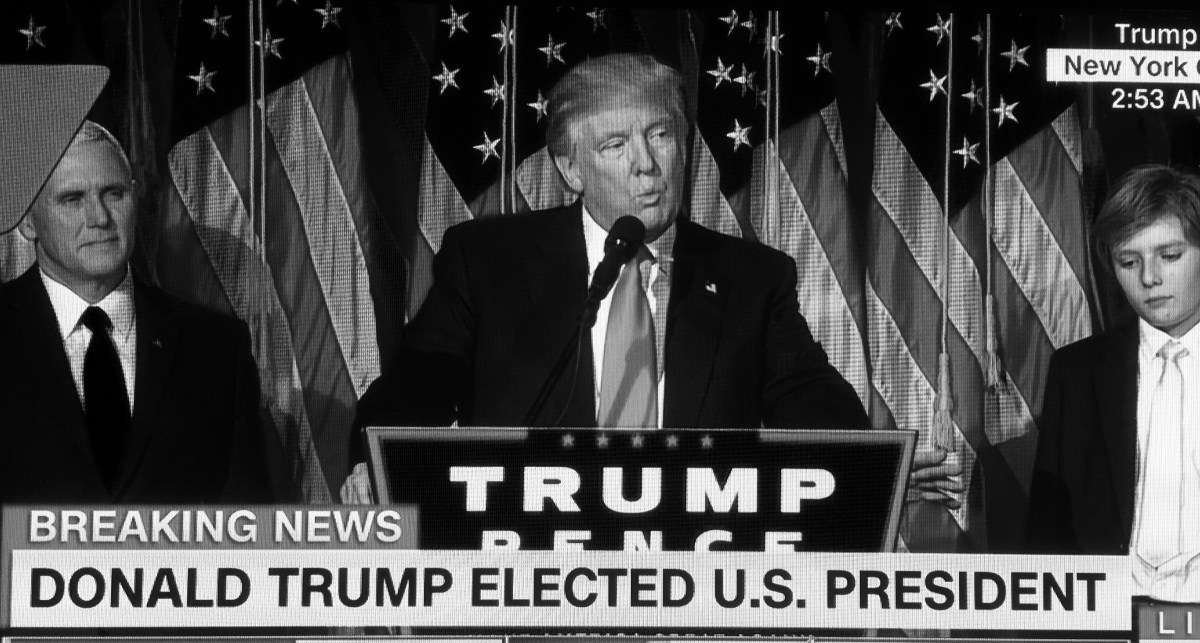
As the exhausted, miserable people on my television reported that Secretary Clinton had conceded the election by phone and our new president elect addressed his constituents for the first time after the political upset of an American generation, I sat up in my bed, quietly trying to digest what just happened. My wife, a woman of Mexican descent, a mother to a special needs child and a military wife who suffered through three wartime deployments nodded off in disgust a few hours earlier. I’ve already started to make my peace with it though.

I’ve been about as vocal a critic of Donald Trump as anyone you’ll find. I can’t and wouldn’t revise anything I’ve said about him. But I make it a point to stay objective about things. And to deliver a level headed clear-eyed assessment of things that matter. And right now, before I make that peace, I’ve got to account for a few things that I know now, that I didn’t know four hours ago.

So here goes…

-Donald J. Trump is the most effective political marketing machine of our time. It’s not close.

-Crowds mean more than polls. In retrospect, that makes sense. But I was stone cold dead wrong on it.

-There’s still enough white working class men out there that if you make an election a referendum on their value as a part of America, you better have them on your side.

-No one gives a rip about third party candidates. No matter how much more qualified they are.

-Many white men-and women-are more comfortable with the idea of a black man being president than a woman.

-Hillary Clinton is un-electable.

-The message of change is the only one that matters.

-The people still choose the president.

-This actually wasn’t close. (Trump won every contested state)

-We know nothing. (I actually knew that one already.)

Tomorrow, in a few hours, the sun will come up in America as it has for centuries. And things will go on uninterrupted. We’ll get the kids off to school. I’ll sit in traffic forever and I’ll think about a few things. I’ll think about what it all means and about what’s going to change about what it tells us about ourselves as a people. I’ll think about what to tell my kids about our president. Big problems. Big thoughts. Big questions.

There’s one other thing worth noting though. For the first time in my life, Donald J. Trump and I are on the same team. And I don’t know what to do with that other than hope like hell that he’s the best God damn president of my lifetime. Because there were dark and frightening powers that helped this come together for our new president elect. But there were also good and decent people who believed that this was their best option to drive change in our political process. And the only way that we get through this in one piece is for those good and decent people to help hold our new leader accountable for delivering on what they saw in his message-a  change for the better from the political status quo.

Democracy…warts and all.

The American System

Mass conflagration.

It’s one of my favorite terms. It’s a kind of training exercise on a naval ship. It simulates a scenario where everything has gone so horribly wrong in combat that the crew is no longer trying to focus on the military objective of defeating the enemy. Instead, they’ve shifted their resources to saving the ship and themselves. It’s not an easy thing to do. It requires lots of coordination and expertise. So you have to practice it. I did it more times than I can remember during the two years when that’s what I did with my life-serve on a ship.

I’m not on a ship any more. I’m not even in the navy any more. But I experience mass conflagration often-for about an hour, every morning,  in my house, when my wife and I are getting our children ready for school. If you have grade school aged kids, you know exactly what I mean. If you pretend you don’t, you’re a bald face liar.

No matter how hard we try, within the first 30 minutes of our day, my wife and I surrender all attempts at making this a “great” morning and instead are forced to focus on two things 1) getting them to the bus alive and 2) staying married. Save the ship…and her crew…Both are in question more times than I’m happy to admit. To be fair, neither are ever her fault.

The risk to #1 is caused by my kids. Every morning they appear to be both equally surprised by the existence of school and unaware of the any activities required to get them there. Again, if you have kids, you know exactly what I mean. The risk to #2, staying married, is more interesting-and also why I’m talking about getting my kids ready for school in the morning in a politics and society blog. Why my wife hates be by the time the bus gets there is really the issue.

I have what I like to call a linear approach to solving the problem of getting through the morning with school aged children. I like to think that waking up earlier, preparing lunches the night before, waking the kids up earlier, or limiting breakfast options are all things that give us more time to get out of the house. Yelling louder makes them move faster…gives us more time to get out of the house. My approach is more rigor, leads to more efficiency, leads to less time required, leads to less hurrying, leads to less stress, leads to a calmer, happier morning-a better outcome.

It seems like a common sense approach.  Many people like common sense, effort in-results out approaches. Because it makes us feel like we’re in control. But here’s why I’m wrong-and she’s right.  And here’s why my approach has the opposite effect of a calm, happy morning for my family. I’m not in control.  Neither is she. No one is. Because morning in the Hughes household is complicated.

My kids, are young. And their needs vary. Some are autistic and can’t really communicate-yelling makes it worse, not better. Some have very real medication needs. Others are simply a pain in the ass-yelling helps them-hurts others.  Sometimes my wife has clients she has to see early. And sometimes she doesn’t. And sometimes my job emails me in the middle of the night and an emergency is waiting for me when I wake up. So even if I wake up early, my attention goes there instead of making pancakes. And then I’m grumpy about work and no pancakes all at once.

Mornings in the Hughes household look a lot more like a living breathing organism then an assembly line. Living breathing organisms are hard to control. Assembly lines are not.  Assembly lines are linear. Input, effort and execution yields outputs. Organisms are systems. Sometimes inputs don’t match outputs the way you would think. Some things work with others better than others work with some.  Improving a single aspect (screaming at one kid) can potentially have a negative effect on another (an autistic panic in the one sitting next to him). Doing some things worse (waking up later) can actually make others better (more rest, less grumpy-but still grumpy-dad).

Mornings in the Hughes household are a system-a set of connected things or parts forming a complex whole. And the goal of that system is to get our children to school fed, clothed and in a state of mind to learn. And when you apply a linear strategy to a system, well, you get yelled at by your wife for being stupid. Because it doesn’t work. Doing things that don’t work over and over again is stupid.

About the only time I don’t apply systems thinking is when I’m being an obtuse rock head dad or husband. I don’t really know why, but I know I’m not alone. Outside the home though, I’m a systems thinker. I’ve taken a systems approach to fighting wars and insurgencies. I’ve used it to build software products. I’ve used it to market this blog. Just about any problem more complex then brushing your teeth takes systems thinking. I live by it. Because its how you solve hard problems. Which are the best kind to solve.

America is a system-a giant system. Problems like poverty, job creation, racial inequality and terrorism take systems thinking-because they’re hard, complex problems with lots of overlapping and inconsistent inputs. Doing something logical and linear may sound like a good idea. (We have too many people from outside our country inside our country. We must build a wall.) Because it’s simple and it makes you feel in control. But it actually doesn’t solve the problem. Because it’s not actually designed to solve a problem. It’s designed to make people angry or happy. Because it’s politics.

The core difference between a political debate and a debate of any other kind is that other debates focus on differing opinions to solving an issue. Political debates focus on differing opinions of what the issue is. There are no solutions to political debates. And nowhere besides government do we focus the energy on the politics of something and not the solution. Good non-government entities usually use the word politics at the beginning of a sentence used to describe an effort or decision that didn’t make any sense. My wife and I never argue over whether or not its good if the kids get to school on time-only how effective me yelling at them is. See the difference? Spending a morning on the former would be stupid.

This is a round about way to get to the following fairly simple point.

Politics are stupid.  

Political cycles are a long standing dialogue that argues whether the problem at hand is making our country great again or keeping it great. Those are two very different problems. And it’s party agnostic. Whatever party owns the government, owns the burden of arguing to keep our country great. Whatever party  is out in the cold owns the burden of arguing that we must return the party to greatness. The problems you identify when your task is keep are very different then the problems you identify when your task is return.

Here’s my point again: Politics are stupid.

Systems thinking is not. Political thinking is linear. You are allowed and expected to make simple arguments that people can digest that have no chance at solving any material problem in politics. Political motivation and systems motivation cannot occupy the same space at the same time. You cannot solve hard problems without systems thinking. You cannot solve problems with politics.

Politics are lunacy. Political opinion is a waste of time.

So the next time you are about to engage in a political debate with someone or spend time listening to two gas bags argue about whether or not something is a problem by proposing simple bite sized ideas that won’t solve anything important, pause and say to yourself, out loud.

“What I am about to do is an absolute and thorough waste of time.”

If you must continue, realize you’re using the same part of your brain that argues whether or not Lebron James is better then Kobe Bryant-or whether or not the best Pebbles are Co-Co or Fruity. Political thinking is capable of solving one problem-maintaining or taking control of government. The less time you spend there-says the guy with the political blog-the freer you are to think about the things that matter.

Like how the hell your son can lose his shoes twice in one morning.


The Pledge

240 years ago last month, the committee to draft the Declaration of Independence was selected by the First Continental Congress.  The full committee included Thomas Jefferson, John Adams, Benjamin Franklin, Roger Sherman and Robert Livingston.  Sherman was called away and never signed it.  Livingston reviewed and signed the document the three others provided, without edit.  As a result, no one outside of academia has any idea who Sherman and Livingston are. Of Jefferson, Adams and Franklin, only Franklin was the Benjamin Franklin of our history books by then, having seemingly invented most of the things invented in the 18th century.  The others were simply two respected lawyers and landowners from Virginia and Massachusetts.

Jefferson asked Adams to write the first draft.  He refused, stating that he had been far too “obnoxious” in his calls for its creation to be taken seriously.  Self awareness is a powerful accomplishment.

There are a lot of memorable words in that declaration.  One’s we recite regularly and point to as the foundational ideals of our American society.

“We hold these truths to be self-evident, that all men are created equal..” 

That’s an important one.  Though we didn’t really mean it at the time.  The next 240 years or so would be one long fight to fix that.  The enemies of our independence pointed to that statement and rolled their eyes at our hypocrisy, the author himself owning scores of other “equal” men.

“they are endowed by their Creator with certain unalienable Rights, that among these are Life, Liberty and the pursuit of Happiness” 

Also important, taken from John Locke in the previous century though.  It wasn’t a new idea, but the genius was how Jefferson coupled it with equality for all, a powerful sword against the class system and subjugation of the crown. Perhaps no other words, save scripture, have bound a society more strongly than the equality and liberty declared in the first few sentences of that great document. 

But for me, it’s not the most important part.  There’s another one, buried down deep in the last paragraph-after the laundry list grievances against the crown.  We rarely get to it. We remember the first line.  But it’s the last line that gives the document its power.

“And for the support of this Declaration, with a firm reliance on the protection of divine Providence, we mutually pledge to each other our Lives, our Fortunes and our sacred Honor.”

Then they signed it.  56 men, most of them the upper class of colonial society, lawyers, planters, publishers, shipping magnates-gentlemen.  The power of the document was not in its borrowed words.  Men had been thinking and writing and longing for the things Jefferson wrote in the opening paragraph for as long as men have been thinking and writing and longing for things.  It was the commitment to action that changed the world-the risk of lives, fortunes and honor.

The only thing that has moved our world forward, towards life, liberty and the pursuit of happiness is action in the name of others-more importantly action by those not motivated by self-when the “have’s” of society ignore their positions of situational wealth and well being to give voice to a cause on behalf of the “have not’s”.  Nothing happens until the people least effected by something, speak up for those most effected by it.  For millennia, rulers used patronage to appease the classes most capable of insisting on change. It can be an impassable barrier to progress. Self preservation is the greatest friend oppression ever had.  The Declaration, even for just a moment, changed things.

240 years after this great document was signed, we can all take measured satisfaction that we’ve aligned to protect our liberties and insisted, too slowly perhaps, on equality.  But the thing we have to ask ourselves is this. Have we held true to the powerful pledge those 56 men locked arms together and marched forward with, against the best interest of their fortunes and their honor?

If you are wealthy, do you give voice to the needy, even if it may cost you something?  If you are included, do you insist, even at risk to your own standing, on the inclusion of those who aren’t?  Or have you been appeased by your own success.  Are you willingly powerless in service to self.

The world moves forward when those without the dire need give voice to the plight of those with it.  When those not being killed by gun violence demand a dialogue about a solution on behalf of those who are.  When those not subject to disproportionate treatment by the justice system insist on accountability.  When those able to marry and participate in a society of family insist on inclusion for those who can’t. When those who’s financial outcomes may be worse off if they insist on environmental protection, do just that in service to a better world for future generations.

Things get better when we’re prepared to sacrifice for others. When we go beyond the abstract of talk and ideas and into the reality of action. Where our lives, fortunes and honor are at stake.  In those selfless moments, we capture what has made America great. When we choose to do nothing because the status quo suits us, the world stands still.

We’ll celebrate our country today.  We’ll celebrate equality and liberty.  We’ll celebrate the men who wrote and signed that document.  But if you can, take a moment to account for your actions in the face of others in need.  And remember the greatest victory of our founding fathers.  The courage to cast off the burden of self preservation in service to the greater good.  That’s America.  When we’re great, that’s what we do.


Failure’s Art

There’s something disproportionately sad about an abandoned work of industry. A vacant run down factory. Or a boarded up store, or empty hotel. It’s  more than the decay and disrepair. More than the esthetic blight. It’s hard to put your finger on it but seeing it evokes a strong emotional reaction, if you’re prone to those sorts of things. That’s what you feel when you stumble across one. They’re monuments to the mortality of enterprise. Where something was once a buzz of activity but is now silent.  It once represented someone’s work in action-a machine of human industry. Supplying value to shareholders and opportunity to the community in harmony.  A living organism of mankind’s effort to sustain and progress.

Until it died. And the death is what you see. And what you feel. Someone somewhere had hopes beyond this end. Those hopes died too.  Someone had to uphold the obligation of the loser in the game of investment.  That’s how it works. It’s a cycle.

Beyond the lost profits though, there’s a community that shoulders the fallout. There are those who didn’t invest yet still lost. Industry is more than the balance sheet. It’s people.  And towns.

I don’t get back to Atlantic City, where I grew up, very often.  There’s 2,800 miles between there and my life now.  And years.  It’s more the years than the distance that separates me from it now.  But when I do go back, like I did this past weekend, I make it a point to go back to those places where I spent my youth-right in the teeth of the beast, on the beach and the boardwalk.  It’s a unique combination of resort and urban grit that you can only find in Atlantic City.  Especially at the north end.  Where it’s really old.  And really tough.

I grew up with the homeless,  mentally ill and addicted that live under the boardwalk there.  My father, a lifeguard on the Atlantic City Beach Patrol used to keep me around the station to run errands for the other guards.  They called it being a “mascot”.  Far too young to responsibly do it, I’d wander up the boardwalk, lunch orders in hand talking to the familiar burnt out occupants of that unique brand of skid row.  Those were my earliest memories.  And though they don’t sound fond, they are. If for no other reasons than it’s home.  Home is our first memories.  And the human condition craves it.

So when I parked my rental car and set off on foot, cheese steak sub under my arm, I wandered up to my old beach.  The one that I got to work when I was finally old enough to be a guard myself.  I wanted to sit and watch it. The way I used to.  The way that it was.

A lot of it is the same.  And a lot of it isn’t.IMG_0247

I found myself walking through the remains of the towering Trump Plaza Hotel and Casino on my way to the boardwalk. 25 years ago, when I worked the beach on Georgia Avenue, its shadow loomed over the surf.  The deafening music from the deck above the casino blared in our ears all day.  It was menacing.  And active.

The shadow is still there.  But the activity is gone.  FullSizeRender(3)The Plaza is dead. It closed two years ago  destroying itself, thousands of jobs and millions of tax dollars with it. Three other casinos have also closed since.  Thousands more jobs, millions more tax dollars went with them.  The city is bankrupt.  The local economy is shot.  And the people are just trying to get through.

I was walking through failure’s art.

I could feel it in my gut when I walked through the old valet parking entrance, past the once bustling lobby and up onto the boardwalk, empty on the cold day, wind blowing hard from the north end, storm clouds moving quickly over the top of me.  It felt apocalyptic.FullSizeRender(1)


The easy thing to do here would be to draw a straight line from the failure of that building to the man whose name used to grace it.  You can still clearly see the outlines of the letters on the decaying facades.  Trump…
This was all his.  FullSizeRender(4)

I’m not going to do that though.  Blame does little in the face of such crippling destitution. After all, this was business.  And business has a cycle and a purpose.  And though others have taken up the task of chronicling Trump’s path along this journey that ended in the bones of his casino laying bare in wind and the rain, I’ll leave that to them. Instead I’ll deliver a very simple message of contrast.  And ask you to do the rest for yourself.

As I shook off the dark feeling of failure, walking under the walkway from the garage that had no cars to the hotel that had no guests, I walked a few hundred yards south and sat down on a bench to eat.  I soaked it all in.

The view was very different a stones throw away. Now, a titan stood in front of me.  A massive relic from the days when men built things of steel and stone-Boardwalk Hall, the marvel of architecture that served as convention center for the city until the 90’s and has served as a bustling entertainment venue since.

FullSizeRender(5)

Carved into the limestone facade facing the Atlantic Ocean since it’s construction in 1929 was something I never noticed before.  I worked the beach in front of it eight hours a day, six days a week for two years.  And I never noticed it.  Perhaps it was the abandoned lot to the south of it, another one of Trump’s old hotels torn down years ago.  Or the abandoned building to the north of it, the Plaza I just walked through that made the words stand out.  In letters as tall as a man across its 300-foot face there’s an inscription.

“A permanent monument conceived as a tribute to the ideals of Atlantic City, built by its citizens and dedicated to recreation, social progress and industrial achievements.”

IMG_0262On the north tower are the words. “education, science, conventions, art, industry”.

On the south, “festivities, music, pageantry, drama, athletics”IMG_0261

My high school graduation was in that building.  So was my brother’s and thousands of others.  My dad played football there.  The 1964 Democratic National Convention was held there, less than a year after JFK was shot. LBJ was nominated.  The Beatles played there in 1964. The Stones came later.  Mike Tyson knocked out Larry Holmes and Michael Spinks there.  The list is long and storied but I’ll stop there to make my point.

FullSizeRender(6)

That building has made good on the promise of its inscription. And here’s the contrast and the lesson in that three blocks of boardwalk. Business and profits alone are not what a society is built on. They’re a means to an end. An important one. But not the goal. A society is built on sustainment. On education, science, art, industry…festivities and all.  A society is its citizens, its ideals, its industrial achievement. The things carved into that permanent structure, flanked by the failure of quick profit and personal gain. Those words represent the heart and soul of a people. And they endure.

If you’re going to raise your hand and lay claim to the responsibility of serving and leading them, and the distinction between the roles profit and societal progress isn’t clear to you, then I’d ask you to take a stroll down a few hundred yards of boardwalk in my home town. The difference is crisp. And the lesson is clear.

A society doesn’t win.  It lives.  And progresses.  Together.  And it’s leaders serve.  Not profit.


The Scourge of Our Time

Have you normalized it yet?  Have you gotten used to it?  I have.

Not yesterday morning when I woke up to breaking news on my Twitter feed.  Or to messages of prayer and outrage on Facebook.  Or to another running live feed on CNN.  I normalized it long before that.  Someplace far away from here.  Sometime after some kid blew himself up at a funeral in a crowd of women and children before we could stop him.  Perhaps before a different group across town blew themselves up outside the city operations center and then  blew themselves up again when the first responders arrived.  Or maybe it was a few months later when our corpsmen, a mother away from her family on deployment, took a round to the head from a sniper while she was handing out medical supplies to locals in need. That’s about the time that I started to settle in on the idea of it all. That’s when I started to understand what it was that we’re in for.

Now, I don’t blame you if you’re not there yet. After all, this is all new to you.  And fresh in the headlines. Except that it’s really not.  The real live feeling of danger and even fear may be.  But the terrorist attacks, they’re kind of an old story by now.

It’s been 18 years since our embassies were blown up in Kenya and Tanzania. I’ve been to those sites. Talked to people who were there.  They remember it clearly.  We don’t.  It’s been 16 since the USS Cole had a hole the size of a minivan blown in the side of her.  I had a classmate on that boat. He wasn’t one of the 17 who died.  I saw him the other day.  It didn’t even come up.

The same amount of time has passed between 9/11 and today as had passed between the end of the Vietnam War and the election of George H.W. Bush.  We’ve been at this for a long time.   Perhaps we should feel frustrated that it’s not ending.  Or perhaps we might look at it a different way.

Radical Islamic terrorism is the scourge of our time.  Like global wars were the scourge of the first half 20th century and the fear of nuclear annihilation was the scourge of the second half.  It’s purposely sensational and inherently frightening to everyday Americans.  But it’s not going anywhere. I’m sorry to be the bearer of that bad news.  It’s not going away if you somehow make all guns illegal.  It’s not going away if you ban Muslims from coming into our country. It’s not going away if you go and destroy ISIS.  When I left Iraq six years ago, every bad guy that we’d been chasing for most of the previous ten years was dead or captured.  They’ve all been replaced.   And the ones we kill or capture now will be replaced.  We’re on about our fourth generation of extremists by now.   That’s how this thing works. It’s being fed by an endless well of destitution and instability.  Turning off that flow is a generation away, minimum.

And one other thing.  It’s not going away if you call it radical Islamic terrorism.  And it’s  not going away if you refuse to.  So ignore that noise.  That’s politics.  And the only thing politics can do here, is hurt. There are good Muslims and bad ones.  Just like there are good and bad people of every religion.  But the bad ones are using their religion for evil right now. This one is more complicated than our urges to generalize allow.  So put your energy elsewhere.

So should we care at all?  Of course.  Because it can actually get a lot worse than it is now.  And it might.  And if you made me guess, I’d say it will.  So we should care.  And make smart decisions and investments that we need to in order to keep our people safe.  If you are frustrated with law enforcement, then let’s put the political pressure there.  Not on hate and misguided blame games.  I’ll caution you though, this work is immensely difficult.  It’s not finding a needle in a hay stack.  It’s finding a needle in a stack of needles. And you miss sometimes. And looking at it in retrospect always makes it seem clear as day.  But it never is.   That’s how it works.  Like I said, it’s not going anywhere. So invest wisely and pay attention.

But that’s not all we should do.  There’s something else critically important that we have to remember that great societies before us have done under much, much worse circumstances.

Like our friends across the pond, the Brits.  Over a period of 267 days from the summer of 1940 to the Spring of 1941, London was bombed 71 times by the Luftwaffe.  32,000 civilians were killed. Another 87,000 injured.  That’s two and a half Orlando attacks a day, for most of a year. Not off in a far away land.  In their home town, where they worked.  Where their children went to school.  And their most potent defense against such unimaginable horror was simple.  Stay British.  They took precautions. They moved nonessential people to other parts of the country.  They ceased certain activities, but above all, they stayed calm, and carried on.  And there’s a lesson there for us.  It’s this.

Live your American life.  Nothing short circuits the grand plan of the Caliphate like us not giving a rip about them or what they do. That doesn’t mean we tempt fate and take no action.  We will do what we must.  Go to war, pour money into security and police and intelligence activities.  Do all of it in the name of safety.  If it keeps Americans safe, and if we still get to behave, at our core, like Americans, then I’m all for it.  But if you think that electing a “strong man” or trampling on personal liberties is going to turn off this switch, then I would challenge your thinking.

This problem has no one cause and no one solution.  That’s a lesson others aren’t heeding though.   Places like Poland are passing sweeping legislation that give broad and unchecked power to the government in the event of vaguely described terrorist activities, something that hasn’t happened in their country since 1939.  All in the name of fear and the illusion of safety.  It’s political.  And we know better.  We’re America.  Not Poland.  Land of the free is more than just a song.  But it carries a price.

We lost 50 people yesterday.  And for their friends and family, it probably doesn’t feel like a price worth paying.  It never is for those that pay it.  That’s the thing that will never normalize for me. I can normalize the activity.  The dark, empty sadness of the loss of human life though, I pray that never goes away for me.  But I’m past the outrage.  And horror and fear.  And on to another emotion.  A burning will to stay America-who we are.  Stay free and protect our liberties.  Just live life.  One foot in front of the other.  One breath at a time.  Amidst a horrible see of danger and destruction that’s been with us since we were us, in some form.  An unbroken line of human tragedy.  It’s part of the human condition.  My faith taught me that.  As well as to love and accept everyone, including my enemies.  Hard to do I know.  But it’s commanded.

I’ve been done with the fear game for a long time.   There’s darkness in this world.  There always has been.  Always will be.  But I’m over it.  And the sooner you are, the sooner you’ll be free from this fools game of panic and blame-free to move on to the next scourge.   Whatever that one is, I pray that it impacts as few of us as Radical Islamic terrorism has.   For now though, my thoughts and prayers go out to the families and friends of those impacted by this iteration of our nation’s struggle.  My energy goes there.  Sadness and love-the only thing I feel any more when I see this.  Because all the rest doesn’t matter.  Just the sadness of loss.  And the hope and healing that comes with love.

Like I said.  I’ve been at this a long time.


Ten Things I Learned Writing an Objective Political Blog

About 18 months ago I decided to be more intentional about my growing social-media commentary and start a blog about society, politics, foreign policy or anything else that mattered.   I’m a data and technology guy with a history degree and a vet with a handful of war-time deployments. And I have an autistic son. That pretty much hits most things. So I felt that I could put together some interesting perspectives on things that are effecting Americans today.  So about 60 articles and 100,000 or so words later, I’ve got a pretty steady following.  Last month over a thousand people a day visited my site and interacted with my content in 137 countries.  It’s not quite a social hysteria, but it’s enough to make a few observations.  So I thought I would share.

Here’s the top 10:

1. People like lists.

More than 3.  Less than 20. It guarantees them that no matter what they click on, it won’t be the dreaded wall of unbroken text that crushes the soul of anyone reading something on a smartphone while they’re supposed to be doing something else.  Without one, it’s almost impossible to keep your place while scanning your phone in a slow work meeting, a conversation with your spouse about their day or watching six year old soccer.

Or an otherwise unnecessary new paragraph.  Put a list out there, no matter how droll the topic, (see title above) then people will read it.

2. No one has time or interest for more than 750 words.

My wife, love of my life and grand supporter of my creative outlets has room for about 500 of mine.  Some have room for more.  But when you scroll to the bottom of the page on your phone in an effort to gauge the investment you’re about to make, 750 words or so is about where the less than “serious” folks drop off.  Unless of course you make it a list…

3. Most things that matter, can’t be effectively and responsibly discussed in much less than 1,500 words.

Which means we’ve got about 750 word gap between the attention span of the modern human and what is required to garner understanding on an issue.  Chapter 1 of The Book of Genesis  is about 750 words.  Which means the entire creation of the universe fits in the gap between our willingness to know something and the time in which we need to invest to understand it.

4. People share things that they have not read.

It’s a fascinating phenomenon.  A modern blogger, equipped with the basic tools and analytics of their craft can tell how often their posts have been shared or liked on Facebook, or re-Tweeted on Twitter.  And they can also tell how often their page has been visited.  Armed with those two points of data, bloggers, especially ones that deliver political messages and societal commentary, come to the regular conclusion that no one is reading the crap that they are sharing.

It’s called “slacktivism”-a term coined in the modern social media environment to describe attempting to appear to care about or support a cause by doing little more than reading and sharing posts about it.  You know, “raising awareness” with your thumb.   And I’m here to tell you that many don’t read any of it.  The smarter or more edgy the headline or blurb, the more people share it that never even opened it.  You know who you are.

5. Facebook is the greatest social achievement since the invention of television.

And it’s not close. 1.6 billion people used Facebook last month.  As memberships on the planet go, here’s the breakdown:

  1. Humans
  2. Christians
  3. Facebook
  4. Muslims
  5. Chinese

Nothing the planet has ever seen has the optional membership and daily engagement that Facebook has.  And that’s powerful.  But what’s more powerful, is what they’re doing with it.  Over the past 18 months, I’ve been able to get the content of my blog in front of 700,000 targeted people with interests in exactly what I was talking about, at the moment that I was talking about it.  As a result, my blog has been read by over a hundred thousand people from all over the world.

And I’ve been able to accomplish this with a marketing budget less than my cable bill.   Here’s the point, Facebook can distribute information in a way that no other entity on the planet can or ever has.

If you’re wondering why “Chewbacca Mom” was a big deal, consider this.  That video was viewed 50 million times in a day-130 million over the course of a week.  To put that in perspective, the Super Bowl attracted 112 million viewers this year.  The cost of 30 seconds worth of advertising during the Super Bowl is $4.5 Million.  It’s valued at that because you can’t get that many people to be a part of a focused audience without something extraordinary, like the largest sporting event on the planet.

Until now.  Now you can get it with a woman putting her phone on the dashboard of her car in the Kohl’s parking lot.  And hitting no more than three buttons on her phone. And with Facebook Live, it’s all internal content on Facebook’s domain.  No more kicking to YouTube. No more loss of traffic.

The world is a different place and most of it appears to be happening on one site. And it’s probably only a matter of time before regulation, at least in America, starts to invade the space.

6. There’s really only two types of people in the world. 

Those who see the world independent of perspective.  And those who see the world from their own perspective.  The second views the world and its inhabitants as a virtual series of concentric circles, increasing in importance as you approach the center where there is the greatest concentration of people like them. It’s not so much specifically about them. Everyone has their own personal bias and desire for self preservation.  But that group puts a premium on people like them.  Everyone else, not so much.

The other group has no such rings, just a common concern for their fellow man, sometimes no matter how silly or misguided their fellow man is.

It’s not a perfect classification.  It’s a spectrum with extremes.  But you can break down just about every societal issue, its points and counter points by that litmus test.  If I cared about everyone else the way I cared about me and mine, then I have one position.  If I don’t, then I have the other.  Simplistic I know.  But I would challenge you to counter it with an honest argument.  It’s not easy.

7. Still plenty of racism to go around.

There’s a surprising amount of people still comfortable with saying overtly racist things in public venues. If you don’t think it’s out there, peruse the comments section on this site’s Facebook page.  Enjoy! And then take a shower.

8. Cognitive dissonance is a real problem. 

And the information age is actually making it worse.  What’s cognitive dissonance?  It’s a theory developed by Leon Festinger in 1957 that  states that people have a powerful motive to maintain cognitive consistency. And that powerful motive can give rise to irrational and sometimes “maladaptive” behavior.

The example Festinger used was a study of a cult, in which the members of the cult had given up their homes and possessions because the world was going to be destroyed by a flood.  After the prescribed flood did not occur, those less committed members were able to disavow the cult’s beliefs and move on.  The more committed ones sought to explain that the flood was avoided by their faithfulness.  Translation, some can make their reality fit their mind set more than others.

That used to be really hard to do.  If you believed something, and it were proved wrong through circumstance or logical progression of events in the old days, then you either had to accept it, or be crazy.  Now, with the advent of the information age and the plurality of media realities one can create for one’s self, it’s a lot easier to shape your reality to whatever brand of reality you want.  And the cycle goes on.

9. No one cares about data.

I’ve built algorithms to rank presidential performance, run correlation studies on economic indicators and dissected the entirety of the Bureau of Labor Statistics survey tables to run trend analysis. My favorite comment, used more than once…”what a bunch of crap.”

If you agree with me, you don’t need my data. If you don’t, you don’t believe it. In the end, people consume things that they agree with or are about them.

10. Being a veteran lets me say things others can’t.

And I don’t know that it’s  a good thing. In fact, I’m pretty sure it’s not.  Because there’s a lot of less than impressive veterans out there saying less than impressive things. And people appear to put more stock into them than they ought to. There’s a difference between paying respect for service and pretending that someone has a level of credibility for having served that they actually don’t. For anyone who served at any time in history, they can probably look back at the folks they served with and think of quite a few they wouldn’t take political, societal or economic advice from. Or advice on other less dynamic things like how to make a cup of coffee, or where to buy a carton of milk. Or how to get through the day without hurting yourself…or others.  You get the point.

I couldn’t have said that by the way, if I weren’t a vet.


So there it is.  The 10 things I’ve learned. The world is full of bias, self preservation and short attention spans.  It probably always has been, because it’s full of people.  And we’re nothing if not predictable.  A person can change.  People, that’s another matter all together.  But now that I’ve shared these things, maybe you can move forward with a bit more measured conviction about the things you run into on your phone, or your computer, or you’re in-laws house.  And if you’re starting a blog of your own, and you have your sites set on mediocre part-time success remember.  People like lists.

Longing and Hope

Dwight Eisenhower usually didn’t vote.  When he did, he never told anyone about what or who he voted for.  For years, people speculated about his political leanings. He was old school Army.  His didn’t lean- he served.  In 1947, Harry Truman, a Democrat, offered him a crack at the vice presidency.  Ike declined.  In 1952,  18,000 people filled Madison Square Garden for a rally organized by a citizen’s committee for Ike.  The event included messages from Humphrey Bogart, Lauren Bacall and Clark Gable, all urging him to run for office.  It ended in Irving Berlin leading a rendition of God Bless America. In his book Ike’s Bluff, author Evan Thomas detailed his response.  To a friend, he wrote “I can’t tell you what an emotional upset it is for one to realize suddenly that he himself may be the symbol of that longing and hope.”

The next day, General Dwight D. Eisenhower (retired), tentatively accepted the invitation to run for the office of president-as a Republican.

Less than a decade after he led the largest invasion in the history of mankind to defeat the most dangerous enemy in the history of mankind, Ike was sworn in as our 34th president.   He assumed office during the war with Korea and ended it within a hundred days.

Ike hated politicians-Democrats and Republicans alike.  He disliked the military brass at the Pentagon too.  “I know better than any of you fellows about waste at the Pentagon and about how much fat there is to be cut-because I’ve seen those boys operate for a long time” he told an adviser.  He hated grand-standers and “desk pounders”-having once worked for General Douglas MacArthur, the great grand-stander and desk pounder of American military history.  He knew them when he saw them and he had no patience for it.

Ironically, Ike hated war.  Not the way someone who didn’t know war hates war-out of fear or misunderstanding.  He hated it because of his familiarity with it.  As president, he avoided small military conflicts because he understood that whether or not a small conflict became a big one was really just a matter of chance.  In the new world of nuclear power,  our greatest adversary was taking territory and building ballistic missiles, launching polished satellites that flew over America, reflecting the sun’s light down for naked American eyes to see as they passed over head.  Peace wasn’t just a goal.  It was survival.

In his farewell speech, he warned of our industrial military complex, growing at an unsustainable rate-yet sadly, he understood why.  “I wish I could say tonight that a lasting peace is in sight.  Happily, I can say that war has been avoided.” he finished.   He suffered the burden of the insurmountable stress of keeping the peace during the first time in the history of mankind when a failure to do so would have resulted in the end of civilization.   It took it’s toll.  He suffered a heart attack in 1955. And a stroke in 1957.  He labored through constant, severe gastrointestinal pain.  By the end, when he left office, escorted by a lone secret service car back to his home in Gettysburg, he was a shadow of the man he once was. He had given more to his country than anyone really knew. He was duty bound to hide it-the servant leader and soldier to the end.

Not since George Washington, had a president been demanded into office by the American people the way Ike was. And not since Washington, was a president’s greatest accomplishment navigating the catastrophically delicate waters of global piece the way Ike had. Ike’s resolve to maintain peace was the fulcrum that lifted the world from the edge of destruction.  And he knew it.

Today, a day after another terrorist attack has successfully evoked a response from those seeking to fill the office Ike once filled, it’s fair to ask, which of them is worthy of his role.  Is it the one that urges us to use religion as a means to identify areas for proactive policing?  Is it the one that tells us that we need to wall America off from the outside and torture our enemies to keep us safe. Is it any of them that didn’t serve-not one day collectively-in uniform.  When we look back through history at our truly great presidential behavior, it’s fair to be disappointed with our options.  Because we’ve lost something in our search for our next leader-the notion of service.

There’s a generation just over the horizon with different values formed by different burdens though.  One, like Ike’s, defined by war and conflict-less sensitive to the populous demagoguery common to those not grounded by the selfless principles of service.  One that understands that the pursuit of power should be tempered by its purpose to aid our fellow man.  One that has seen up close and personal the toll that torture, authoritarianism and reckless hate have on the human soul.  Something happens to you when you see it.  The way Ike did. The way we did.

This too will pass.  And quietly if we’re smart. We’re struggling through the death spasms of a tired time where people who haven’t experienced the problems of today’s world are arguing the principles of a political debate that’s been dead for a generation.  But change will come.  Until then, heed Ike’s warning.  “We must not fail to comprehend its grave implications….The potential for the disastrous rise of misplaced power exists and will persist.”  Wherever this goes, be wary and watchful of where we place our power.  If you can’t get it right, it’s best not to get it too wrong.