What You Need to Believe

I want to take a very brief moment to make a very important point. Because there are some very serious people in very serious positions that are making a very public declaration that I feel is extremely harmful. I heard as recently as this morning, from someone I respect, the following:

Donald Trump, after at least 50 years of despicable behavior and after being caught on tape bragging about how he can do anything he wants to a woman, up to and including “grab her pussy” because he’s a star, is the most appropriate option available for the highest office of the most powerful nation the world has ever seen.

It’s probably appropriate to point out, that it should be the least surprising thing in the world that a man who behaves worse publicly than anyone I’ve ever seen would also behave worse than anyone I’ve ever seen when he thought only Billy Bush was looking.

But I digress. I said I wanted to make a very quick point. Because it’s important that we get on the same page here. We’ve got a few weeks left. So here it is:  By now, after all we’ve seen from Donald Trump, in order to believe he is the most suitable candidate for president, you would also have to believe the following, with a level of certainty that only can come with seeing it or hearing it yourself personally (perhaps hearing it said to Billy Bush on a leaked tape):

-Hillary Clinton was not simply negligent, but willfully so, in her conduct as Secretary of State during the time and events that lead to the death of Ambassador Stevens in Benghazi. You are certain of this (certain like you heard her saying it on a leaked tape to Billy Bush). And though one of the longest congressional inquiries ever held investigating the incident showed nothing more than instances of poor judgment by multiple levels of government and defense, the Republican led congress either failed to do their due diligence or is in fact secretly supporting Hillary Clinton.

-You also need to believe that former Chairman of the Joint Chief’s of Staff and Republican Secretary of State Colin Powell, who said in a private email that he felt like Clinton got a “bad rap” has no idea what he’s talking about. And that you have a firmer handle on the role, appropriate conduct and reasonable expectations of outcomes for the Secretary of State of the United States. You may also need to believe that Michael Bay makes movies worth watching not named “Transformers”.

-Hillary Clinton has clear, certain knowledge (certain like she heard him caught on tape saying it to Billy Bush) of the 42nd President of the United States sexually assaulting women. Moreover, armed with that knowledge, she has taken no action to prevent future or seek justice for past acts.

-Hillary Clinton’s use of a private server was intentionally done to harm the United States of America or promote personal gain on a criminal level, and though a six month investigation was conducted by the Federal Bureau of Investigations and no criminal charges have been brought against her, you either know better than the FBI or you are certain (certain like the director got caught saying it on tape to Billy Bush) they are either corrupt or complicit.

-You are not just pro-life. But additionally, you view abortion to be murder. And electing Donald Trump will enable an immediate or near term change in the Supreme Court ruling of Roe -V- Wade and therefore voting for someone else is actually not just endorsing, but enabling murder. The ability to actually affect change here matters. Because if he can’t change it himself, then this issue is actually not really in play and ceases to meet the criteria for belief stated above.

-Public defenders that defend criminals as a critical function of our system of justice actually are in favor of those criminal activities. And accepting to defend people who cannot stand trial without representation is an endorsement of their behavior and character.

-You believe that there is proof that Hillary Clinton, while Secretary of State, was criminally trading U.S. interests for donations to the Clinton foundation. And though the author of the book Clinton Cash, Peter Schweizer, has gone on the record saying there is no proof that it happened, you are certain (certain like you heard her say she did it to Billy Bush on a leaked tape) that you know more.

There may be more. I might not have gotten all of them.  And you don’t have to believe all of them. Believing any one of these might be enough to start, but not finish, the following debate:

Someone who we know with 100% certainty is guilty of the behavior highlighted above is more or less suitable to be president than someone we know with 100% certainty brags to people that he barely knows that he is allowed to sexually assault women because he’s a “star”.

If you believe these things, I really can’t argue with you. Because you either have information that the global media community hasn’t gotten their hands on. Or because you don’t really believe it, you just can’t get past the politics. And since the rest of us know that the first one probably isn’t true, then the second one is. You don’t believe it with certainty (certain like you heard it on a leaked tape to Billy Bush). You may just be a die hard conservative. Which I applaud because we need those. We really do. And I want to help you. Because when the rest of us hear you say these things, all we really hear is that grabbing women’s genitals because you’re famous is OK. What we really hear is that sexual assault is not that big a deal.

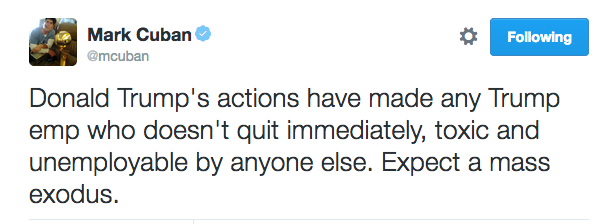
Consider this a public service message. For your own good, just go quietly into the night on this one, without a fight. You might maintain your strength in Congress. Which is good, because conservative ideology is important. But you have to stop. Because it won’t end well. In fact, for many, it already hasn’t. Consider the following from Mark Cuban:

screen-shot-2016-10-08-at-2-35-27-pm

That may be a bit heavy handed. And it’s probably unfair to those just trying to work hard and make a living. But for those with a choice, it’s probably not. And for those with a vote, it’s probably not either. We’ve wandered into a territory we never have before in our political history. Which usually requires you to do something you’ve never done before. It’s this: Put down the political looking glass and see this for what it is. Stop the false equivalency comparisons. This is a rare time when the burden of proof has been met to make this a clear binary decision. It’s not enough to condemn the words. Condemn the man. Condemn his goals. Condemn his participation in the future of our country.

Or condone the actions they represent.

The American System

Mass conflagration.

It’s one of my favorite terms. It’s a kind of training exercise on a naval ship. It simulates a scenario where everything has gone so horribly wrong in combat that the crew is no longer trying to focus on the military objective of defeating the enemy. Instead, they’ve shifted their resources to saving the ship and themselves. It’s not an easy thing to do. It requires lots of coordination and expertise. So you have to practice it. I did it more times than I can remember during the two years when that’s what I did with my life-serve on a ship.

I’m not on a ship any more. I’m not even in the navy any more. But I experience mass conflagration often-for about an hour, every morning,  in my house, when my wife and I are getting our children ready for school. If you have grade school aged kids, you know exactly what I mean. If you pretend you don’t, you’re a bald face liar.

No matter how hard we try, within the first 30 minutes of our day, my wife and I surrender all attempts at making this a “great” morning and instead are forced to focus on two things 1) getting them to the bus alive and 2) staying married. Save the ship…and her crew…Both are in question more times than I’m happy to admit. To be fair, neither are ever her fault.

The risk to #1 is caused by my kids. Every morning they appear to be both equally surprised by the existence of school and unaware of the any activities required to get them there. Again, if you have kids, you know exactly what I mean. The risk to #2, staying married, is more interesting-and also why I’m talking about getting my kids ready for school in the morning in a politics and society blog. Why my wife hates be by the time the bus gets there is really the issue.

I have what I like to call a linear approach to solving the problem of getting through the morning with school aged children. I like to think that waking up earlier, preparing lunches the night before, waking the kids up earlier, or limiting breakfast options are all things that give us more time to get out of the house. Yelling louder makes them move faster…gives us more time to get out of the house. My approach is more rigor, leads to more efficiency, leads to less time required, leads to less hurrying, leads to less stress, leads to a calmer, happier morning-a better outcome.

It seems like a common sense approach.  Many people like common sense, effort in-results out approaches. Because it makes us feel like we’re in control. But here’s why I’m wrong-and she’s right.  And here’s why my approach has the opposite effect of a calm, happy morning for my family. I’m not in control.  Neither is she. No one is. Because morning in the Hughes household is complicated.

My kids, are young. And their needs vary. Some are autistic and can’t really communicate-yelling makes it worse, not better. Some have very real medication needs. Others are simply a pain in the ass-yelling helps them-hurts others.  Sometimes my wife has clients she has to see early. And sometimes she doesn’t. And sometimes my job emails me in the middle of the night and an emergency is waiting for me when I wake up. So even if I wake up early, my attention goes there instead of making pancakes. And then I’m grumpy about work and no pancakes all at once.

Mornings in the Hughes household look a lot more like a living breathing organism then an assembly line. Living breathing organisms are hard to control. Assembly lines are not.  Assembly lines are linear. Input, effort and execution yields outputs. Organisms are systems. Sometimes inputs don’t match outputs the way you would think. Some things work with others better than others work with some.  Improving a single aspect (screaming at one kid) can potentially have a negative effect on another (an autistic panic in the one sitting next to him). Doing some things worse (waking up later) can actually make others better (more rest, less grumpy-but still grumpy-dad).

Mornings in the Hughes household are a system-a set of connected things or parts forming a complex whole. And the goal of that system is to get our children to school fed, clothed and in a state of mind to learn. And when you apply a linear strategy to a system, well, you get yelled at by your wife for being stupid. Because it doesn’t work. Doing things that don’t work over and over again is stupid.

About the only time I don’t apply systems thinking is when I’m being an obtuse rock head dad or husband. I don’t really know why, but I know I’m not alone. Outside the home though, I’m a systems thinker. I’ve taken a systems approach to fighting wars and insurgencies. I’ve used it to build software products. I’ve used it to market this blog. Just about any problem more complex then brushing your teeth takes systems thinking. I live by it. Because its how you solve hard problems. Which are the best kind to solve.

America is a system-a giant system. Problems like poverty, job creation, racial inequality and terrorism take systems thinking-because they’re hard, complex problems with lots of overlapping and inconsistent inputs. Doing something logical and linear may sound like a good idea. (We have too many people from outside our country inside our country. We must build a wall.) Because it’s simple and it makes you feel in control. But it actually doesn’t solve the problem. Because it’s not actually designed to solve a problem. It’s designed to make people angry or happy. Because it’s politics.

The core difference between a political debate and a debate of any other kind is that other debates focus on differing opinions to solving an issue. Political debates focus on differing opinions of what the issue is. There are no solutions to political debates. And nowhere besides government do we focus the energy on the politics of something and not the solution. Good non-government entities usually use the word politics at the beginning of a sentence used to describe an effort or decision that didn’t make any sense. My wife and I never argue over whether or not its good if the kids get to school on time-only how effective me yelling at them is. See the difference? Spending a morning on the former would be stupid.

This is a round about way to get to the following fairly simple point.

Politics are stupid.  

Political cycles are a long standing dialogue that argues whether the problem at hand is making our country great again or keeping it great. Those are two very different problems. And it’s party agnostic. Whatever party owns the government, owns the burden of arguing to keep our country great. Whatever party  is out in the cold owns the burden of arguing that we must return the party to greatness. The problems you identify when your task is keep are very different then the problems you identify when your task is return.

Here’s my point again: Politics are stupid.

Systems thinking is not. Political thinking is linear. You are allowed and expected to make simple arguments that people can digest that have no chance at solving any material problem in politics. Political motivation and systems motivation cannot occupy the same space at the same time. You cannot solve hard problems without systems thinking. You cannot solve problems with politics.

Politics are lunacy. Political opinion is a waste of time.

So the next time you are about to engage in a political debate with someone or spend time listening to two gas bags argue about whether or not something is a problem by proposing simple bite sized ideas that won’t solve anything important, pause and say to yourself, out loud.

“What I am about to do is an absolute and thorough waste of time.”

If you must continue, realize you’re using the same part of your brain that argues whether or not Lebron James is better then Kobe Bryant-or whether or not the best Pebbles are Co-Co or Fruity. Political thinking is capable of solving one problem-maintaining or taking control of government. The less time you spend there-says the guy with the political blog-the freer you are to think about the things that matter.

Like how the hell your son can lose his shoes twice in one morning.


Best Intentions

The Vision

That’s how it starts. That’s how anything you do on purpose, that matters, starts- with a vision. The vision isn’t the work or the good breaks or the tough luck or the temporary successes and failures that you wander into along the way. The vision is the end. The end is the point. The end, is everything.

The Beginning

December of 2007 was where the vision started for me. I was staring out the window of a sprawling corner office on the top floor of the Merrill Lynch building in downtown San Diego. It wasn’t my office. It was the branch director’s office. I was waiting for him. I had bad news-I thought.

I’d been working in the financial industry for about two years. I was new, but doing pretty well. By the summer of 2007 though, I was worried. We limped through August with a sharp dip in the market that I hadn’t experienced before. It added uncertainty and stress-a notion that there were things in motion that were beyond my control. That was new for me. I was used to war. What you couldn’t control in war was often final. This was open ended, somehow more frightening. The housing market was starting to show cracks. There were concerns about the capital structure of the financial sector as a whole. I wouldn’t go so far as to say that I knew we were in trouble, only that I was suddenly aware of the existence of trouble, when perhaps before, I wasn’t.

To be safe, I affiliated in the Navy reserves that summer to help minimize the risk for my family. That’s what I did before Wall Street. I served. At the height of the surge in Iraq, I figured it was still a smart bet. I had a wife, two kids and a mortgage and there was danger out there that worried me more than war.

That December, I was recalled to active duty. That was the bad news-I thought. I told my director. He thought I was joking. I wasn’t. The really bad news came later for everyone in that building. Within a year Merrill Lynch, in business for over a century, would be bankrupt. Within 18 months, I would be in Iraq. The America that I tried to assimilate into in 2005, after two tours in Operation Enduring Freedom, no longer existed. The free fall was on.

The stock market dropped 50%. Unemployment raised 100%. Real estate property values dropped by a third. Property foreclosures spiked 40%.  We were spending $15 Billion a month on war and losing 75 service members a month to combat. Two of the big three automakers, Ford, Chrysler, GM, the industry that built modern America, went bankrupt. Dozens of financial services firms representing hundreds of years of business and trillions of dollars of assets went under. Of the 11 largest bankruptcies in American history, seven happened within an 18 month period starting in March of 2008. The president, George W. Bush, had an approval rating of 25%, three points higher than the lowest ever recorded, one point higher than Nixon when he resigned. 83% of Americans believed that the country was heading in the wrong direction.

Globally, over $34 trillion of wealth was destroyed in 2008 and 2009. That’s twice the size of the entire economy of the United States. Gone.

Those are the numbers and historical facts. They mean little to most people though. What matters much more was the impact on their lives. For me, it was bad. The company I worked for went bankrupt. The industry I worked in folded. I dropped out of business school and went back to war in Iraq to support my family.  I left a four year old, a two year old and a four month old at home with my wife, in my house that was now worth a little over half of what I paid for it. Things were bad, not just philosophically, or morally. Things were bad materially. Lives were worse-many were ruined.

That’s the hole that America was staring out of in 2008. We weren’t staring up at a mountain to climb, to ascend to a different peak above where generations before us toiled to take us. We were staring out of a deep, dark hole, up at where we once were. We needed a vision. That’s how important things start, remember?  A view of what the end would look like if we all just agreed to start. The vision that gets you out of a hole isn’t necessarily the same one that gets you to the top of the mountains you climbed before. That one looks like strength and achievement. The vision you lean on when you’re in a hole, is hope and change. That’s the vision we got.

The End

So what did the end look like?  2,835 days into his presidency, President Barack Obama’s administration has overseen drastic change. I know what I’m about to say will be argued against heartily. There will be anger and disagreement at the facts and data I’m about to deliver. In advance of that, I’ll add two things. One: This data is accurate and inclusive and not different than the same economic data used to show the dire circumstances we were once in. It’s from original sources-as is. I know some of you still won’t believe it so I’ll offer my other point. The reason you won’t believe it is the point of the rest of this essay.

Here’s where we are. Unemployment has been cut in half. The stock market has more than doubled. American corporations have never been more profitable. 20 million people have healthcare that didn’t before. The auto industry just had its most profitable year in history. We are no longer spending and deploying large occupying forces to active wars in Iraq and Afghanistan. The man who planned and funded the 9/11 attacks is dead. We found him in an allied country. We flew a team in that allied country without permission, raided his home, killed him and dumped his body in the Atlantic Ocean like he was a Decepticon.

Right about now, you may have stopped reading and started qualifying all that data with points of your own about how they don’t tell the whole story. Go ahead if you must. You’re not wrong. It’s not the whole story. But even if it were inflated by 100%, it would still be one of the most drastic economic recoveries in history. So try to push on, because there’s more here than just a cheer-leading exercise for the president.

So, that’s where we are. Much better then we were eight years ago.  My family? Much better too. As are most of the families I know. There are bad things too, like wage stagnation, and ISIS and Donald Trump. But I emphasized the things that people 100 years from now are going to look at and assess to understand the impact of the Obama administration on America. Whether or not he’s the reason for it is a different question. But it’s fairly impossible to argue that we are in a worse place today then we were when I looked out that window on the 32nd floor of the Merrill Lynch building in 2007. The vision we were given then was hope and change. When we think about the end we hoped for, now that we can see it, in a material sense, in the ways that make American lives better, we’ve realized the vision, perhaps even better than we had any right to expect. Things need to continue to get better. We’ve not finished the march. But things are better. It’s not close.

The president’s approval rating is over 50%-not bad for a second term. Somehow, over 70% of the country believes we are moving in the wrong direction though. 2008 perhaps, feels a lot further away and better than the reality. Which actually takes me to my point. It’s not that I believe that President Obama is miraculous, though much of the trajectory of measurable data during his presidency actually is. My point is something else. It’s this: If you have a burning disapproval for our 44th president, 100 years from now, no one is going to understand why. And in absence of understanding, they’re going to assign a reason to it. It’s what we do. And that reason, if I had to predict it based on current trends, will be racism. And that’s not fair. Fair criticism is one of the most important responsibilities of a democratic populous. And we don’t get any right now. So, I’m going to do something to help and provide my own.

First, I’d like to add a disclaimer. I’m a fan and supporter of the President-mostly because I’m a fan of all of our presidents, while they’re in office. They’re on my side, and at one point, I even worked for them. But beyond that, the message of this president resonates with me. And his personal conduct has been exemplary. I believe that most of the social change that he’s ushered in was well over due and I believe that he oversaw one of the more important-all be it imperfect-financial recoveries in our country’s history. That’s the way I see it. As usual though, the way I see it is but a fraction of the story.

I have decent, intelligent, friends that I respect, that can’t say the words Barack Obama without a grimace. It’s not just that they disagree with him politically-though they do. It’s more than that. They can’t stand the idea of him. And they’re not racists. And I fear that we haven’t done the work to understand why. If we do though, we might find that we come across the term generous orthodoxy.

What is generous orthodoxy?

If you’re a fan of Malcolm Gladwell, his books Blink or The Tipping Point or Outliers or anything else he’s written, you may also be a fan of his podcast Revisionist History. Like most things he produces, it’s fantastic. This past week he introduced me to the term generous orthodoxy while I was in the middle of struggling to answer the question of why reasonable, non-racist, intelligent Americans can’t stand our president despite what most would agree is at least a “serviceable” effort in office.

According to Malcolm Gladwell, generous orthodoxy is a term coined by 20th century theologian Hans Frei. It means to seek the useful middle ground of generosity -being open to change-and orthodoxy-being committed to tradition. These are Gladwell’s words, not mine.  But they grabbed hold of me tightly.

He goes on to argue that the only true way to convince an orthodox group, one rooted in tradition, to be generous-open to change, is to show them that you actually care about their way of life, the way it is-not just the way you think it ought to change.  The idea is that even though you are driving for change, you are willing to acknowledge the value of what it is that you are going to change and acknowledge that you owe your very existence and your position to effect change, in some way to what that group represents. As only Malcolm Gladwell can, he uses seemingly disparate examples like a Mennonite pastor cast out of his profession for marrying his gay son to his partner or a black student at Princeton protesting the name of the overtly racist Woodrow Wilson to make his point. I won’t give it all away, you have to listen to it. It’s important stuff. But what I will tell you is that it occurred to me, halfway through his message, that he was actually talking about the greatest failure of the Obama presidency.

Remember now, I’m a fan. But all presidencies have their failures. Some are worse then others. This particular failure is nuanced. Because it’s not a failure of policy or tangible outcomes. Not all of his policies were winners of course. And the tangible outcomes aren’t perfect, but they clearly don’t warrant outrage-to reasonable people that is, at the level that any of us who’ve ever dared to say something positive about him in public forums have witnessed. But there’s definitely a failure here. It’s a failure of generous orthodoxy. The president and his supporters have effectively delivered the message of generosity-change.  But we didn’t spend much time acknowledging the orthodoxy. And that’s a problem. I’ll explain.

There’s a whole population of Americans that don’t give a rip about health care and gun control or marriage equality. It doesn’t make them right. But it also doesn’t mean that their entire culture and way of life is wrong. And I think, somewhere along the way, here in America, those of us sympathetic to progressive causes have forgotten the value of orthodoxy. We’ve gotten so wrapped up in what’s wrong with the groups that don’t share our point of view-the pockets or racism, the religious hypocrisy-that we’ve forgotten what’s right about them.  We’ve forgotten what we owe to our orthodoxy.

The heartland of America is a place where family and faith are still the center of the community. Those are good things, no matter what. It’s a culture where fathers and sons and daughters spend time in the outdoors, learning how to hunt and survive in the rugged territory their father’s father’s fathers settled. Those are good things. They value service to country and patriotism, and personal liberties and hard work. Those are all good things. Because most of them are good people who love their country and fellow man. They’re people who have made America, along with the bold intellectual progressives of the rest of the country. Without both, we would not be America. The push and pull of that debate has been making us strong since Jefferson and Adams quarreled about the roles of government. But somewhere, we’ve forgotten it. And that’s a failure because it makes it hard for us to get things right. And even when we do, it doesn’t seem to feel like we’ve gotten it right because someone, somewhere is being left out-the orthodox or the generous.

It’s the danger of losing that balance. And it’s failure that didn’t start with this administration. But when your vision is change-generosity-you bear the burden of balancing the orthodoxy.

This is what happens when you don’t: One side, focuses only on orthodoxy. And in doing so, does things like claim that President Obama is a foreign born Muslim who founded ISIS. The other, focuses only on generosity and it doing so labels all not in violent agreement with the change, a racist or a bigot. Neither is right. And neither is fair.  And no one a hundred years from now will understand that nuance. They’ll look at the data. And the wars that ended or started. The territory gained or lost. All of that matters. But those things are really just outcomes of a people in motion. It’s the lives and attitudes of those people that matter most.

So how do we find the balance?

I’ll take a lead from our 43rd President, George W. Bush. The fact that I’ve given credit to -W-, Obama and Malcolm Gladwell in the same essay shouldn’t be lost on you, if you strive to find the balance of generous orthodoxy.  A few weeks ago, at the heart wrenching memorial service for the eight slain Dallas police officers he gave us a hint.

Too often we judge other groups by their worst examples while judging ourselves by our best intentions.”

He’s right. And he’s saying in his own words, our failures are not acknowledging the values of others. So ask yourself, what happens when we focus on the others “best intentions”?  The answer is the sweet balance of generous orthodoxy.  We’ll forget that message a thousand times again as we have forgotten it a thousand times in the past.  But as long as we wander back to it from time to time, we’ll be alright.

Failure’s Art

There’s something disproportionately sad about an abandoned work of industry. A vacant run down factory. Or a boarded up store, or empty hotel. It’s  more than the decay and disrepair. More than the esthetic blight. It’s hard to put your finger on it but seeing it evokes a strong emotional reaction, if you’re prone to those sorts of things. That’s what you feel when you stumble across one. They’re monuments to the mortality of enterprise. Where something was once a buzz of activity but is now silent.  It once represented someone’s work in action-a machine of human industry. Supplying value to shareholders and opportunity to the community in harmony.  A living organism of mankind’s effort to sustain and progress.

Until it died. And the death is what you see. And what you feel. Someone somewhere had hopes beyond this end. Those hopes died too.  Someone had to uphold the obligation of the loser in the game of investment.  That’s how it works. It’s a cycle.

Beyond the lost profits though, there’s a community that shoulders the fallout. There are those who didn’t invest yet still lost. Industry is more than the balance sheet. It’s people.  And towns.

I don’t get back to Atlantic City, where I grew up, very often.  There’s 2,800 miles between there and my life now.  And years.  It’s more the years than the distance that separates me from it now.  But when I do go back, like I did this past weekend, I make it a point to go back to those places where I spent my youth-right in the teeth of the beast, on the beach and the boardwalk.  It’s a unique combination of resort and urban grit that you can only find in Atlantic City.  Especially at the north end.  Where it’s really old.  And really tough.

I grew up with the homeless,  mentally ill and addicted that live under the boardwalk there.  My father, a lifeguard on the Atlantic City Beach Patrol used to keep me around the station to run errands for the other guards.  They called it being a “mascot”.  Far too young to responsibly do it, I’d wander up the boardwalk, lunch orders in hand talking to the familiar burnt out occupants of that unique brand of skid row.  Those were my earliest memories.  And though they don’t sound fond, they are. If for no other reasons than it’s home.  Home is our first memories.  And the human condition craves it.

So when I parked my rental car and set off on foot, cheese steak sub under my arm, I wandered up to my old beach.  The one that I got to work when I was finally old enough to be a guard myself.  I wanted to sit and watch it. The way I used to.  The way that it was.

A lot of it is the same.  And a lot of it isn’t.IMG_0247

I found myself walking through the remains of the towering Trump Plaza Hotel and Casino on my way to the boardwalk. 25 years ago, when I worked the beach on Georgia Avenue, its shadow loomed over the surf.  The deafening music from the deck above the casino blared in our ears all day.  It was menacing.  And active.

The shadow is still there.  But the activity is gone.  FullSizeRender(3)The Plaza is dead. It closed two years ago  destroying itself, thousands of jobs and millions of tax dollars with it. Three other casinos have also closed since.  Thousands more jobs, millions more tax dollars went with them.  The city is bankrupt.  The local economy is shot.  And the people are just trying to get through.

I was walking through failure’s art.

I could feel it in my gut when I walked through the old valet parking entrance, past the once bustling lobby and up onto the boardwalk, empty on the cold day, wind blowing hard from the north end, storm clouds moving quickly over the top of me.  It felt apocalyptic.FullSizeRender(1)


The easy thing to do here would be to draw a straight line from the failure of that building to the man whose name used to grace it.  You can still clearly see the outlines of the letters on the decaying facades.  Trump…
This was all his.  FullSizeRender(4)

I’m not going to do that though.  Blame does little in the face of such crippling destitution. After all, this was business.  And business has a cycle and a purpose.  And though others have taken up the task of chronicling Trump’s path along this journey that ended in the bones of his casino laying bare in wind and the rain, I’ll leave that to them. Instead I’ll deliver a very simple message of contrast.  And ask you to do the rest for yourself.

As I shook off the dark feeling of failure, walking under the walkway from the garage that had no cars to the hotel that had no guests, I walked a few hundred yards south and sat down on a bench to eat.  I soaked it all in.

The view was very different a stones throw away. Now, a titan stood in front of me.  A massive relic from the days when men built things of steel and stone-Boardwalk Hall, the marvel of architecture that served as convention center for the city until the 90’s and has served as a bustling entertainment venue since.

FullSizeRender(5)

Carved into the limestone facade facing the Atlantic Ocean since it’s construction in 1929 was something I never noticed before.  I worked the beach in front of it eight hours a day, six days a week for two years.  And I never noticed it.  Perhaps it was the abandoned lot to the south of it, another one of Trump’s old hotels torn down years ago.  Or the abandoned building to the north of it, the Plaza I just walked through that made the words stand out.  In letters as tall as a man across its 300-foot face there’s an inscription.

“A permanent monument conceived as a tribute to the ideals of Atlantic City, built by its citizens and dedicated to recreation, social progress and industrial achievements.”

IMG_0262On the north tower are the words. “education, science, conventions, art, industry”.

On the south, “festivities, music, pageantry, drama, athletics”IMG_0261

My high school graduation was in that building.  So was my brother’s and thousands of others.  My dad played football there.  The 1964 Democratic National Convention was held there, less than a year after JFK was shot. LBJ was nominated.  The Beatles played there in 1964. The Stones came later.  Mike Tyson knocked out Larry Holmes and Michael Spinks there.  The list is long and storied but I’ll stop there to make my point.

FullSizeRender(6)

That building has made good on the promise of its inscription. And here’s the contrast and the lesson in that three blocks of boardwalk. Business and profits alone are not what a society is built on. They’re a means to an end. An important one. But not the goal. A society is built on sustainment. On education, science, art, industry…festivities and all.  A society is its citizens, its ideals, its industrial achievement. The things carved into that permanent structure, flanked by the failure of quick profit and personal gain. Those words represent the heart and soul of a people. And they endure.

If you’re going to raise your hand and lay claim to the responsibility of serving and leading them, and the distinction between the roles profit and societal progress isn’t clear to you, then I’d ask you to take a stroll down a few hundred yards of boardwalk in my home town. The difference is crisp. And the lesson is clear.

A society doesn’t win.  It lives.  And progresses.  Together.  And it’s leaders serve.  Not profit.


Good Night…And Good Luck

On the evening of March 9th 1954, the American free press produced one of it’s finest hours. That night, from the now legendary Studio 41 in New York,  esteemed World War II correspondent and acclaimed radio/television journalist,  Edward R. Murrow dedicated the entirety of his evening news program, See It Now, on CBS, to addressing an infamous figure in American history. At the time, his infamy was not yet fully documented.  In a little under an hour, Murrow changed that.

Senator Joseph McCarthy and his ongoing investigations of American citizens who were suspected of being members of the Communist Party had a grip on the nation’s hopes and fears.  Over the previous four years, McCarthy had set off a national panic by persecuting members of government, the media, Hollywood, even the military.  McCarthy’s activities as the Chairmen of Senate Operations Committee assumed guilt and publicized hearings in which the burden for closure was laid at the feet of the accused to prove they were not communists.  McCarthy had taken advantage of the national anti-communist fervor to gain and wield personal power-accusing anyone that challenged of the same crime as those being challenged already-communism.

By 1954, McCarthy set his sites on Murrow, who responded with one of the most famous and important media broadcasts in our history.  He concluded the broadcast that was filled mostly with McCarthy’s own recorded words with his own.

“This is no time for men who oppose Senator McCarthy’s methods to keep silent, or for those who approve. We can deny our heritage and our history, but we cannot escape responsibility for the result. There is no way for a citizen of a republic to abdicate his responsibilities. As a nation we have come into our full inheritance at a tender age. We proclaim ourselves, as indeed we are, the defenders of freedom, wherever it continues to exist in the world, but we cannot defend freedom abroad by deserting it at home.

The actions of the junior Senator from Wisconsin have caused alarm and dismay amongst our allies abroad, and given considerable comfort to our enemies. And whose fault is that? Not really his. He didn’t create this situation of fear; he merely exploited it — and rather successfully. Cassius was right. “The fault, dear Brutus, is not in our stars, but in ourselves.”

Good night, and good luck.”

The broadcast hit its mark.  McCarthy’s televised response in which he accused Murrow himself of communist activities was too obvious for the American public, even in their inflamed and fearful state, to ignore.  By the end of the year, McCarthy was formally censured by the Senate and stripped of most of his power.  Three years later, his chronic drinking killed him- cirrhosis of the liver.

Murrow’s coverage of Senator McCarthy showed the power and importance of the de facto “fourth branch” of American government-the free press.  It was a clear and inarguable victory of the power the American people, armed with information and empowered by a government that actually still cared about public opinion.  The river that ran underneath the event, carrying it to it’s historically fantastic conclusion, was trust.  Specifically trust in Murrow.  And more broadly, a trust in the press.  How far we’ve come from then to now, is a problem that weighs heavily on our future and our ability to adjudicate the actions of our leaders, through the democratic process.  If democracy is our vehicle, the free press is our fuel.

Sixty years later, we’ve found the tenets of our branches of government in dire straights.  A congress so frozen by partisan motivation that we’ve ushered in two decades of executive directives as the sole way to accomplish anything-an incomplete Supreme Court, unable to provide decisive rulings-the Office of the President, likely to be turned over to flawed candidates.  And as much as we would like to vilify all of them, I’ll take Murrow’s lead.  “The fault, dear Brutus, is not in our stars, but in ourselves”

In a democracy, it is always the fault-and the prerogative- of the people. But the root of the problem is not in our judgement or our collectively failing conscience.  It lies somewhere else.  Somewhere exposed by the silent response to the following question.  Who could stand in front of a television camera today, and in less than an hour, deliver information in such a clear and trusted manner, that America as a whole, would uniformly join in a chorus of American will and effect immediate change?  Who could do that, and have it be anything other than noise?  The silence, is telling.  Here’s why.

We’ve got intentionally partisan entertainment organizations masquerading as journalistic entities-groups like Breitbart, Huffington Post, Fox News, MSNBC and countless others that look and feel like they are giving us information so that we may better form our opinions.  But they’re really just picking and choosing parts of reality to weave into the tapestry of a narrative that is their brand.  True journalism is dictated by truth and relevance. Not brand.

Let’s be clear though. It isn’t the journalists at the core of the issue. There are talented,  professional people everywhere, as many as there ever have been, laying it on the line to bring air and light to things that desperately need it.   Most of these stories in a vacuum, are meaningful, worthwhile pieces.  For the most part, in it’s molecular form, journalism is alive and healthy.  The problem lies not in it’s production, but instead, in it’s distribution-a lopsided delivery, designed to meet the brand and voice criteria of an outlet.  There are very few media outlets, where one can get both sides of a story, beyond a point-counterpoint of two talking heads yelling at each other on a panel.  No matter what point is made, someone will jump on the ratings lift generated by a counter point. Even when there is no responsible counter point.

The only one left to argue against Murrow in favor of McCarthy, was McCarthy.  And so he did.  And so he went.  Because he was that wrong.  And when someone is that wrong, silence is not unbiased.  It’s consent.

Which leads us to another troubling reality.  Those stalwarts of objectivity, those happy few bands of brothers who refuse to be outlets who overtly slide one way or another seem to have lost their nerve.  The major network news organizations, the lions of the free press, have confused objectivity, with passivity. One can still be objective and non-partisan, and slay a dragon that is in the wrong.  The dragon is slain, not because of a given agenda.  But because it is a dragon–that’s what we do with dragons.

Murrow was not partisan.  He was trusted and objective.  But he knew McCarthy was wrong.  Dangerously wrong. So he acted.  That’s not happening right now.  And the outcomes, are the normalization of outrageous behavior an the ineffective execution of societal norms.  There’s no counter argument, to serious people, that Donald Trump’s behavior, statements and track record should ever have be tolerated by the press.  The press not tolerating a candidate is different than him not getting elected mind you.  If the conservative base in our country wants to nominate him, fine.  But that doesn’t make his statements and actions appropriate.  And right now our serious press outlets, in an effort to remain objective, are tolerating things they should not.

This week, after being questioned by the press about the delay in payment to a veterans charity from a highly publicized charity event, Trump struck back with frightening rhetoric. And the press took it, allowing him to carry the narrative that there was an inherently dishonest press, one the American people could not trust.  The tone, all of this will change when I’m president, hung silently behind each word.  And the press, largely took it. And then took it when he called in to question the suitability of a federal judge and celebrated drug prosecutor because of his ethnicity-because he ruled against Trump. A few headlines.  No hard questions.  More silence.

But it did awake a lion from the past.  From the days when powerful men feared the truth brought upon them by men of conviction-organizations of conviction.  Dan Rather, 84 years old with 50 years of American accountability filed behind him since the days of Eisenhower, Vietnam, Kennedy the civil rights movement, the Cold War- answered.

I felt a shudder down my spine yesterday watching Donald Trump’s fusilade against the press. This is not a moment to be trifled with. It wasn’t his first tirade and it won’t be his last…

…I know what it is like to sit in those seats and feel the scorn and even wrath of politicians of all political persuasions. Attacking the press for unfair coverage has long been a bipartisan pursuit. Sometimes it works. I am happy to say that more often it doesn’t. But Trump’s brand of vituperation is particularly personal and vicious. It carries with it the drumbeats of threatening violence. It cannot be left unanswered.

This is not about politics or policy. It’s about protecting our most cherished principles. The relationship between the press and the powerful they cover is by its very definition confrontational. That is how the Founding Fathers envisioned it, with noble clauses of protection enshrined in our Constitution.

Good journalism–the kind that matters–requires reporters who won’t back up, back down, back away or turn around when faced with efforts to intimidate them. It also requires owners and other bosses with guts, who stand by and for their reporters when the heat is on.

I still believe the pen is mightier than the sword. And in these conflicted and troubled times, we should reward the bravery of the men and women not afraid to ask the hard questions of everyone in power. Our nation’s future depends on it.


The days of Woodward and Bernstein, of Murrow and Wallace and the voices of our past are far closer in time than they feel in our memories.  Our nation’s future depends upon them continuing the call.  The countless online presences may serve to dilute the dialogue.  But we have to be more vigilant. We must not continue to be satisfied with equal treatment for unequal actions.  And now more then ever, we must rely on that entity, whose creation separated us from all other ruled men before us. The Press, in its entirety, cannot be perceived to be dishonest.  It is not.  People are dishonest.  Information, when vetted and delivered with the motivation of truth and relevance is omnipotent.  Men with much to hide have but one recourse-discredit.  We owe it to our society to not bite that hook.  Too much is at stake.

Mr. Trump is correct.  The press in this country is a real problem.  For those with unclean hands, it always has been.  And I hope it always is.


At All Costs

A little over a year ago, we launched this website to give people a safe place to gain some background and context for things that were happening in the world around them-a place free from political spin where we didn’t tell people what to think.  Instead we told them the why behind things and challenged them to come to their own conclusions.  The last two publications on chartwellwest.com have been intentional departures from that practice.  They were opinion pieces motivated by a political end-to encourage opposition to the candidacy of Donald Trump.  Though focused on Trump, he was not actually the greater end to our intent.  Instead, the focus was defeating something larger-authoritarianism.  For such an important message, I’m fine with the purposeful hypocrisy we’ve indulged.  There’s more at risk here than most people appear to be grasping.  But we’re going to get back to talking about the why anyway.  Because when you shine a light on what is behind the political rise of Donald Trump, opposition grows a strong and graspable handle.  Whether or not you grab it, is up to you.

This past weekend, Amanda Taub wrote a thorough and appropriately candid review of several research projects conducted by PhD candidate Mathew MacWilliams at University of Massachusetts Amherst, Professor Jonathan Weiler at Vanderbilt and Professor Marc Hethrington at the University of North Carolina.  Taub’s article is magnificently detailed and long.  But it can be effectively summed up by three insights and a conclusion that will help paint the why behind my vitriol opposition to Mr. Trump.

These insights are based on the assumption that there are people who, as a function of their personality, are predisposed to gravitate towards authoritarian ideology.  This assumption is backed up by data and research in the field.  Authoritarian ideology being formally defined as favoring or enforcing strict obedience to authority, especially that of the government, at the expense of personal freedom.

Here’s the big story of their findings highlighted in Taub’s article, in her words.

  1. “In the 1960s, the Republican Party had reinvented itself as the party of law, order, and traditional values — a position that naturally appealed to order- and tradition-focused authoritarians.”
  2. “many authoritarians might be latent — that they might not necessarily support authoritarian leaders or policies until their authoritarianism had been activated. This activation could come from feeling threatened by social changes such as evolving social norms or increasing diversity, or any other change that they believe will profoundly alter the social order they want to protect.”
  3. “when non-authoritarians feel sufficiently scared, they also start to behave, politically, like authoritarians.”

It’s fair to point out that not all Republicans are authoritarian.  But it is also fair to imply that if you were of authoritarian disposition,  and you were inclined to choose a political party over the last 50 years, it would be Republican. Which leads to the compelling conclusion that explains the phenomenon that has culminated in the symptom of our national political sickness-Donald Trump:

“… if social change and physical threats coincided at the same time, it could awaken a potentially enormous population of American authoritarians, who would demand a strongman leader and the extreme policies necessary, in their view, to meet the rising threats.”

Pretty straight forward.  Now consider this timeline:

  • 1964-The Civil Rights Act
  • 1973-Roe V. Wade
  • 1984-The First Woman Vice Presidential Candidate
  • 2008-The First African American President
  • 2015-Same Sex Marriage Equality
  • 2016-The First Female Presidential Candidate

These represent a half dozen landmark social progress milestones that, at the time, the Republican party opposed in some way. Which tells us that we’ve been marching forward with social progress for 50 years and the Republican Party, as is it’s function as our conservative voice, opposed it. I’m not bashing them.  It’s their job. But we haven’t had Donald Trump until now.  Why did it change?

There’s another critically important event that’s missing.  On September 11, 2001, foreign born, Muslim terrorists hijacked and flew four planes into two skyscrapers, the Pentagon and a field in Pennsylvania, killing over three thousand Americans, live on national television.  There was no state to defeat in order to declare an end to this threat.   The broadly amorphous entity that did execute it and other attacks since, still exists.   The slow warming pot of fear and social progress had been brought to a roaring boil over the last 15 years.  Social progress and physical threats are happening at the same time.  And now, we’re facing the fallout.

But why is it that some of us, more than others, are so concerned with the rise of an authoritarian sounding candidate?  Why don’t we just take it in stride and surrender to the “he’s gonna tell it like it is and show those guys who’s boss”  mentality?  Why do we refuse to say the words “at all costs” when it comes to protecting our sovereignty and our traditional culture?  I can’t speak for everyone, but I know for me, the reason is clear.  I’ve actually seen it and experienced it first hand.  And most of the people I know who have at the level I have, are shouting right along side me.

I’ll start with a not too unique experience of mine.  The first time I actually felt it was when I was on a trip to the National Holocaust Museum in Washington, DC.  I was a freshmen at the Naval Academy, there on a trip for one of my classes.  If you’ve ever been there, you probably know where this is going.   I walked into the “shoe” room.  The room where thousands of shoes from the people murdered by the Nazi’s were piled four feet deep in a display.  They were all shapes and sizes and styles-womens shoes, kids shoes, baby shoes- representing the horrible, indiscriminate massacre of Europe’s Jews.  For the first time in my life, I was in the room with the human toll of authoritarian rule.  It was one of a handful of times where I have been overcome with grief and was unable to contain my emotion.  It would not be the last time I would see it though.

A few years later as a lieutenant in the Navy, I was a part of a humanitarian mission to East Timor, a small Pacific Island nation north of Australia. After decades of occupation, the Indonesian military had pulled out two years earlier. I was on my way to an orphanage to supervise a construction project.  Our driver suddenly veered off course and into a back alley.  Just about the time that I was about to hit the panic button, we emerged from the alley and onto a loading dock next to a seawall in the harbor.  The driver got out and stood on the sea wall and started to shout.  Our guide translated.  He was telling us that the children we were going to see lost their parents on that sea wall. They were lined up and shot there about 18 months before we arrived, by the authoritarian forces leaving the island. The driver’s brother was one of them. As he stood there, screaming at us, that feeling, the one you get when you are in the presence of true, avoidable human tragedy, grabbed me and wouldn’t let go. You know it when you feel it.  If you haven’t you won’t understand.

Later in Sub-Saharan Africa I witnessed a land forgotten by time and progress as resources funneled from the people to the government to sustain their own power.  Later in Iraq, I saw the dysfunction of a society that had lived for so long under authoritarian rule that it had lost its ability to self regulate decency and good will towards their fellow man.  Like an abused child, you could not undo overnight what took decades of abuse to cause.  The problems in all three of those areas rage on.  Some are getting better-too slowly.  Others are falling back into darkness.

When I hear Americans, most who by virtue of living in this great land have been entirely sheltered from the true destruction of authoritarian rule, calling for a leader who embodies it to rescue them from their deepest darkest fears, I feel compelled to shout back as loudly as I can, because they know not the evils of the cure they seek.  So I’m going to keep shouting.  And I’m not going to stop.

In the spirit of fairness, this isn’t really Donald Trump’s fault.  He is a symptom of our disease, one fifty years in the making.  And maybe it’s not as dire as I think.  About a third of Americans are registered Republicans.  And less than half of them are actually supporting Donald Trump.  They are those vocal few who subscribe, perhaps even subconsciously to the “at all costs” authoritarian mentality.   That means that about 80% of Americans do not.  So maybe this goes quietly away after the general election.

But maybe it doesn’t.  I’ve seen what the end of the path looks like-in the eyes of those whose lives have been destroyed by it.  And I know how few off-ramps that path offers.  So I’ll shout as long and as loud as I have to in order to keep us from taking it.  Because there is no fear great enough, no tradition strong enough worth abandoning our true founding principle to be a more perfect union built by our people, for our people-all of our people.   No one ever promised us safe. No one ever promised us traditional.  They promised us freedom and liberty-two inherently unstable, unpredictable and delicate things.  Be wary of who you entrust with their preservation.


The Cult of Personality

It finally happened. While I sat in my car during one of my soul crushing Southern California commutes, jammed into the I-15 freeway, paying my morning penance for living in the suburbs, it happened.  On the radio, pundits were worked into a lather, clambering about the latest runaway victory of candidate Trump. Their tone was acceptance.  Gone was the harsh warnings of the danger of nominee Trump or President Trump, dare we say. Gone was the disbelief or predictions of failure. Acceptance had seeped into their consciousness. And for the first time, I felt myself starting to normalize a Trump general election candidate-then a President Trump.  I could feel myself preparing for what that might be like. Because that’s what we do.

We humans are capable of normalizing amazing things. We can put up with a lot, if we choose to. Years ago, deployed as a Naval Officer to Africa, my team built a camp in a remote location. Within days, a massive hive of killer bees infested the showers and stung us to death whenever we wanted to get clean. I remember one time in particular after I’d showered and endured a half dozen bee stings to the face,  mumbling to a buddy heading the other direction, “At least I’m clean”.  I was willing to deal with quite a bit of downside-repeated bee stings to the face, because I was so dirty. I felt it was a fair trade off. Get clean, or don’t get stung by bees. I had no third option. Now I was normalizing President Trump, because I felt like I had not other choice.

So there I was, sitting in my car, stuck in traffic, suffering through the bee stings to the face that was candidate Trump’s victory speech in Nevada. I started thinking, “maybe it wouldn’t be too bad to have that ass hole stick it to the Chinese…maybe he might finally strike a deal between Israel and Palestine…maybe he could bully congress into doing something for once” and then I caught myself. I was surrendering. And I’m not the only one. We have entered into dangerous territory.

Here’s some background. I grew up in Atlantic City. Donald Trump has been a part of my life for my entire life. My family has worked in his casinos. I used to watch his helicopter land on the pier on the beach that I worked on as an ocean rescue lifeguard in high school. He ran those businesses into the ground and got out, in the nick of time, Trump style. Atlantic City is for losers is likely what he would say.  I don’t know him. I’ve never been in the same room as him. But I know plenty who have.  And they all say mostly the same thing about their personal encounters with him. He seems like a nice guy. He makes you feel important.  And he’s very gracious with his attention.  That’s about all I really know about him aside from the cartoon character he’s been playing in the media the last few decades. As a guy, he sounds lovely. Of course, that’s also what people said about Saddam Hussein.  About Joseph Stalin…about Hitler.  Which brings us to the problem.

Trump isn’t Hitler. He’s not Stalin. He’s probably not even Putin. But people haven’t really figured out how to articulate why he shouldn’t be president. They scream louder and louder that he can’t or won’t win and like a cosmic sci-fi movie villain, he absorbs the negative energy and grows stronger with each word of malice. I’m done predicting that he won’t win. I’m done predicting anything because I’m sick of being wrong. I won’t tell you why he can’t be president.  Because he certainly can be president. And if we’re not careful, he will. Instead, I’ll try another approach. I’ll tell you why he shouldn’t be president. But I’m going to do it in a way besides pointing to the fact that he’s Donald Trump. That’s clearly not working.

Here’s how we’ve tried so far.

He’s a chauvinist bigot. 

He might be. He might not be. I don’t believe anything he says is sincere so it could all be an act-hold that thought. He’s a 70 year old white guy from New York who was born with a lot of money so he’s probably got a little of the old white guy thing going on that we white folks know many of our dad’s generation struggle with-prejudice and sexism. Sorry folks, that may be a little uncomfortable truth for some of us. The people who like Trump-angry white people-don’t care.

He’s a dishonest demagogue that will say anything to make you support him. 

Congratulations, welcome to politics.

He’s a bully. 

See last item.

He’s a manipulator.

See last two items.

He is a lousy businessman who has filed for bankruptcy four times.

That’s actually a lot of bankruptcies. But it’s a pretty normal practice and it was chapter 11, the type where you do it so the business lives to see another day. It’s not a smoking gun.

He’s a rich kid who got all his money from his father.

Ever hear of the Roosevelts?  JFK?

He’s a draft dodger.

We’ve had one president in the last 50 years serve in combat. Thank you George H.W. Bush for your service.

You get the point.  You can play this game all day long. It doesn’t work. Trump’s most brilliant talent is staying relevant in our ever shifting culture. He started with real estate and then moved into our consciousness as someone synonymous with simply being rich in the 80’s and 90’s. Then he morphed into a reality TV star and invaded social media and now he’s impregnated our political machine with the Trump brand.

When someone becomes that ubiquitous, they become a walking talking, tweeting, insulting, bullying, Rorschac test. People start to see in him what they want. For those feeling left behind by a changing economy, he’s a business man who will solve it. For those feeling marginalized by our changing culture, he’s going to kick out all the foreigners. For those scared of terrorists, he’s going to bomb the hell out of ISIS. For those of us who want to shout down inequality and bigotry, he’s someone to hate.  He is different things to different people. Like scripture, if you stare at candidate Trump for long enough, he will tell you whatever you want. And there’s one thing you can’t argue about with someone. It’s their religion.

But that doesn’t mean we should get baptized by him. Here’s why.

There are three critically important dimensions to useful political thought.  Effective political thinkers need be equally principled, empathetic and pragmatic. Looking back at candidate Trump’s public and private life experiences, he fails this test in an extremely dangerous and troubling way. More so than any person seeking the office of President of the United States in a long time, maybe ever. After 40 years in the public eye, it’s almost impossible to point to areas where he has been a part of something bigger than himself, built on a guiding principle that made other people’s lives-people he didn’t know or wouldn’t be in a position to receive something in return from-better.

He appears to be entirely devoid of anything that mimics empathy. Heads of government need to be able to feel the pain of the people they govern as if it were their own. That doesn’t mean that they have to be selfless or even charitable. It means that they have to have the capacity to care about the outcomes of other people. Candidate Trump fails.

He does have one thing in abundance-pragmatism. Unfortunately, pragmatism without empathy towards those you govern and not grounded in principle other than self promotion is powerfully dangerous. It’s that thing that the truly dark rulers of history seem to have in common- the ability to get things done without the troublesome headwinds of principle and care for others. It’s the recipe for how the governing of man has gone horribly wrong for thousands of years.

This is usually where supporters of one candidate start to throw out the flaws of the other candidates in response. But here is where that doesn’t really work for candidate Trump. Every other candidate, on some level, does better at the standards explained above. Here’s how you can tell. Take a look at how they’ve spent their life and then look at candidate Trump. Candidate Trump was named the president of his father’s $200M real estate firm in 1974, when he was 28, six years after he graduated from Wharton.  What he’s done since, is on display for the public to see. At no point has he even appeared to serve someone else. And that’s hard to find, even for someone not running for president.

If you run the other candidates and recent presidents through that test, the difference is staggering. Hillary Clinton was one of 27 women in her graduating class from Yale Law School. She had a wealth of opportunity and chose the Children’s Defense Fund as her first professional role. Ted Cruz is the son of a Cuban immigrant who graduated from Harvard, was the editor of the Harvard Law Review and then served as a clerk for several federal judges including Supreme Court Justice Rehnquist. He’s horribly unlikable but he appears to actually believe in something other then himself. Bernie Sanders chooses to call himself a democratic socialist, something that has limited him his entire career until recently, because he believes in it. John Kasich has answered to the people of his state as the Governor of Ohio. Some are supporters.  Some are not. But at a minimum, he appears to have governed with benevolent intent. President Obama, same a Cruz, son of an immigrant, Harvard graduate, became a community organizer. Reagan was the president of the Screen Actors Guild and then governor of California. JFK was a decorated war hero as the commander of PT-109. You can go down the list and point to times, whether you agree with them or not, that other candidates have served someone other than themselves.  

But you can’t for Trump.

And this is what that means. If candidate Trump were to be President Trump, the first group of people that he will be responsible for serving, above his own interests, will be the entirety of the American people and by virtue of our standing as a global power, mankind.  And that is as strong a case as anyone can make against anyone doing anything. There’s a lot at stake here. It’s not the time to get comfortable with candidate Trump. And if he is nominated by the Republican Party to run for office in the 2016 Presidential Election, it’s not because he’s right. It’s the death spasm of a scared, angry ideology that has poisoned the conservative mind of our country. And we should think that it’s as ridiculous now as we ever have. Because it is. It’s just a lot more dangerous.