In Search of Elliot and Archibald

On May 18, 1973, the United States Senate began nationally televised hearings on Watergate.

Incoming Attorney General-designate Elliot Richardson, recently appointed by Republican President Richard Nixon, assigned former solicitor general Archibald Cox to serve as the Justice Department’s special prosecutor for the investigation. The rest, as they say, is history. 478 days later, amidst mounting evidence that he himself broke the law by authorizing illegal activities against the Democratic National Committee, Richard Milhous Nixon became the only man to resign the office of President of the United States of America.

At the time that the Senate Committee launched their hearings and Cox began his investigation, there was no public evidence that implicated President Nixon in those illegal activities. The election, held the previous November, was won by Nixon in one of the great landslides in presidential election history. He took just under two-thirds of the popular vote, a tally impossible to explain by any illegal activities. But he broke the law. And then he tried to cover it up. So he had to go.

By all other respects, Nixon was, at a minimum, a serviceable executive.

The most powerful man in the world broke a law that had no measurable impact on his claim to office or the effectiveness of his administration.

Still he lost power.

Not through force of violence or activity outside the rule of law. But because the institutions that firmly stood in place to limit his power insisted that he lose it. There was a legislative branch that acted independently of political goal. There was a judiciary and law enforcement entities that insisted on seeing it through. There was a free press that spoke truth to power. And there were Americans of character and principle in positions of authority.

Watergate was the application of the rule of law. Might did not make right. There were limits to power. And we saw them in action.

On October 20th, 1973, it came to a head on what’s since been called, the “Saturday Night Massacre”.  With mounting pressure and evidence piling up against him, Nixon ordered Attorney General Richardson to fire the special prosecutor Cox. Richardson refused.

He was fired.

His immediate replacement William Ruckleshaus also refused and resigned. Eventually, a third, Robert Bork, carried out Nixon’s order.

The damage had been done though. Within a year, Congress passed the articles of impeachment. And Nixon was gone.

There have been and always will be inappropriate people who inappropriately seek power. There will always be outside powers looking to interfere in our wellbeing as a nation. But what has made us uniquely great, what has delivered 55 peaceful transfers of power and 2 percent per capita economic growth for 240 years, is the institutions and functions of government that respond to them.

The great risk of our times, is that perhaps now, they can’t. Or they won’t.

We’re about to inaugurate someone who has held no position of government in his life and can scarcely point to a single aspect of service in seventy years; with suspect business dealings and personal behavior.

But he’s not the real risk.

The real risk is the Americans standing next to him and the institutions charged to check him that scare me the most.

We’re no doubt in for a very different experience. And perhaps the only person who could drive the needed change is someone like Donald J. Trump. But I’ll ask the question to his supporters.

When am I allowed to be concerned?

What does he say and what does he do that alarms you?

Because we’ve shrugged off quite a bit already. And when the people who supported a candidate’s rise to power can’t be counted on to eventually tell him he’s gone too far, we’re left with the institutions to do it. When I think of those institutions today, it gives me grave concern.

Who in Trump’s inner circle blows the whistle?

Who on his cabinet resigns over principle?

What Republican stands for no more in Congress.

Who in the press will we believe? 

Who are today’s Elliot Richardson and Archibald Cox?

Our most serious problem probably isn’t Donald J. Trump. It’s that the answers to those questions feel like the same ones that failed to check the truly dangerous leaders in history that hurt so many. And that’s new in America.

American Vision: Revised Edition

My mother’s favorite poet was Robert Frost. She kept a book of his poems with illustrations on our old wooden bookshelf in the living room of our house in New Jersey. There were a handful of books on that bookshelf that I would pull down and thumb through from time to time. One was a compilation of photographs of Lincoln. Another was an illustrated account of the Kennedy assassination. Another was the story of our accomplishment of space flight. They were huge books, about half the size of me with colorful pictures, worn dust jackets and coffee stains. She’d gotten them in college in the 60’s. They sat on that shelf for decades. Some of them are still there, though she’s long since passed.

screen-shot-2016-12-24-at-6-29-00-am
Stopping by Woods On a Snowy Evening By Robert Frost

I remember the picture of a tree on the page with Frost’s Stopping by Woods on a Snowy Evening. It looked like the tree in my front yard. I would read that poem over and over again. There was something about the end of it that just stuck in my head. The part about the woods, “lovely dark and deep.” And the part about life, “miles to go before I sleep”, twice said.  There was beauty in that described moment of peace. And the realization that it was fragile and fleeting and that there was work ahead that made it more so. One last breath of fog in the cold night air while your feet stay still in the snow. And then it’s back to the business of life. Less beautiful. More permanent.

Life moves on. The future is our only constant. And no matter how beautiful or still or comfortable the peace of now might be, you cannot stay in it. The instant you realize it is the now you’re experiencing, it becomes the past. And you must move on. There’s work to be done.

Elections aren’t what make democracy great. They are a messy, imperfect means to an end. Accountability is what makes democracy great. And elections are the best measure of that accountability that we have to do that thing that is so hard to do. Since the days when we wandered out of the woods and onto the planes and further still over the horizon, the process of choosing who we allow to leads us has been hard, costly and not always for the best. The way we do it in America has yielded strong outcomes for centuries though. But it is not what makes us great. The greatness comes in between. After we choose. After we begin our journey again. We’ve got quite a bit of road ahead of us to cover. We’ve got miles to go. No sleep in sight.

There is a world beyond our current myopic focus. Our politics or the Jihad of a small group of foreign, hateful, religious zealots have distracted us. The world is about to remind us that those things weren’t quite the magnitude of threat we’ve faced in the past. What lies ahead, the rhetorical promise of a new arms race and the rise of an eastern power with enough resources to dominate the world for centuries, are far more serious threats. Threats that will force us to remember a time when Russian field commanders had nuclear weapons release authority for the payloads being placed in Cuba, 90 miles from our shores. Or when global imperial powers had the capacity to cripple our military with equal or greater military might of their own. And nothing the last president did, or the one before him or the next one is at fault. It’s the ebb and flow of a global species in which there is rarely a singular power that remains singular for very long.

It’s time to pick our heads up. There are sails on the horizon. And we’ve got work to do.

It’s been 45 days since the American people elected Donald J. Trump president. And it’s another 30 until he is sworn in as the 45th president of the United States of America. We’ve had enough time to reflect on what the election says about us. And what it says about the state of our political discourse. And what it says about our culture. We’ve taken our deep breath in the cold dark woods. And it’s time to move on. And it’s time to move past the what and why’s of what happened. It’s time to ask the better question. What do we want from a Donald  J. Trump presidency? What do we want for America? The answer is pretty straight forward.

I don’t want him to fail. I don’t want him to be the disaster that would prove secretly delightful to those of us who so strongly opposed his candidacy. That justification can only come with four years of failure. Four years of worse outcomes for the American people. Four years of a weaker country amidst the backdrop of a rising China and a belligerent Russia. I don’t want that and neither should you. What I want out of a Trump presidency is the same thing I would want out of any presidency. Success.

Success is a weak word. It hasn’t done the work. The work of success begins with a narrow vision of what right looks like in the end. And if you don’t have one for America, then you haven’t done the work.  And you don’t know anything about the effectiveness of her direction. And if your vision is 1950’s American, it’s a bad one. Success starts with a vision. So I’ll share with you mine. Because a great 21st century America needs to start moving forward in earnest. A great 21st Century America accomplishes the following, no matter who sits in the oval office or what ideas they have about America and her people:

  • 25 Million new jobs created over the next ten years. China is on the hook for ten million a year. They’re still in catch up mode. We can win with a quarter of that.
  • Balance the federal budget by 2030. If you refuse to accept any other outcome, it can be done. But you are going to have to re-define your reality of taxation and government services. If you can’t, your future is already decidedly less great.
  • Eliminate fossil fuels within 75 years. Not through regulation. Through innovation and a better way. 100 years from now people need to laugh at their grandparents for digging dead things up from the ground and burning them for power. Pay attention to what Elon Musk is doing. And root for him to succeed.
  • A complete overhaul to modernize American infrastructure by 2025. I don’t mean repair. I don’t mean upgrade. I mean build again. Better, more innovative, more American. We win with better things and a better way of life.
  • Manned space flight to Mars by 2035. If it sounds silly, then I’d ask you what happens when a people reach their ceiling? They atrophy, or they blast through it. I’m for the latter. Again, watch Musk.
  • Put science, treatment and doctors back at the center of American healthcare. Get shareholders out of the game. Do that in any sustainable way possible.

That’s not an exhaustive list. You could probably find other things. But it’s a start. And we have to start. That’s what a vision looks and sounds like. That’s what making 21st century America great looks like.  It’s more than a red hat and a snappy saying. It’s hard work.

There’s something refreshing about turning away from the messy footprints behind us that got us where we are and turning towards a goal. It’s cathartic. Because you spend time thinking about what you want. So much of American mind-space for the last 18 months has been focused on what we don’t want. It’s time to move on. And move forward.

If you’re one of the tens of millions of Americans who the president elect alienated with his campaign rhetoric or personal behavior, I’m not going to ask you to just get over it. But I am asking you to have a vision for what you want. Not simply what you don’t. And it’s entirely fair to assume that in order to realize that vision, it’s mandatory to build some foundation of unity where Americans aren’t living in fear of each other or the government. And if that can’t be done with Mr. Trump, then step one on the vision, is choosing a new leader. So be watchful. We are a nation of people. But we are a government of laws-laws that exist for the betterment of our people. No one is above them. We didn’t elect a king. Only a president.

It’s time to get going now. Feet moving over the snow again…miles to go before we sleep. Miles to go before we sleep.

Are You a Watkins or a Massengill?

In 1937, the pharmaceutical firm S.E. Massengill Company launched a liquid form of the drug sulfanilamide to help fight strep throat infections. They called it Elixir Sulfanilamide. The drug was never tested on animals or humans. Because they didn’t really do that back then. But it did contain a chemical compound related to anti-freeze. The result of the drug’s distribution was a nationwide mass poisoning. Over a hundred people died, mostly children. Thousands more were made violently ill. After the early reports of death and illness, the company tried to recall the elixir. They could not. No one kept records back then. So the FDA had to use the entirety of its field force to track down all the available bottles of the medicine, door to door, to avert further crisis.

At the time, the only law that S.E. Massengill Company violated was the mislabeling of the drug as an elixir. Elixirs contain alcohol. Elixir Sulfanilamide did not; just anti-freeze. The only reason the FDA was empowered to participate in the recall was because of that fortunate mis-labeling. In response to the tragedy, there was a public outcry and Congress passed the 1938 Food, Drug, and Cosmetic Act requiring clinical testing be conducted before any pharmaceuticals go to market, among other sweeping regulatory changes.

Dr. Samuel Evans Massengill, the owner of the company, offered his assessment of the events shortly after the recall. “..there was no error in the manufacture of the product. We have been supplying a legitimate professional demand and not once could have foreseen the unlooked-for results. I do not feel that there was any responsibility on our part.”

Harold Watkins, the company’s lead chemist who developed the compound personally was more contrite. He committed suicide shortly after.

S.E. Massengill Company survived. It’s one of a half dozen companies that have merged, split or spun into Glaxosmithkline, the massive British pharma company that manufactures household name drugs like Advair.

The Food, Drug and Cosmetic Act of 1938 is hard to poke holes in. It’s pretty difficult to argue that if we can’t manage to not hand out anti-freeze to children with sore throats without government intervention, then perhaps we ought to have some government intervention. So have some we do. Most would agree that we’ve come a long way towards the safety and efficacy of our medicine since the 30’s. For the most part. There’s a gap though. Because the funny thing about regulation, when large sums of money are involved, is that it tends to drive minimal acceptable behavior. Here’s how it works.

For 50 of the 80 or so years of it’s existence, the only people the Food, Drug and Cosmetic Act of 1938 protected, were white men. Because the only people that participated in the clinical testing were white men. And it’s not just because we had a long history of only really meaning white men when we pass laws. There’s actually a slightly better answer for this one.

If you need to test a drug that you think is going to help people, and you have limited time and resources to do it, like everyone does, you probably need to find the most stable, common test subject. Now, from a biology perspective, we men are pretty boring. We don’t have exciting things like menstrual cycles, pregnancy or menopause. We just get horny, then old, then bald and grumpy and dead. But our body chemistry stays pretty consistent. And since we white folks in America have historically been the majority of the population, the safest, most consistent, effective and efficient test subjects to pick were white men.

Additionally, in the early 60’s we had the thalidomide tragedy, where thousands of pregnant women were prescribed thalidomide to help with morning sickness. The outcome was that thousands of babies around the globe were born without limbs. The less tragic but more enduring outcome was a knee jerk reaction to eliminate women all together from clinical testing because they ran the risk of becoming pregnant or being pregnant, and no one wanted to repeat the thalidomide tragedy. So, at first, no one wanted to test women because it was inefficient. And then, no one was really allowed to. At least until the 80’s, when people started to notice.

It sounds like a reasonable excuse. Right? Well it depends. Are you a woman? Are you an African American who is at higher risk for diabetes, heart disease and a litany of auto-immune issues that needs the drugs that weren’t tested on people like you before they were issued to people like you?  Are you one of the women who sleep drove off a highway because Ambien metabolizes 15% slower in women then it does in men of equal weight. But no one told you because no one knew. If you are, then I would imagine that the excuse gets less reasonable. Especially since we’ve since found out that sex and race have much more of an impact on a drugs effect than we originally thought. So we’ve had some more regulation regarding the requirements to test women and minorities over the last thirty years.

Now, there’s a chance that you read the last few paragraphs and you were satisfied or at least sympathetic to the biological explanation of exclusion of women and minorities from clinical testing. And though you wish the science of the time had known better, you understood the approach and even appreciated the efficient principles behind it. As a result, you don’t carry too much ill will towards those who were responsible for it. You might say something about those that executed a policy of women and minority exclusion from clinical testing that sounds something like, they were “supplying a legitimate professional demand and not once could have foreseen the unlooked-for results.” As a result, you bristle a bit about government sticking their nose in the industry and forcing things on companies that are just trying to run a business.

That’s how Dr. Massengill felt. Remember?

On the other hand, you could be outraged. Perhaps because you are a woman. Or perhaps because you are one of the tens of millions of ethnic minorities in America. And you feel that an entire industry, one with nearly unending profits and durability decided to focus on efficiency instead of your wellbeing for something as important as the medicine you take to keep you and your family safe. And like the parents of those poor children who were fed anti-freeze that destroyed their kidneys and killed them, you might take offense to the opinion that no one was responsible for bad behavior.

Thats’ how the chemist Watkins felt. Remember?

So are you a Watkins? Or a Massingill? Somehow, history feels somewhat better about Watkins. Even if Massingill did die rich in his bed. But that’s not really the point.

Change is coming in the domain of government regulation. Seek the debates that ask the better questions: Does the regulation in question provide sufficient benefit for the cost? Is your sense of benefit impacted by your own experience with it? Answer those questions, and you’ve got a sound opinion. Anything else is just noise. And it’s about to get really noisy.


War is a Choice

War is a lot of things. It’s brotherhood and sacrifice and heroism. It’s one man giving his life to save others. It’s an entire society mobilizing towards a common and just end. It’s the free people of the world drawing a line in the sand against the encroachment of tyranny and casting it into the dustbin of history. It’s a struggle, to the death, in the name of good and freedom and liberty.

These are the things we need to believe about war in order to fight it. And service towards those ends is what we need to believe in order to honor those we ask to fight it for us. Because if you can’t then you run the risk of being reminded of exactly what war is.

Beyond the abstract visions that we sell ourselves to do it, war is a very real and terrible thing. War is the taxi driver in East Timor taking me 20 minutes out of our way to show me the sea wall on which his parents were lined up and shot. It’s the cooler sitting next to my desk full of the body parts of a teenager who blew himself up. It’s me looking at it uneasily, waiting for the technicians to come and take it away to try to identify him. War is the dozen women and children he killed the day before at a funeral. That’s what war was for me. I got off easy.

Because war is much worse.

It’s the 40 thousand civilians—men, women and children- killed by Nazi bombs from the sky in England during the blitz. War is the 300,000 Chinese killed in the Rape of Nanking. War is the 120,000 civilians killed during post invasion Iraq. And now war is the death squads going house to house in Aleppo killing women and children by the dozens. War is all of those things. Whether we sell those parts, or not.

War is one other thing. It’s a choice.

No matter how much we spin it. No matter how much we believe that our safety and the future of our society is at stake, war is always a choice. If the forces of evil are at our doorstep, inside our borders, marching on the capital itself, the movement to fight is a choice. Sometimes it’s the best choice. Sometimes it isn’t. But the iron die is never actually cast, no matter how much we need to believe it was. And the progression towards arms is never inevitable.

War is always a choice.

We point to the isolated atrocities of war as outliers. We think of them as extreme and rare cases to plug into our overall calculus of choice. They give us comfort, knowing there will never be another like it. There was only one My Lai massacre. There was one Abu Ghraib. There was only one Batan Death March. There was only one Andersonville. Those singular events are isolated. And they will never happen again. But the consistency of those sort of events are as much a part of modern war as artillery or tanks or ships. Rest assured, when we mobilize and march to war, someone somewhere will be sitting in their house in fear, having never lifted a finger to harm anyone, and they will be killed. It might be a stray bomb. It might be an accidental target. It might be a death squad or a chemical attack.

Sometimes it’s our fault. Sometimes it isn’t. But it’s going to happen. And it happened because somewhere someone chose it to in the name of something reasonably sellable-security, democracy, capitalism. Though the specifics of the horror are impossible to predict, the certainty of horror is not.

Aleppo has fallen. And the aftermath, death destruction and human tragedy in the streets, is the ultimate end to how modern cities fall in war. It was no different in Berlin. It was no different in Fallujah. And it wouldn’t have been any different in Tokyo, had we not avoided it by annihilating others from above with nuclear destruction. There will be blame to go around. There will be calls for war crime inquiries. And there will be calls for us to act.

To volunteer once again.

Man is a sentient, warring animal. We are capable of committing horrible transgressions in the name of our interests. And we are capable of feeling every ounce of pain it gives us. And now, as the grim events in Syria play out on our televisions and our social media feeds, we need to feel it. All of it. Because we should never miss the opportunity to account for the true costs of war. All of its death and suffering and cruel unfairness. And balance that against the true weight of our gains. And reflect honestly about what side of the ledger holds the most value.

So don’t turn away too quickly. And don’t point to other peoples as unique in their destruction. This is a habit of man. But it’s also a choice. And in these times of fresh tragedy, it’s important to remember that when we decide what to do next.

The Day We Shrunk the World

There’s a common narrative about the meaning of what happened in Hawaii 75 years ago this past week. It sounds something like this. The forces of evil, previously growing unchecked in their pursuit to conquer the world, had finally awoken a sleeping giant. And though they dealt her a vicious blow, they sealed their doomed fates that morning. The forces of the free people of the world answered back and with a clear and decisive victory for good in an inarguable statement of the strength of moral and just authority.

It’s not a bad narrative. And it’s not entirely untrue. There has been no more clear example of the greatness of the American expression of liberty, democracy and capitalism than the conduct of our people, our industry and our government during World War II. And for a little while, those that perpetrated the injustice of pitching the globe into a war that would kill 60 million men and women did suffer harsh and near final consequence. But both our greatness and their destruction were perhaps less permanent than any of us like to admit. Germany and Japan, a within the span of two generations are now the third and fourth largest economies in the world. Their people enjoy a stability and quality of life reserved for a handful of societies in human history. And we Americans, the victors, have found ourselves tangled in near constant war and have enjoyed the spoils of victory much differently than perhaps we would have thought.

A few centuries ago, before he became a musical and then a political debate, Alexander Hamilton pointed to the true consequence of Pearl Harbor, a century and a half before it happened. As he urged the American people towards union and the acceptance of the newly created Constitution, Hamilton pointed to the poor state of Europe after centuries of war and division.

“The history of war, in that quarter of the globe, is no longer a history of nations subdued and empires overturned, but of towns taken and retaken; of battles that decide nothing; of retreats more beneficial than victories; of much effort and little acquisition.”

Hamilton dreamed of a union unlike Europe, so vast and sturdy that we would be free from threat of external incursions. And he was right. For 150 years, the only material damage ever dealt to us was by our own hand in the bloody war against ourselves to end slavery. But Hamilton could never have dreamed of a world where huge ships could travel the Pacific in a week’s time and launch things called airplanes to destroy an entire fleet of ships in an hour. And he could never in his wildest dreams imagined atomic energy and the horrors of nuclear warfare that ultimately answered them. Pearl Harbor was the moment in time when the world shrunk. And thereafter, no one was ever too big or too united to be free from threat. Pearl Harbor was the stark realization that forever more, anything worth owning was to be owned by someone with the means to defend it.

The lesson of the last 75 years, if we take the time to complete the narrative of what Pearl Harbor means, is one where we’ve realized Hamilton’s vision in painful ways. Where America has fought battles that decide nothing. Where our retreats have been more beneficial than our victories. Where we have exerted much effort with little acquisition.

The world has changed. And the threats have changed with it. Small groups of men with conviction can inflict great injury on world powers. Foreign entities can encroach through cyberspace to impact sacred instruments of democracy. These threats are real and dangerous. But they are very different. And we appear to be content to respond to them with the weapons of centuries past-generals.

Be careful when you respond to different problems with the same answer. National security in 2016 is perhaps not as dependent on military strength as it once was. I say this as someone who spent most of his adult life in the service of arms. I appreciate the notion of service and the benefits of military strength. But we should have learned over the last 75 years that fighting ideas or economic systems with armies, generally just kills our young men and women and not the ideas. And if you staff the team responsible for the security of our people in 2017 and beyond, with generals who fight kinetic wars, as the incoming administration has, then it begs the question, what, if anything have we learned?

Fighting the last war is always how the next war starts. But winning it tends to come with the realization that you’re doing it again.

Well, we’re doing it again.

The Mandatory Future

Once, I was the AUXO. That’s what people called me and that’s what I answered to. It’s one of the fun quirks of serving as a naval officer on a war ship. People just call you what you are instead of who you are. And I was the Auxiliaries Engineering Division Officer on a guided missile destroyer. The Auxiliaries Engineering Division-“A Gang” for short, owned just about every part of engineering equipment on the ship that didn’t actually turn the shaft. Which means my team had to know how to operate, maintain and repair just about anything from industrial grade maritime air conditioners to hydraulic steering units to the toasters in the galley. And they had to do it well, like people’s lives and the national interests of America depended on it. Because they did.

As the officer in charge, I never looked at my enlisted men, Enginemen by trade, as a bunch of people who wished they were me. They didn’t. I never thought that I had succeeded and they hadn’t and that’s why I was where I was, in charge, and they were where they were, doing damn hard work. It wasn’t because I was particularly enlightened as a 23 year old ensign. I simply understood an important truth. That their job mattered. And it was difficult. And that I probably couldn’t do it. I never told them how to fix something. I just made sure that they were resourced and focused enough to be the kind of group that fixed things right. That squared just fine with them. Because that’s all they ever wanted. No more. No less.

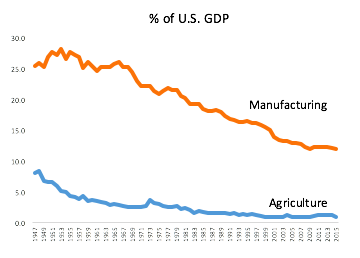
Working class America doesn’t want to be management class or professional class or any other class either. Like my team, they want to work. They’re not poor. And they’re not unsuccessful. And they want to continue to be the backbone of our country. They want to continue to be the most productive, efficient and effective group of humans that has ever gathered. They don’t wish they were me, peering out of my Silicon Valley tech firm office surrounded by walls of white boards with “big thoughts” on them. And they don’t want to be “in charge” either. We managers are stiffs. And we don’t know how to do anything useful. And we don’t have any value unless we’re supporting them in doing what they want to do-build and maintain and fix America. It is perhaps the purest, most honorable desire a human can have: to work hard at important work.

screen-shot-2016-12-04-at-6-49-19-am
Source: Bureau of Economic Analysis

We’re not going back to making things the way we used to though. We’re not going to employ millions digging holes in the earth or sowing and reaping the harvest or rolling out the last century’s modes of transportation. Those days are gone. We’ve found other ways to make money. We’ve grown finance and healthcare and insurance and real estate and business. We’re about to retire an entire generation that saw their nation grow in strength and their economy boom for almost every year of their life. Their legacy will be fifty years where the only thing that was built was the computer technology industry, by a handful of men, in a small town in Northern California.

screen-shot-2016-12-04-at-6-52-08-am
Source: Bureau of Economic Analyis

There’s good news though, for those who want to work hard at important work again, even if it doesn’t sound like it. That good news is that we’re in a whole heap of trouble again. And by we, I mean planet Earth. China and India and the rest of the developing world are trying to make their world look like ours. And that’s a problem. That’s 2.5 billion people moving from 18th century American technology and resource needs to modern America. China appears to be interested in doing it overnight. That’s 2.5 billion people worth of cars burning gasoline, power plants burning coal and air conditioners busting power grids. It won’t work. And they don’t care because it won’t be them that runs out of the resources. And there’s only one way to stop it.

21st century America needs to look a lot more like what the people of 20th century America thought it would look like when we went from the first manned flight to leaving the planet and landing humans on the moon and flying back in a short enough span for one person to have seen both with their own eyes. From 1830, to 1930, we went from horseback and drawn carriage to flight sophisticated enough to use in war. Now, nearly 90 years later, most of mankind is still using some form of the same vehicles today that they used then, burning the same fuel. That life, won’t scale. And it’s not because I’m a tree hugging liberal who cares too much about the environment. It’s because of math. And because the nation that will win the next two hundred years is the one that figures out how make power without burning things. That’s the problem. And it’s not an optional one. That’s the good news.

Putting our strong working class men and women back at the center of what we do and who we are as a country means that we’re going to have to start building and making and maintaining things that don’t exist yet, not last century’s things or the things other places have figured out how to build at scale for low cost. When we do, America will once again be tangibly stronger, with better things and a more effective way to live than anyone else. That’s what makes a people great, what they do, not how they feel.

And if you can’t imagine a future where we aren’t burning things to make our power, than you can’t imagine the mandatory future. And if that’s because of your political or financial interests, then you need to go. That’s the swamp I want drained. Mr. Trump, if you’re listening, put your energy and your ego behind driving the change that wins the race for a different power source and you will be remembered for generations as the man who won the 21st century for America. History forgives quite a bit in exchange for outcomes like that.

If any of my three boys wants to throw on the blue coveralls and get to work turning wrenches and solving problems by fixing material things that actually exist, I’ll be damn proud. But if they choose to enter the professional life, the “management class” then I want them to understand that the life my generation chased, finance and law and computer innovation, won’t change the world the way our future needs it to. If they want to change the world, they need to get back to work in fields like engineering and science that enable greatness. Because if the best and brightest of our young leaders keep growing up thinking that they want to get into Wall Street or be a lawyer or even break into crowded Silicon Valley to figure out the next great app that makes our lives nominally easier, then we’re in trouble. Because we’ve decided once again, to stop trying to solve new problems and focused instead on making more money solving old ones.

Fifty years from now if we are a culture of bankers and business managers, then we’ve failed. Banking and management are enablers to greatness. They aren’t the greatness. The greatness that is America is the genius to understand how to solve real problems and the strong back to solve them. We are a nation that makes things.

Of Men and Ideas

Listen to the people in your world that vigorously disagree with you. Don’t try to change their mind. Don’t argue with them. Not yet. Not until you’ve listened. Just listen and seek to understand.

It’s a rare and difficult principle to maintain. I do try to get outside the echo chambers that agree with me as much as I can. But sometimes, I don’t know I’m in one until it’s too late. Recently, around October 8th maybe, I realized that I’d been in one for quite a while. It was one that told me that Donald Trump was personally too despicable to be president of the United States of America. Clearly I was wrong. Because I didn’t do that thing I just said to do. I didn’t seek to understand. I saw the man. And I dismissed him, with good cause to be fair. But I never dug down deep into understanding Trump-ism. I fought the man, never the idea. And that’s a problem.

So what is Trump-ism?

You can find the answer wedged somewhere between Scott Baio and Jerry Fallwell Jr. telling Yo Mama jokes at the Republican National Convention this year. A man named Peter Thiel spoke. Thiel is a billionaire Silicon Valley businessman who is one of the few men in the world who have founded multiple billion dollar corporations. He sits on the board of directors for Facebook. He counts people like Elon Musk as his partners and peers. And if there’s a Mount Rushmore of the modern “dot com” business ecosystem, Thiel is on it. You could write ten thousand words on what’s right and wrong with Thiel and still not be done. You could write another ten thousand on why he doesn’t fit any molds that we like to put people in. I’m not going to do that here. But I’m familiar with him. And as someone who works in the tech world and moves in the Silicon Valley circles, I can get you pretty far with a few sentences.

Peter Thiel has had success listening to what everyone is saying and doing, and going and finding something else, building it before anyone else does and winning before there is competition. He asks aloud in his books and speeches, and urges us to ask ourselves, what truth do you believe, that almost no one else does? It’s a hell of a question, especially in business. He is, after all, Silicon Valley’s contrarian. If you want to know more about him, Google him. There’s loads of stuff, much of it ugly and negative. But as far as this discussion goes, that stuff, is noise. Because it’s fighting the man again, not the idea. His ideas, though, are at the emotional center of Trump-ism, whether or not he ever intended them to be. They can be summed up in two Peter Thiel quotes:

“For a long time our elites have been in the habit of denying difficult realities. That’s how bubbles form.” Thiel is the anti-bubble.

Yes.

People incorrectly believe that “If you don’t conform (to diversity), then you don’t count as diverse. No matter what your background”

I love it.

When I read those quotes as a business leader and someone who has worked on my own start-up, I get pretty fired up. It evokes emotion. It stimulates me. They are powerful words that speak directly to the psyche of change makers-people who want to drive to a better tomorrow. And when I posted those quotes and his name on my Facebook page without commentary, I got a very heavy dose of feedback about Thiel being a white nationalist and an anti-semite and a rape apologist and an opponent of the free press. All of which may be true. I don’t know. I’ve never been in the same room with the man. But none of the dissenting commentary addressed the ideas he had. Because in a vacuum, they are ideas that are nearly impossible to discredit.

We don’t live in a vacuum though. And right now, those words are being spoken in the Trump-ist echo chamber with great excitement.

So what exactly is that truth Trump-ists believe that no one else does? Except all other Tump-ists of course. Steve Bannon, chairman of Breitbart News and recently appointed chief strategist of Donald Trump’s administration can help explain it. Now, it’s possible that hearing the words Steve Bannon evokes a blinding rage in you and a need to spout out a laundry list of grievances about white supremacy, misogyny and maybe even a twenty year old arrest report for domestic violence. And that’s fine. But realize, you’re doing it again. That’s the man. The man is easy to beat. The idea, well, that’s another thing all together.

So here’s the idea in his words.

America is in “a crisis both of capitalism and the underpinnings of the Judeo-Christian west in our beliefs.”

Bannon says that crony capitalism and globalization have eroded the stability of our country and weakened us to the point of crisis. Whether or not he believes it matters far less then what it means. Thiel and Bannon are Trump-ism. They form a combination of contrarian, anti-elite non-conformists, conforming together behind the belief that the key to restoring righteous capitalism is a focus on the return to a Judeo-Christian led world.

If not…it’s going to be China for a hundred years…

That’s the idea. And it comes in the form or a red hat, and a slogan.

It’s powerful idea. And it represents one side of the modern political argument in America today. You couldn’t have sent a worse champion than Hillary Clinton to strike it down if you tried. She was perfect if you were fighting the man. But she wasn’t fighting the man. She was fighting the idea. And she was powerless against it. Perhaps if we had taken the time to understand the idea, we may have thought differently. Perhaps that’s why the Democratic National Committee is in ruins, when most of us thought that it was the Republicans on the edge of oblivion.

That doesn’t mean Trump-ism is right though. In fact I believe it’s quite wrong. But it took a little digging and understanding to get there for me. And in order to do that, you have to be willing to divorce the ideas from the men saying them, especially since some of those men are only saying those ideas because they know they are the ideas that work right now. Because the ideas are not wrong because of the men saying them. The ideas, by themselves, on their own merit are wrong. Dangerously so. And we need to start screaming from the mountain tops why.

First, intended or not, the core argument of Trump-ism, Judeo-Christian leadership of the world, is a substantial part of the argument that white supremacist groups use to further their message. Trump-ism left off the part about racial superiority. Those groups gladly add it back in. And when you deliver the Trump-ism message, and you are willing to accept anyone who believes it, without strong condemnation of those specific groups that add racial superiority to it, it provides oxygen for them to grow and breed and start to normalize and call themselves things like “Alt Right”. And then they form groups that sound snappy like The National Policy Institute. Make no mistake about it.The National Policy Institute is a white supremacy organization. If you can’t get a couple hundred of your members in a room without a bunch of them throwing out Nazi salutes or yelling sieg heil, and the first Op-Ed on your pretty web page is about the folly of desegregation in schools, then you are a white supremacy group.

You can call yourself something else. And you can ooze into the room with lots of other dis-enfranchised people and tell them you are the same. But you aren’t. And unless the leadership of the new Republican Party denounces it and cast it out of their numbers, a dangerous political discussion is on the horizon. Because whether or not to denounce and eliminate from prominence groups that further white supremacist ideology cannot become a political debate.

Secondly, because frighteningly the first part isn’t enough, if the “Judeo-Christian” portion of your message really is the whole message, than that’s a problem. Because that’s not American. America, imperfect in her ways, has been defined by relative inclusivity. Our strength has come from differing people coming to us from places with their ideas and their drive to build something. And my opposition to Trump-ism is grounded on the belief that I’m not willing to give on that. Not because I’m full of love and togetherness and because I’m naive to those out there that want to do us harm. I’ve fought them all over the world in places you’ve probably never seen doing things you’ll probably never do. I’m not willing to give on that relative inclusivity because turning inward makes you weak. And ignoring the skills and ideas that others have, and forcing them to seek other places to have them, makes others stronger. My message of dissent is about making and keeping us strong.

It pretty simple for me.  If that big idea that you have that no one else agrees with, that Peter Thiel disruptive change the world for the better idea, is that the words penned in our Declaration of Independence or in the Bill of Rights are wrong, that all men aren’t created equal and that only some are born with liberties and the freedom to pursue their faiths, then fine, let’s have that debate. And let’s have it in earnest. The fact that middle America, my strong patriotic brothers and sisters that took up arms with me to fight Islamic fundamentalism and other ideologies that threatened our way of life appear willing to have it, hurts me. It hurts me down to my soul. Because I believed, and I still need to believe that we are better than that. And that the principles that I swore to defend with my very life didn’t only apply to me and people like me. They applied to everyone.

So let the debate begin.

Once, We Were Many

The progress of humanity has taken many forms. From society to faith and religion to exploration and technology, we are beings in movement. We are defined by our movement. And though there are many streams of progress, the general path of man has been a slow, methodical march towards one world. Where we were once millions of families, we were then thousands of tribes, then hundreds of nations, then dozens of empires. And eventually we became a new world and an old. And now, connected by information technology and decades into our first truly global trade market, east and west, are collapsing into one. The journey, millennia in the making, is nearer to that end-one world- then perhaps many of us are willing to admit. That is the natural progress of man. And denying it doesn’t change it any more than drawing the blinds to block out the sun makes it night.

The natural progress of a person, one individual, is different though. By ourselves, we are inherently distrustful of outsiders and susceptible to having our passions raised by those who point blame towards the few among us that don’t fit in. And when our passions are high enough and we hurl that basic human instinct to turn inwards in the face of adversity against the natural progression towards one global society, we create friction. And sometimes if the friction is great enough, we stand still. But the halt is only temporary. Eventually, the tectonic plates of progress move forward, fueled by the man made powers of free markets, trade, technology and innovation. The longer we hold them in place, the more severe and unnatural the opposition, the more violent the eventual movement becomes. History teaches us this.

When economic and racial friction impeded the progress of abolition and the anachronism of slavery existed in post industrial revolution America, the snap back was violent. It cost us over a half a million lives and destroyed the economy of the south for a century. When ultra nationalist fascism existed in the culturally integrated melting pot of Europe, the friction it caused was the most devastating global war in the history of our species. The world lost 28 thousand people a day for six years to that violent end. This is the cost of resistance to the path of humanity. And as constant as the force of progress has been, the friction of that resistance has also been constant. The only variable is how long we allow the friction to halt it. And then, how violent the return to progress is.

ISIS, for the people of Iraq and Syria, is the violent end to a halt of progress hundreds of years in the making. BREXIT is the beginning of another one. And the 2016 U.S. election is another. Yes, the 2016 U.S. elections and ISIS and BREXIT are different flavors of a similarly structured message-trouble is coming, turn inward. And though they may feel like a failure of the liberal or progressive movements to continue the unfettered march towards social progress , they’re not. They are a failure of adherence to conservative principles.

Conservative government principles are about people limiting government through liberties. Not government limiting people through fear. And conservative ideology is not most effective when it halts progress. It’s most effective when it insists that progress is thoughtful and focused. We’ve forgotten those principles. Because we’ve lost our nerve.  And when conservatives lose their nerve,  fundamentalism, that troubled offspring of conservative thought that fills the vacuum created by the absence of courage, seizes us. The return to fundamentalism, is what precedes the pauses to progress that history teaches us, never end well.

I’ve heard, more times than I can count, that the result of the last election was was caused by the Democratic party losing touch with middle America. Well, it’s been a long time since the Democratic party was in touch with middle America. A more likely cause was that it was time for a return to conservative leadership after eight years of progressive executive movement. It’s damn hard to hold the White House for twelve years. And when the opportunity for change revealed itself, it found a people wandering lost among the prairies following voices on microphones over the airwaves and talking heads on their television instead of strong, conservative leaders of character. Absent were the men and women willing to take conservative approaches to solving the world’s problems instead of tucking their heads into the sand and walling off America from the outside world. Courage lives in the future. Fear and weakness live in a desire to return to the safer days of old.

We elected an American fundamentalist message masquerading as a message of strength. And so we shouldn’t be surprised when the team formed to deliver on the promise of that message is laden with American fundamentalists. Perhaps you’d hoped for different. Perhaps you should spend a moment to ask yourself why. Why did you think it would be different than what it’s turning out to be? You might find that perhaps your willingness to accept was less about optimism and principles and more about fear.

If you’re relying on the opposition to keep the surge of American fundamentalism at bay with sensational headlines of “white supremacy” and “misogyny” remember how well that worked in the general election. It’s easy to ignore the opposition. So that’s what America will do. As only a failure of American conservative leadership gives birth to American fundamentalism, so too is it true that only strong American conservative leadership can be its end.

Senate confirmations are coming for the newly selected cabinet of the president elect. The election is won. Silence is consent. And you don’t have any excuses any more to sit idly by and watch the conservative light fade into the distant memory of the American mind.

Be wary of who we trust our society to. Ideas like liberty and equality are exactly that. They are ideas. They are abstracts that have bound our people together. And they are powerful. But they’re not invincible. And they’re only permanent, if we believe them.

The world is watching.

What Now?

I’m not a liberal. I’m not a safe space, social crusader.

I’m not a sore loser who can’t get over the fact that Hillary Clinton wasn’t elected president. The notion that I had to put what lukewarm support I had for a candidate behind her was a source of great frustration for me.

I am, at my very core, someone with conservative foundations.

I believe that men and women, whenever possible, should be free to live their lives without government intervention. My family and my Christian faith are the center of my life. I like my guns. Chances are, I’m better than you at using them.

I’ve worked with and for the toughest most dangerous men on the planet. Men you’ve read books about. Men you’ve seen movies about. I’ll never claim to be one. But I’ve proven myself useful in their presence. I share this with you so you understand where and who the message I’m about to deliver comes from.

I’ve been all over this planet. And there’s a troubling observation that I’ve made on my way. It’s that mankind, when left to our own devices, does not naturally accept different people. Whether I saw Sunni and Shia in Iraq refusing to recognize the humanity of the other because of relatively nuanced differences in their common faith, or tribal warfare and genocide in sub-Saharan Africa or racial oppression and modern slavery of East Asia, the ingrained need to divide and subjugate others is ever present. In mankind’s darkest moments, the most common culprit has been that division.

For most of the last seventy thousand years, since the cognitive revolution of man drove us to organize, we’ve programmed ourselves to trust and support those that are similar to us. The result is that there have been frighteningly few societies in the history of mankind which have not been separated by either race, class or gender.

Where there is one race, we make caste systems.

Where lack of structure provides no castes, we subjugate gender.

It’s as consistent across time and region as the number of our limbs or the shape of our organs.

Fifty years ago in America, we made the first real effort, at scale, in the history of man, to change it in a society as diverse as ours. And since then, we’ve made great but imperfect progress. The work isn’t done. But we’re further than where we were 50 years ago. When we get there and make good on the promise penned by our forefathers, it will be the greatest, rarest accomplishment in our history.

On Tuesday, we took one giant leap backward on the arc of our journey to one people. And over the last four days, I’ve been bombarded by explanations of why Donald J. Trump was just elected president. I don’t need any more. I didn’t need them in the first place.

I know why he was elected.

He was elected because the only message that matters for the American government in 2016 is a need for change. And when the alternative to that change was someone who moved into the White House when I was fifteen, (I’m 40 now) that choice was clear for some.

But it was a choice.

And the ultimate choice that was made, the one people will remember a hundred years from now, was a willingness to ignore personal decency and fair treatment towards people who are different in service to that change. That was the choice that the minority of the American electorate made. That was the choice that about a quarter of eligible American voters made.

I’m not here to argue the legitimacy of the results. And I don’t get to pick and choose whether I support democracy because of the outcomes. I won’t tell you that you are a racist or a bigot if you voted for Donald Trump. I won’t even tell you that you personally are indecent. But I will tell you what you just bought with your choice.

You bought a very vigilant, sensitive and loud American majority who will cry foul at the drop of a hat for anything that resembles attacks on those we have fought so hard for these last fifty years.

Because what you showed us with his nomination and your vote in the election, is that you can’t be trusted to do it without us.

Many of my devout conservative friends were remarkably quiet when their candidate trashed their personal values. And they were remarkably quiet when their candidate made inexcusable first hand remarks about minorities, women and disabled Americans. And they were remarkably quiet when the dark forces of white supremacists aligned themselves in support of their candidate.

I understand why. You couldn’t live with the alternative. So you rationalized out of fear that speaking up would enable it. Well, that risk is gone now. You avoided the end you couldn’t live with.

That excuse is gone.

And now it’s fair to say that tolerance of that behavior from here on can only be seen as an endorsement of it. So when there’s a KKK rally in North Carolina to celebrate the election of the candidate you support, you no longer have any excuse not to condemn it with the same uncompromising vigor that you condemned Hillary. Let’s see the memes. Let’s see the Facebook posts. Let’s see the outrage.

Perhaps the rest of America can trust you to hold the leader of our government to the change you so uncompromisingly sought. But we won’t trust you to look out for our fellow Americans who are different.

So, get ready for four years of vocal, loud, peaceful I pray, dissent. If you thought the core Trump supporters would be loud if Hillary Clinton won, what do you think is going to happen now that you’ve  marginalized a group that has much more to lose than freedom from background checks for guns and a ten percent lag in wage growth?

At stake for them, is participation in our society. And if their vocal insistence on it is something you aren’t willing to tolerate, then perhaps you might consider a different path in thirty months when you get to choose your next leader without the looming evil of Hillary excusing your choice.

You can’t point to her any more as cause.

If insistence on decent treatment of all Americans makes me a liberal in the eyes of conservatives, then maybe we should take some time to reflect on who our modern conservatives actually are. The world is watching.

So What Did We Learn?

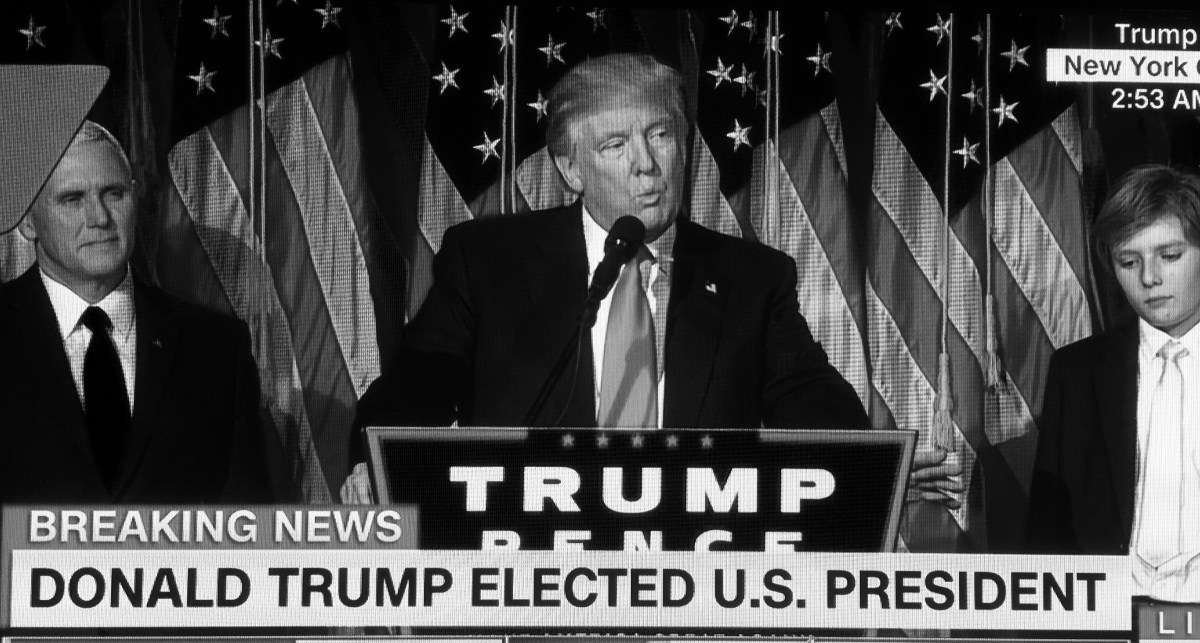
As the exhausted, miserable people on my television reported that Secretary Clinton had conceded the election by phone and our new president elect addressed his constituents for the first time after the political upset of an American generation, I sat up in my bed, quietly trying to digest what just happened. My wife, a woman of Mexican descent, a mother to a special needs child and a military wife who suffered through three wartime deployments nodded off in disgust a few hours earlier. I’ve already started to make my peace with it though.

I’ve been about as vocal a critic of Donald Trump as anyone you’ll find. I can’t and wouldn’t revise anything I’ve said about him. But I make it a point to stay objective about things. And to deliver a level headed clear-eyed assessment of things that matter. And right now, before I make that peace, I’ve got to account for a few things that I know now, that I didn’t know four hours ago.

So here goes…

-Donald J. Trump is the most effective political marketing machine of our time. It’s not close.

-Crowds mean more than polls. In retrospect, that makes sense. But I was stone cold dead wrong on it.

-There’s still enough white working class men out there that if you make an election a referendum on their value as a part of America, you better have them on your side.

-No one gives a rip about third party candidates. No matter how much more qualified they are.

-Many white men-and women-are more comfortable with the idea of a black man being president than a woman.

-Hillary Clinton is un-electable.

-The message of change is the only one that matters.

-The people still choose the president.

-This actually wasn’t close. (Trump won every contested state)

-We know nothing. (I actually knew that one already.)

Tomorrow, in a few hours, the sun will come up in America as it has for centuries. And things will go on uninterrupted. We’ll get the kids off to school. I’ll sit in traffic forever and I’ll think about a few things. I’ll think about what it all means and about what’s going to change about what it tells us about ourselves as a people. I’ll think about what to tell my kids about our president. Big problems. Big thoughts. Big questions.

There’s one other thing worth noting though. For the first time in my life, Donald J. Trump and I are on the same team. And I don’t know what to do with that other than hope like hell that he’s the best God damn president of my lifetime. Because there were dark and frightening powers that helped this come together for our new president elect. But there were also good and decent people who believed that this was their best option to drive change in our political process. And the only way that we get through this in one piece is for those good and decent people to help hold our new leader accountable for delivering on what they saw in his message-a  change for the better from the political status quo.

Democracy…warts and all.