Fear and Immigration: A Journey Through America’s Sense of Self

The American story is one long continuous struggle to expand our sense of self. Our charter identifies our union as an establishment of the people, by the people, for the people. In that we have been universally consistent. The grand internal struggle has been and still is answering one question.  Who are the people?

The great civil rights saga of the past 230 years has played itself out in the form of protest, legislation and even war. Nowhere is this more clear than in the evolution of our immigration policy.   Few things serve as a more accurate proxy of our collective efforts to include or exclude than how we guard access to our most sacred gift of citizenship. One underlying theme flows through our past though.   Exclusion gives way to inclusion, and our country grows in strength and relevance. We’ve long since determined that the eligibility for the honor of being ordained American lies not in one’s specificity of race or national origin. Hundreds of years of painful, sometimes violent, change has beaten back that particular call for nativism into the dark corners of our society. Instead we have but one more hard question to answer. And this question sits at the heart of our 21st century immigration debate. How should one become one of “We the people”?

Understanding that we Americans have varying degrees of comfort with the concept of inclusion, it may be hard for some to accept the theme that exclusion giving way to inclusion is universally positive. Taking a little time to study the language of our legislation and the light it sheds on the horrifying ideologies that motivated it can help with that. Here’s what happened over the first 180 years or so.

The United States Naturalization Law of 1790 granted citizenship to free white persons of “good character.” The emphasis of course being on white.  We were less specific about the metrics of good character. We added all people born in America with the 14th Amendment 80 years later after we killed about 600 thousand of each other to solve the question of slavery.

In 1870, we included “aliens of African nativity and persons of African decent” but excluded “all other non-whites” from citizenship. It’s not particularly clear what is included in “all other non-whites” but it was implied that it meant everyone else…in the world.

By the 1890’s we opened the floodgates at Ellis Island and started to realize that we needed a national strategy for immigration. After all, our citizenship laws were pretty basic. White’s and blacks are in.  All others are out.  There were a lot of other people out there though so we needed to take action. Enter the immigration Act of 1917. The act was specific in barring, “homosexuals, idiots, feeble minded persons, criminals, epeleptics, insane persons, alcoholics, professional beggars (amatuers were fine), all mentally or physically defective, polygamists and anarchists”.  And one other group….all Asians. Previously only Chinese were not allowed to immigrate. We let them back in 1943.

By 1921, we shifted to an emergency quota system, which allowed up to 3% of any given national origin, as documented in the 1890 census, to immigrate to the United States. This sounds on the surface to be an equitable approach. Though somehow people of Asian decent still weren’t allowed to be citizens yet. Since most people in America in 1890 were of German, Irish or British decent, from 1921 to 1965, 70% of all immigrants came from those countries. We did make progress though. The Luce-Celler Act let people of Asian decent be real live American citizens in 1946. It also allowed for 100 immigrants a year from each Asian country.   Yes….100

Enter the Hart-Celler Act of 1965. This actually, for the most part, is our current policy of record. It focused on skills based Visas and immediate family of American citizens.

Oddly, there’s little mention at all in any of the immigration policies aimed specifically at Latin America.  Which is interesting because the term immigration in 2015 is almost entirely about Latinos.  Referring to the United States Census Bureau adds to the confusion because Hispanic is actually not a race according to them.  It’s an ethnicity.  I encourage anyone to read their explanation of the difference and make heads or tails of it.

If you’re confused and amazed and potentially outraged by this collection of facts and timelines, don’t fear, that’s normal. If anything, it strengthens my resolve in the belief that applying high level intellectual thought to the categorization of human beings isn’t a great use of our time.

So what does it all really tell us.  It tells us that our history on immigration and citizenship is not a straight line. Our preferences and policies bounce from one crisis to another with knee-jerk reaction to whatever hysteria is happening at the time. Without question though, when you read out loud the actual words of exclusion in our policies, it sounds ridiculous. Because it is. Nowhere in our history does it show a period of inclusion followed by horrifying social or economic outcomes as a result. Since we broadened the scope of our immigration allowances, we have seen a massive influx of people from around the world of different ethnic and cultural backgrounds. We are not, however, overrun by foreign-born people.   By 2013, 13% of people residing in our country were not born here. With the exception of the 30 years following WWII, 13% is entirely aligned with our historic norms. It’s usually been about 12-13%.  Certainly since 1965, innovation and economic growth have not been impacted. We have been and are still as relevant, profitable and prosperous as we’ve ever been. So what’s the problem? It relates back to our original question. How does one become one of “We the people”? In this, we actually find two problems. One of them isn’t hard at all, if we’re honest about it. The other is tougher.

The first problem: What do we do with the 12M undocumented immigrants presently living on our country?   This is not going to be a popular answer in certain circles but it’s pretty clear if you look at it through a historically contextual lens.  Which is what you do when you want to make a good decision. What we do is we find a way to make as many of those who are not here in a legal status, legal residents with the fastest path to citizenship possible. And we do it quickly.  They are already here and participating in our economy and our society.   60% of them are located in six states, Texas, California, Arizona, New Jersey, New York and Florida. Which means that for 44 of our 50 states, this is an issue in principle only.  This isn’t about skills either. They’re already doing the work that others won’t.  The engine of an upwardly mobile society fires best when those at the lower end of the socioeconomic spectrum are there because they just arrived; not because they’ve been held there by generations of exclusive and divisive policy (see Jim Crow).

I am also not forgetting that this group of people “broke the law”.   One of the wonderful bi-products of military service over the past 15 years or so, is that you get to see the world, one destitute wasteland at a time.  In doing so you truly appreciate the beacon of hope and progress that is the first world. Having had that experience, I will not begrudge any person who, assuming they’ve broke no other laws, simply does exactly what I would do if I were born into the hopeless poverty that these people come from. When we’re truly honest with ourselves, most people can find a way to accept that. Unless of course they are in the throws of the second issue.  Good old fashion fear. That issue will be more difficult to crack.

The fear of foreigners in our country is as old as our country. From the Alien and Sedition Acts of 1798, all the way up through our modern debate about undocumented residents, it has been present.   The level of fear, like the common ebb and flow of modern opinions tends to be related to our reactions to whichever event we’re closest to in our history. To highlight just how different our views can and have swung, check out a comparison of two national party platforms.

Platform 1:

We believe there should be local educational programs which enable those who grew up learning another language such as Spanish to become proficient in English while also maintaining their own language and cultural heritage. Neither Hispanics nor any other American citizens should be barred from education or employment opportunities because English is not their first language.

Platform 2:

To ensure that all students have access to the mainstream of American life, we support the English First approach and oppose divisive programs that limit students’ ability to advance in American society.

Surprisingly, both of these platforms come from the same party; The Republican Party. The first one was what Ronald Reagan ran on in 1980. The second is the one Mitt Romney ran on in 2012. By definition, both highlight the conservative view on the most basic of cultural identity aspects, language.   They also show that, even in the conservative circles, our points of view are highly subject to our national mood. And right now, our mood is still very afraid.

We’re 14 years beyond the terrorist attacks of 9/11 and quickly approaching, I hope,  the back slope of a fear peak. As we approach the great political debate that will be the 2016 presidential election, how can we have the most effective outcomes relative to immigration? Take the fear out of it. If we don’t we’ll get something that resembles the “birther” debate,  which has a special place in my heart.  I’ve actually lived in Kenya. Any person who is one generation removed from someone who figured out how to get out of there should be celebrated, not forced to show their birth certificate or called a religion that they’re not. Kenya, by the way, is about 70% Christian. As an independent, nothing turned me off more to the conservative cause during the 2008 presidential election than the layers of stupidity that was the “birther “debate.  So when it comes to immigration, let’s not do that.  When it comes to immigration, let’s be fearless. Because in war, business and policy, the motivation of fear is an absolute killer.   Replace your fear with thoughtfulness and perspective. The history shows it’s the path to prosperity and progress.


In Memory of My Friends

Freedom isn’t free. That’s the message playing out on my social media stream with heartfelt devotion this Memorial Day weekend in pictures of Arlington National Cemetery or flag draped coffins, reminding us, maybe for just a few days, that some have made the ultimate sacrifice in the name of freedom. And as a Veteran, I am deeply appreciative of the honor that my friends and family show my fallen comrades. They’re right. Freedom isn’t free. We pay for our freedom. We pay for it with our industry and our innovation. We pay for it with our compassion and our willingness to compromise in the name of the greater good. We pay for it with our commitment to pay attention to things that matter in service to exercising our democratic duties as Americans. Sometimes, when we must, we pay for it with the lives of our young men and women.   And so this weekend we honor them.

I would like to take our collective conscience a little further though, past honor and respect. Past gratitude, past reverence. This weekend I would like ask people to move past all of it and spend some time in conscious thought about what the cost of war is; the honest cost of war.  In our history, we have lost 1.2 million men and women to combat deaths. Of these dead, the logical majority were young people at the dawn of their membership in the brotherhood of mankind. The average age of the 58,220 Americans killed in Vietnam was 23.

What masterpieces of art, what forces of industry, what transcendent leaders and humanitarians were snuffed out well before their prime? What husbands and fathers, mothers and sons paid the ultimate bill for goods they never received? As has been the case through the ages, the youth pay dearly for the misgivings of our elders and their inability to find solutions without violent ends. In With the Old Breed, the most honest war book I’ve ever read, written by a true American hero who served in the hell of Okinawa and Peleliu, Eugene B. Sledge gave voice to our dead.

“I am the harvest of man’s stupidity. I am the fruit of the holocaust. I prayed like you to survive, but look at me now. It is over for us who are dead, but you must struggle, and will carry the memories all your life. People back home will wonder why you can’t forget.”

Freedom isn’t free. And so neither is war. Though we stand ready to fight to defend our freedom and our way of life, it’s not the only thing we fight for. We’ve fought for our security. We’ve fought for politics. We’ve fought for our economy. We’ve fought and sacrificed our countrymen for many things, not just freedom. In one of his earliest speeches of record, a 28-year old Abraham Lincoln captured a truth that 177 years later, when we’re honest with ourselves, we know to be true today.

At what point shall we expect the approach of danger? By what means shall we fortify against it?– Shall we expect some transatlantic military giant, to step the Ocean, and crush us at a blow? Never!–All the armies of Europe, Asia and Africa combined, with all the treasure of the earth (our own excepted) in their military chest; with a Buonaparte for a commander, could not by force, take a drink from the Ohio, or make a track on the Blue Ridge, in a trial of a thousand years.

At what point then is the approach of danger to be expected? I answer, if it ever reach us, it must spring up amongst us. It cannot come from abroad. If destruction be our lot, we must ourselves be its author and finisher. As a nation of freemen, we must live through all time, or die by suicide.

There’s still the same amount of ocean between us and anyone as when young Abe made his point. It has been a long time since American men and women have died to protect our freedom alone.

As for my generation of fighting men and women, we have a similar, yet different price to pay.  As it was for many of my graduating class from Annapolis, I was on my first deployment when this war started 14 years ago. Since then, over 8,000 men and women have lost their lives. And as callous as it sounds, that’s not a lot of death for 14 years of war. The American warrior is hard to kill these days. There’s another cost that we continue to pay out in much more subtle figures though.

After multiple deployments in the longest war in the history of our country, many continue to suffer the effects of long-term exposure to stress and trauma. Like a car stuck in drive, often the only peace for them comes when the tank is empty or they crash like my classmate Ben. Ben was a Marine Corps officer who served multiple deployments in Iraq. He took his own life this last March after suffering for over a decade with PTSD and depression. I didn’t know Ben well. I didn’t have to in order to know that he was the energy and light in every room he was in. Now that light is gone forever and the world is worse off for it.

For many of us, the environment we lived in put us in a state where we couldn’t stop chasing it. Every year at this time I am reminded of my friend and classmate Jeremy. Jeremy was a Force Recon Marine Corp Major with multiple hard deployments under his belt during the worst of the fighting Iraq and Afghanistan. Jeremy was a hell of a man. He was better than everyone at everything he ever did. If you knew him, you know what I mean. He died in a BASE jumping accident while on leave from the war. Jeremy was my friend and I miss him. He would have made a strong husband to a good woman or a mentoring father to a son or daughter. He’s gone now.  These are the more subtle costs of our modern war.  Less acute but somehow, more painful and cruel.

I am not a pacifist. I don’t believe that, as a nation, the activities of our military in the near past have been entirely in vain. I was a voluntary part of much of it. There are pictures of my teammates and medals on the wall of my den in the open for my kids to see and be proud of. I don’t wish that my country would lay down her arms and surrender the will to wage war in the name of our freedom, our interests or even our principles. I’m asking for something else. What I ask of my American brothers and sisters is that you take the time this weekend to consider something very important.

Ask yourself, when you formed your opinion about when and how our country should engage in armed conflict with foreign countries, did you put enough thought into it to bet someone else’s life on it? Have you truly taken the time to consider the honest cost of war? If you haven’t, try to spend a little time over the next few days to think about it. There are a few people I won’t be able to stop thinking about this weekend that you owe it to.

The Great American Economy: A Study in Data and Self Deception

Economy  noun econ·o·my \i-ˈkä-nə-mē, ə-, ē-\ the production, distribution or trade, and consumption of limited goods and services by different agents in a given geographical location.

When we ask the American people what their top considerations are in any congressional or presidential election, without question one of the top issues they raise is the economy.  From the definition above, it’s hard to actually imagine that people care about the economy in a literal sense though.  The theories and systems related to that which is described by the definition of an economy are best left to classrooms.   What people actually mean when they say “the economy” is that they care about aspects of our fiscal and monetary policy that actually impact our lives.  Fiscal being budgetary and taxation activities.  Monetary being activities conducted by the Federal Reserve that impact interest rates.  We choose to use the word “economy” to sum all that up in one average sized word.  We like terms that we can put in our back pocket so we can pull them out when required in discussion or debate to prove a point.   So the “economy” is what we care about.  And so it becomes top issue.

If you think about it just a little bit more though, you can actually give some purposeful voice to the demands of the people’s economy.  When you think about it in reasonable terms, and its important to be reasonable here because there’s quite a bit at stake, you can produce a pretty distinct list of exactly what we care about. To be even more precise, you can get to eight portions of the economy that we really care about.  Here they are in a somewhat particular order.

What American people want of their “economy”:

1. Income that keeps pace with inflation

2. Job growth equal to employment demand

3. Stable employment rates

4. Historically moderate tax rates

5. Affordable cost of borrowing

6. Participation in growth through investment

7. The ability to retire at a reasonable age

8. A safety net in hard times.

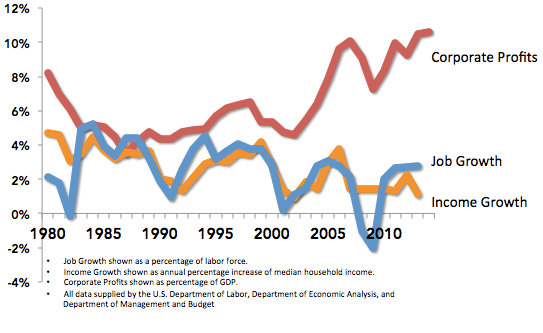
The good news is, we actually have data on all eight of these categories. When you throw economic theory and political principles out the window, you can do some unbiased statistical analysis.  So we did that.  We analyzed 19 separate economic categories that included government spending, income tax rates, interest rates, trade deficits, financial markets, GDP, budget surplus/defecit and corporate profits.  By simple correlation analysis, we can ignore the rhetoric and theory and look at simply what the data tells us.   So here it is both in raw form and commentary.

Screen Shot 2015-05-20 at 10.47.29 PM

What happens when taxes went up? 

People had less money.  But you didn’t need data to tell you that.  But interestingly, job growth increased and unemployment decreased.  The S&P 500 went up.  Corporate profits decreased, which makes sense, because they were paying higher taxes.  In the statistical world, we are always careful to point out that correlation is not causation.  Which means in lay terms, just because two points of data showed a pattern, it doesn’t mean one caused the other.  What we do know is that the data alone does not support the history of dire economic consequences from tax increases.  That doesn’t mean we have to like them though.

What happens when corporate profits increase? 

Surprisingly nothing.  Though profits increased with lower taxation, the growth doesn’t appear to materialize into wage increases, job growth or significant financial market gains.  From a data perspective, the only thing that appears to benefit from corporate profits, is well, corporate profits.  This isn’t a purposeful commentary about the evils of corporate America. It’s simply what the data says.

Screen Shot 2015-06-08 at 11.28.25 AM

What happens when corporate profits decrease?

We don’t know because it’s never happened.   Even during the great recession that started in 2008, corporate profits continued to grow at record rates.  What correlates to the spike in unemployment and the crash in financial markets is a slow down in the rate of growth.  Which means companies were more profitable during that time than in the years previous to the crash, they just weren’t more profitable enough.  And why did it slow down?  As far as the data shows, for no reason at all related to taxes, wages, spending, interest rates etc.  Which leads us to believe that free market forces of expansion and contraction dictate rate of growth; not taxation, wages, spending, trade, currency exchange rate etc.  Again, this is not principle or rhetoric, just data.

Do we spend more tax payers money when we raise taxes?

Oddly, no.  One of the strongest correlations in the entire analysis shows that we spend more when taxes are lower.  Clearly no one is arguing that when we lower taxes, we spend more because taxes are lower.  What we are saying however, is that the data shows us that we spend independent of how much money we collect from taxes.  Which is why our national debt is higher now as a percentage of GDP than at any time in our history.  The conclusion is that it has at least as much to do with historically low tax rates than it is out of control spending.

Is our spending out of control?

We do spend more than we used to.  The increases in spending exist in social security, medicare and medicaid, and social safety net programs.  People live longer then ever before and medical care that simply didn’t exist in the recent past presently does exist.  What we choose to spend on safety net programs is a choice. When unemployment spikes, our government spending does as a result.  Choosing to do so however appears to have no negative impact on any economic outcomes that we care about, other than supplying us with income and resources when we fall on hard times.  It simply means we spend more money.  Which matters, especially when you don’t fund it.

So what’s the “so what”?

What does it all mean?  The rhetoric around taxes and spending and how it impacts our lives is not supported by the data.  We certainly don’t like to pay higher taxes.  Nor should we.  But the increased costs associated with modern lifespans and healthcare are taking their toll.  And this is not because of the Affordable Care Act.  At least not yet. Most of this data comes from well before it was in place..  There is one important consideration though.  Whatever our political affiliation, we all agree that at a minimum, a government’s role is to exist and remain solvent so it can continue to govern. Which is a pretty low bar.  If you take this data seriously, and I do, you see that there’s nothing that actually supports the “trickle down” effect from lower taxes.  Which is actually good in one way.  It leaves us with a clear choice; to have the services that our government presently provides or to not have the services that our government presently provides.  Right now we’re choosing to have them and not pay for them because we’re hiding behind the rhetoric that choosing to pay for them would be bad for the economy.   The data doesn’t support it but our inability to have effective political debates in congress, or anywhere won’t let us get to that choice.  My guess, is we’d have some, divest of others and maybe even improve ones that weren’t working.  We’d be forced to prioritize.  That is, if we could actually talk about this.  Which we can’t.

This level of analysis isn’t particularly hard to do and the conclusions that it yields are strikingly conclusive.  They’re just not popular ones to advocate for because frankly, we can’t have honest discussions any more without being stuck in the irrelevant loop of “government bad” -v- “government good” paralysis.   Which puts us in the impossibly dysfunctional position of having more, paying less and not being able to prioritize anything until we drive off a cliff of insolvency.  Painful truths hurt.  So we don’t say them.  If we don’t want to pay for the social programs, then cut them.  But there will be no denying that we are cutting them in order to preserve the lowest tax rate in my life time. Or, maybe we try reviewing and prioritizing, like any organization on the planet that has a budget. But we can’t, because we’ve stopped talking.   And so the self deception continues and our deficit grows as does our compliance with our insolvency as a nation.  This one actually isn’t that hard. But it’s going to take a discussion.  And we can’t do that any more.

A Republic….If You Can Keep It

exceptionalism noun (ĭk-sĕp′shə-nə-lĭz′əm)

  1. The condition of being unique.
  2. The theory or belief that something, especially a nation, does not conform to a pattern or norm

How fragile is your appreciation for the country you live in? Is it something you could be convinced to abandon? Is it subject to a review of the facts? Is it natural law?  A recent bill, introduced by the Oklahoma State legislature, and passed preliminarily by the body’s Education Committee serves to give the State Board of Education the ability to replace the existing Advanced Placement History Course with a separate state approved curriculum that emphasizes more “American Exceptionalism”.   Presently, the language of the bill is being “reworded” in response to national criticism. The impact of the bill’s passing will likely be minimal; a more positive, yet reasonably factually correct version of American history for some kids in Oklahoma. The questions its proposal evokes, however, are more interesting. What is American exceptionalism? Where does it come from? If I don’t entirely agree with it, does that mean I don’t love America? I served to defend it in two wars. Clearly I love America. But why? If I dare to look in the dark corners of our past, do I still feel the same way? The only way to find out, is to do just that.  Here’s what you might find.

All men are created equal, but some have a denominator…..

Article 1, Section 2, Paragraph 3 of the United States Constitution, also known as the Three Fifths Compromise, is one we would rather forget. It wasn’t an accident. It was the outcome of a long, intentional, broadly argued and long digested debate on how to account for “non-white” persons in a state for federal taxation and representation purposes. The words as they were written:

“Representatives and direct Taxes shall be apportioned among the several States which may be included within this Union, according to their respective Numbers, which shall be determined by adding to the whole Number of free Persons, including those bound to Service for a Term of Years, and excluding Indians not taxed, three fifths of all other Persons.”

Read, black people and Indians are 60% of a person, written in the same ink as “We the People….”

Mostly Unalienable

How long did we wait to throw the Bill of Rights out the window? About five years. The Alien and Sedition Acts were signed into law in 1798 by President John Adams.   Less than a decade into our existence we had enough of “unalienable rights” and decided to extend the requisite time in country for citizenship from five to fourteen years and imprison or detain anyone in the country who wasn’t a citizen for just about any reason we saw fit. At this point in our country, we had a lot of people who hadn’t been here for 14 years. The country wasn’t even 14 years old. To top it off, we also made it illegal to say anything bad about the government in the press or in public. Fortunately, most of those acts expired in 1800, except one. The Alien Enemies Act is still in place today. It was used to imprison 100,000 Japanese Americans during World War II.

The One Sided Debate

Somehow there is actual debate about the role our country played in the elimination of the indigenous people of North America.   Using words like genocide, extermination or apartheid make people uncomfortable, especially in the land of the free. So instead of debate, I’ll offer you two facts. Do with them what you will. 1) The following speech was read by one of our more celebrated presidents, Andrew Jackson on Dec 6th 1830 in reference to the “Indian Removal Act”. He’s on the $20 bill.

 “It gives me pleasure to announce to Congress that the benevolent policy of the Government, steadily pursued for nearly thirty years, in relation to the removal of the Indians beyond the white settlements is approaching to a happy consummation. Two important tribes have accepted the provision made for their removal at the last session of Congress, and it is believed that their example will induce the remaining tribes also to seek the same obvious advantages.”

2) Prior to European and then American involvement in the territory now encompassing the United States, Native Americans represented 100% of the population. Presently, they represent 2%.

The Somewhat less than Supreme Court

On our way to ensuring there would be no way to wean us off our slavery addiction without unprecedented bloodshed, we run into Scott –V-Sandford, widely regarded as one of the most desctructive of United States Supreme Court rulings. Which is saying something when you consider the whole “separate but equal” of Plessy-V-Furgeson that set back racial equality about a hundred years. The Dred Scott decision, as it is more commonly known, basically made a slave’s freedom entirely unrelated to whether or not he presently resided in a state that prohibited slavery. If you were a slave, and you escaped and moved to a place where it was illegal to own people, legally, your previous owner could come and get you back. By force if he needed to. It may not sound like much but Dred Scott effectively provided Constitutional protection to slavery with the same vigor that it protected freedom of speech or the right to due process. Which is a big deal. Chief Justice Roger B. Taney, in writing his majority opinion outlined the risks that would arise from allowing states to determine the legality of passage of former slaves.

“It would give to persons of the negro race, …the right to enter every other State whenever they pleased, …to sojourn there as long as they pleased, to go where they pleased …the full liberty of speech in public and in private upon all subjects upon which its own citizens might speak; to hold public meetings upon political affairs, and to keep and carry arms wherever they went”

The court ruled 7-2 against Scott, who was really just suing for the freedom of his wife and kids.  It was a landslide by Supreme Court standards.

Freedom Fighters

290,000 men gave their lives to preserve the right to own slaves. To put it in perspective, more than a quarter of all American service men killed in combat in the history of our country gave their lives for slavery. I’ve heard from some of my brothers from the South, especially those of my military brothers from the south, that the war was about states rights. In 1860, after the Stephen Douglas, a moderate who would not support Constitutional protection of slavery, became the front runner for the Democratic nomination for President, delegates from the 10 Southern states left and decided to hold their own convention. Begin war. End discussion on states rights –v- slavery as it pertains to the origin of the war.

How Not to Avoid a Second World War

At the end of World War I, President Woodrow Wilson represented the United States at the Paris Peace Conference, which led to the Treaty of Versailles, effectively ending the war.   One of the pillars of the treaty was the League of Nations. The League, proposed by Wilson, was a precursor to the United Nations and represented an international framework with the aim of eliminating future wars between civilized nations.   After the treaty was signed, The United States Congress failed to ratify American membership because Republican Henry Cabot Lodge, Wilson was a Democrat, led a partisan campaign against it.   We never joined and the league was largely declared irrelevant.   We’ll never know if American membership in the League would have avoided World War II. It would have been nice to find out though.

Off to War…or something like it.

Since 1950, the United States has participated in active combat on a large scale in four countries, in which over 400,000 U.S. service members were killed or wounded. During the same time period, over two million men were drafted into service involuntarily.   The last time the United States Congress passed an official declaration of war was June 5th, 1942 against Bulgaria, Romania and Hungary.  Which means we’ve suffereed a lot of loss and heartache of war, without a war.   I mean this in no way to disparage those who served and sacrificed in these conflicts. As stated earlier, I myself served in two.   The truth is, when history fades our passion and the cold light of day is shone on our motives to wage combat, we tend to feel a lot better about those conflicts for which we put a little more due process behind. And it’s been awhile since we’ve done that.  

So What?

There’s a lot more chronicled catastrophe to be found if want to do a little research. But I think you get the point. There are parts of our history that we have no excuse for and not always because we forgot what our forefathers intended. Sometimes, we’ve gotten it wrong completely because of what our forefather intended. We’ve gotten it wrong so many times with such dire consequences that it’s a wonder we haven’t collapsed under our own injustices at one time or another. Our history is a testament to the power of misguided civic leadership and political zeal. I feel that point is fairly easy to make.  For those of you less tolerant of an assault on American exceptionalism, take comfort though.  It’s actually not my point.  If you fear the fragility of my love of country, like our esteemed representatives from the Oklahoma State Legislature, take heart.  Through it all, my faith doesn’t waver. Let me explain.

My love of my country doesn’t come from our historical record. It doesn’t come from the structure of our government or the paper it was written on 228 years ago. It comes from somewhere else; somewhere anchored in the bedrock of our collective DNA. It comes from the promise that was made, upon our conception. Like a husband promising to honor and obey his wife or a father holding his newborn child promising to always to protect, we made a promise as a nation, as a people to serve the interests of each other, without compromise.  And like all who commit to grand and unforgiving purpose, we fell and will continue to fall short, sometimes too frequently. If we’re worth our salt, we neither fear our shortcomings nor lose sight of what was promised.  Every day we move ever closer to the realization of that promise.

The Constitution of the United States is not a divinely inspired document weaving the framework of God’s intent for the governing of man.   The Constitution was and still is, an aspiration. It’s an aspiration to be fulfilled by its people for its people. As history shows, you can get it wrong. Even when you follow the rules you can get it wrong. Sometimes exclusively by following the rules you can get it wrong. Yet we struggle on with the spirit of that promise engrained in our souls, fueling the righteous progress and the mighty failures that dot the timeline of our history.  We have shaped the modern world for whatever it’s worth.  We are an inflection point in the trajectory of mankind.  But most importantly, we did it, as best we could, in the name of serving each other. Even if our definition of “each other” started far too narrowly, we knew the “pursuit of happiness” only worked if it was for everyone.    Which means we preserve it for everyone.  Benjamin Franklin was asked,  when leaving the Constitutional Convention, whether we had a Republic or a Monarchy.  He replied, “A Republic, if you can keep it.” For 228 years we have. A nation built for the people by the people; imperfect in our actions, pure in our intent. That is why I love my country. I fear no facts.  

The American Presidents….By the Numbers

In 1948, historian Arthur M. Schlesinger conducted a poll of 75 historians asking them to answer the question, who are our greatest American presidents?  Since then, and probably before, it’s been a pretty popular debate.

Though previous attempts to rank our presidents have been based on observation and opinion, the names at the top and the bottom of the lists are pretty consistent; Lincoln, Washington, FDR at the top. Andrew Johnson, U.S. Grant, Warren G. Harding are at the bottom. When you actually think about it though, it’s really an impossible question. Is Washington better than Lincoln? Probably not at winning the Civil War at least.  He owned slaves and had a penchant for leading uprisings against his government. Washington probably isn’t your guy in 1861. We’ll never know what speech Millard Filmore would have given the day after the Japanese attacked Pearl Harbor. Most of us will never know anything Millard Filmore said. I promise you though, he was our 13th president.

Circumstance plays a big part of it and so it becomes an illogical discussion.  So why do we do it?  Partially because debate is an inescapable function of the human condition. It’s what we do. We argue about just about anything we can compare. There is another reason though. A more practical one. We debate who our great American presidents are because we are bench-marking our current prospects. We are looking at the greats of the past to see the potential in our future and so we find value in the debate. Because we find value in the debate doesn’t mean that we are having the right debate though.

A more effective question is what makes a great president? And if we were to look at how we’ve evaluated them in the past the answer is clear. For the most part, it’s crisis.  The true great ones, Lincoln, FDR, Washington, led through periods of dire crisis.  Which begs the next question.  Do we really want the next great president? It probably sounds counter-intuitive but I hope I never live to see our next great American president.  I hope that great American presidents are over.  Great American presidents mean war, suffering, economic catastrophe and death.   So when we talk about great president’s, might we have the debate differently? Shouldn’t we shy away from desiring a great president and instead focusing on desiring a great presidency?  That’s what I’m rooting for.

With that in mind, we took a shot at looking back at our presidents through that lens.  We built an algorithm to see what the data says and then compared it to what history says.  The results were interesting.

The good news is that this is actually pretty easy.  Because you can  measure prosperity, progress and opportunity, things we would likely agree make for a “great presidency” by observing patterns in economic data, scope and scale of war, territorial expansion and Constitutional legislation.   So that’s what we did. The table below illustrates the rankings of American presidents by using an algorithm incorporating historically collected data.  The table compares the outcomes of the algorithm to the aggregated results of a dozen or so polls of historians regarding presidential rankings.   As you might expect, the data tells a different tale then the anecdote.

Score Algorithm Ranking Historical Ranking
100 George Washington 1 3
74 Ulysses S. Grant 2 37
73 Thomas Jefferson 3 4
69 Andrew Jackson 4 8
67 James Monroe 5 14
65 Bill Clinton 6 21
63 Ronald Reagan 7 17
63 James Madison 8 13
62 Franklin D. Roosevelt 9 2
61 Grover Cleveland 10 19
60 Rutheford B. Hayes 11 25
58 Dwight D. Eisenhower 12 9
57 Theodore Roosevelt 13 5
57 John Adams 14 18
57 William McKinley 15 20
52 Harry Truman 16 7
52 Andrew Johnson 17 41
52 James K. Polk 18 10
51 John Tyler 19 36
51 Barrack Obama 20 16
50 Lyndon B. Johnson 21 15
50 Woodrow Wilson 22 6
49 John Quincy Adams 23 18
48 Millard Fillmore 24 39
47 James E. Carter 25 27
47 George W. Bush 26 33
47 Calvin Coolidge 27 31
46 William Taft 28 22
45 George H.W. Bush 29 23
43 Franklin Pierce 30 40
42 Martin Van Buren 31 24
40 Chester A. Arthur 32 28
40 Richard M. Nixon 33 32
39 James Buchanan 34 42
37 Warren G. Harding 35 43
37 Benjamin Harrison 36 38
36 Gerald R. Ford 37 26
35 John F. Kennedy 38 11
22 Herbert Hoover 39 30
22 Abraham Lincoln 40 1
19 Zachary Taylor 41 35
17 William H. Harrison 42 38
14 James. A. Garfield 43 29

The data behind the comparison shows several things.  First, the algorithm and the historian polling are moderately correlated, meaning that the two lists are not entirely at odds with each other.  Immediately, some clear differences jump out at us though.  Here are some of the more glaring insights.

Where’s Lincoln? 

I challenge you to find a historian that does not include Lincoln in their top three on their index of presidential greatness. This algorithm, however, does not measure personal greatness.  It measures outcomes relative to the quality of life of the people being governed. Lincoln’s presidency was marked by unprecedented carnage through war, national crisis and ultimately assassination. It’s safe to say if we could have avoided it, we would have.  The numbers clearly show that, giving him the most significant historical overvaluation relative to the data.

There’s something else interesting though. You can’t really capture, through data, the accomplishment of paying off the debt of overdue societal progress. Which tells us that ignoring required change, like abolishing slavery, ultimately results in really lousy outcomes for the people who actually put their foot down to change it.  And though history treats them well, the lives of the American people, as they lived them, were miserable.  So if you can, change things before you have to.

Was Washington really that great?

Was Washington really worthy of the title father of our country?  The data says so.  He had the highest average economic growth of any two term president outside of FDR.  Despite our fledgling status as a nation and our relative inability to defend ourselves against foreign enemies, Washington managed to steer us clear of war.   He signed just under half of all Constitutional Amendments ever passed and he expanded the territorial holdings of our country from nothing to something.  The first eight years of our country’s existence could have gone terribly wrong but it did quite the opposite.  Washington oversaw prosperity, stability, growth and progress on a scale not duplicated by any president since.

Did we really get Grant that wrong?

Grant was a great general, but a bad president.  That is what I was taught in history class growing up and obviously what our historians voted as they ranked him the 37th ranked president out of 43.  The data shows something different.

Though recession hit during the latter years of his two terms, the recovery and post-Civil War boom actually show that America experienced 5% GDP growth annually during Grant’s two terms. This ranks him fourth among all two term presidents behind FDR, Washington, and Jackson for economic growth.  As a modern frame of reference, Reagan and Clinton, both uniformly considered to be fiscal successes as presidents, were both about 4.1%.

President Grant also governed during a period of relatively stable peace and even ratified the 15th Amendment providing the right to vote to African Americans, a significant political debate of the time. So why is history down on Grant? The headlines point towards corruption and the eventual recession of the mid 1870s. Data doesn’t measure corruptions.  Just outcomes, but it does raise an interesting question.  Should we care about corruption if it doesn’t hurt us?  I think we do but perhaps the lens is that it is more of a long term problem.  We shouldn’t tolerate corruption, even in an environment of prosperity because it erodes the fabric of our political discourse. And ultimately it breaks down.  Site Bill Clinton and the damage his character issues did to the perception of trust in our politicians.  More on him later though.

There’s something else interesting in the data relative to Grant. If you look a little deeper, we begin to see indications of what may have been influencing our historians in their selections. Of the presidents that have the largest historic undervaluation relative to the algorithm, the top two, Grant and Andrew Johnson immediately followed Lincoln.  Rutherford B. Hayes, who followed Grant, also cracked the top 6 of undervalued presidents. This group who ushered in the era of those labeled the “forgetful presidents” has been much maligned by history.  But they actually governed during a period of unprecedented growth and stability.  But we know growth and stability isn’t what we remember. We remember the other stuff.  It’s safe to say that Grant, along with Andrew Johnson and Hayes suffered mainly from a case of not being Abraham Lincoln.  History has never really gotten over the fact that America was robbed of being led through post-Civil War reconstruction by the hero that delivered us from near destruction as a nation.

What gets a president noticed?

James Garfield spent 200 days in office.  Despite that, historians have him ranked as the 29th greatest president.  That means, despite being in office for about as long as a single Major League Baseball season, Garfield is considered a more effective president than 14 other men by historical opinion.  Only two of those 14 also served for under a year. Which means Garfield, having done nothing at all, in a literal sense, is considered more effective than 12 other presidents who served in office for years. This includes two term Presidents Grant and George W. Bush.

How is that possible?  The pattern in the data is very clear.  Of the four most overvalued historic presidents, three were assassinated.  Lincoln, Kennedy and Garfield were all killed while in office.The fourth most overvalued president, Woodrow Wilson, was a war time president.   If you want the American people to remember you fondly, get killed in office or go to war. Both things, most would agree would be outcomes to avoid, if we could.


What about the new guys?

The algorithm doesn’t care about how recently you were president. Reagan and Clinton are both ranked in the top ten, having served two peaceful terms of economic prosperity within the last 40 years. Both also crack the top eight undervalued presidencies. Historians tend to need some water under the bridge before they feel justified in giving due credit. After all, they are historians.  The data says that President Obama is ranked 20, just four rungs below where our historians forecast his placement.  The data behind his predecessor, George W. Bush, hands him the title for the lowest ranking full two term president at 26. I have some particularly leftward leaning friends who wonder regularly how “W” got two terms. The data supports their concerns. To keep this discussion data driven and bi-partisan, the outcome of the “Hope and Change” promised by Candidate Obama has him looking up at President John Tyler. From a data perspective, Tyler had a more effective presidency despite his somewhat less inspiring campaign slogan of “Tipecanoe and Tyler too…”

So what?

In the end, the data is just another way to debate the question.  It’s an algorithm that was built by a person, which means it is subject to its own biases and inadequacies. What it does show is that there are patterns to our bias that data and analysis can point out. It also shows that data, while important, often misses the qualitative aspects of measurement, like the gross injustice of slavery that mandated Lincoln’s great national and personal sacrifice.  Or the scandal and clear instances of dishonesty of the Clinton era and the long term erosion of the confidence in government.  But the data does serve to offer a different perspective. It’s why we use data in business.  It’s why we use it in sports.  And now, more than ever before, data is how we make sense of our past and the world around us.

For me it brings our two critical insights.  And the first is that presidential performance is outlived by societal impact.  You can change, for good or bad, things that long outlive your term.  The second is that change is easiest before its needed.  And though we celebrate the presidents who force it under dire circumstance, the lives of Americans who lived through it are largely miserable.  So change things before you absolutely must.  Think social security, climate change etc.  If you don’t and you rely on the “great man” to do it for you, the fee is high for that service.

In the end, it’s data.  And data helps start the discussion.  If it ends there, it’s less useful.  But if you ignore it, you tend to start in the wrong spaces.