Binary Republic


Everything you see on this screen is a manifestation of billions of 1’s and 0’s.  It is truly one of the great discoveries of mankind.  If you create a large enough pool of binary inputs, and push those inputs down far enough into the most minute detailed elements of an environment, you can create complex computer programs that can do things. They can store massive amounts of information. They can talk. They can control airplanes and operate nuclear power plants.  They can monitor our health.  They can connect us to other humans.  We can make programs so complex, they actually start to mimic human intelligence.  But at their basic forms, they are still, 1’s and o’s.  Entirely at the mercy of our design.  Because we, as humans, have consciousness and the capacity for original thought. Unlike the programs we create, we are not binary by nature.  We are not forced into a variable of 1 or 0 by our designer.  We are unlimited in our capacity to explore and wonder. Our thoughts are limitless.  If you looked at my social media stream right now though, you wouldn’t know it.

More binary..

Within minutes of the San Bernardino shootings two weeks ago, threads started to appear on my Twitter feed advocating for stricter gun control laws.  As soon as Syed Farook’s name was released as the shooter, the Muslim-o-phobia thread took over.  Within 48 hours we had a burning debate about what was to blame. Was it guns?  Or was it Muslims?  When you really think about it, it’s kind of an odd point-counterpoint.  It’s like choosing between walking to school or taking your lunch.  It’s not really a choice. But it’s how the dialogue went, and still is going weeks later.  Like we have with so many other complex issues,  we’ve boiled it down to a binary debate.   Pick a side: Minorities or cops.  Health  care or liberty. Regulation or economic growth. Abortion or privacy….you get the point. It’s a thing that we do.   But why do we do it, when clearly we are capable of so much more?

Why so binary?

There’s a lot that goes into why we do this.  It’s actually not because most of us really feel this way.  There are forces at work here.  Let’s start with what it’s actually not though; our politicians.  Our politicians aren’t causing the problem.  They’re not helping.  But they’re not why it’s happening.  For the most part, they’re stuck in a somewhat binary loop themselves that they can’t escape from as a function of who they are and what they are charged with doing. They can either be for something, or against it.  They can’t be both.  We may desire to try to squeeze moderation into the mix.  But moderation doesn’t work right now.   Again, it’s not their fault.  There’s massive headwinds to being reasonable in politics.  And it’s not the political machine.  It starts somewhere else.

Our programmers…

Look no further than our $285 Billion media market.  You will hear over and over again that the Citizens United ruling of the Supreme Court in 2010 is ruining our democratic process by opening up campaign fundraising to corporations and other donors that are eliminating the voice of the people.  It’s become a “boogie man” for all things that are wrong with our political process.  Don’t bite that hook.  It’s a red herring.  I’m not saying we don’t need campaign finance reform.  I’m simply saying that campaign finance processes aren’t doing what we tend to say that they are doing.  Campaign finance money tends to exist in the tens to hundreds of millions of dollars.  Which sounds like a lot to you and me.  In a vacuum it is. When it comes to moving the needle of national consciousness though, it’s nothing.

Here’s something to consider.  The National Rifle Association, that massive evil empire and ultimate antagonist to democracy, spent $28.2M on campaign contributions in 2014.  It sounds like a ton of money.  In media land though, it’s nothing.  It’s $1.8M less than the cast of CBS’ The Big Bang Theory made during the same time frame.  It’s a million dollars less than the Washington Nationals paid their bullpen in 2015.  Which means that more money gets spent on relief pitching in Washington then gets spent on the gun lobby.  And the Nationals didn’t even make the playoffs.  If you’re going to get the attention of the media market, you don’t do it by throwing $28M at it.  You do it by doing things that American people can’t stop paying attention to.  You do it by driving clicks and ratings.  Because that’s what makes the media work.  And it’s not new.  But it is bigger than any other force in our political system and producing content at a scale never seen before.  And it’s sucking the oxygen out of every reasonable political thought we may have.  So they die.  And we’re left with what’s left.  Point and counter-point.  A 1 and a 0.  We’re being programmed.

The Human Binary…

We are addicted to outrage and conflict.  That part isn’t new.  Just like computer programs, outrage and conflict work best when you can focus them on the least amount of variables.  Clearly, you can’t have outrage and conflict with one perspective.  You need at least two.  And more than two is really hard to package.  It’s why team sports work so well. It’s why we have “pairings” for pro golf tournaments on the final day.    It’s why the main good guy has to kill the main bad guy in the end.  It doesn’t work if the villain dies in an unfortunate cycling accident en route to the gun fight. There’s no drama in that.   Conflict is delivered and consumed easiest in twos.  One against the other.  Good and evil…right and wrong.  Conservative and liberal…It’s what we’ll watch.  It’s what we’ll click on.

Here’s the problem with that.  These issues we’re debating aren’t sports and entertainment.  The media serves them up like they are, but they’re not. People’s lives are impacted by them.  These things matter but we’re not entirely sure how to differentiate them from entertainment.  We don’t have to settle for it though.  In fact, this stuff is too important to settle for it. We need to demand more of ourselves.

We’ve evolved past our basic nature in many ways.  When our urge for conflict was harder to feed, before the information age, when you had to go find someone who actually knew what the hell they were talking about in order to engage in debate, we did this better. As a result, our political machine was less polarized and more effective.  There’s good news here though.  We did this once. And we can do it again.  Because doing it is actually  pretty easy.  All you have to do is break the binary code. Break the programming.

What we have to be willing to do better to be better at what we need to be better at?

You can do that with the most powerful thing that we have, that computers don’t; good old fashioned human curiosity.  The greatest force the world has ever seen is our ability to wonder about something.  Wondering leads to questions.  Questions are most useful when we ask them to inform what we want to know instead of consume answers to other questions that are fed to us before we ask them.  When it comes to critical societal issues, there’s one great question you can ask to break the binary code.  One basic infinitely powerful question.

What outcome do you seek for this issue?

If you can try to refrain from jumping to what you believe is right and what is wrong, what you identify with and what you can’t, who is agreeing with you and who isn’t and answer that first magical question to identify the outcome you want for an issue, you’re on your way.   If we paused and did this in aftermath of San Bernardino, we would be two weeks into a much more productive debate.  Here’s what it might look like.

What do we want out of a resolution to the issue of radical Islamic terrorism?  I believe that the answer is that we want Americans to be safe.  Not just from Islamic terrorists. We want Americans to be safe…period.  Which means we have to spend a little time on defining safe.  One question leads to the next important one here.  Are we safe?  Relatively?

We would have to lose 15,000 people this year to radical Islamic terrorist attacks or gun violence to match the per-capita murder rate in 1992.  That’s how far violent crime has dropped in the last 25 years.   That’s about five more 9/11 attacks, this year.  Or, three San Bernardino attacks every day, for the whole year.  Just to get to 1992.  I remember 1992.  It wasn’t that horrible.  That’s not to say that this isn’t a problem. Or that we should be satisfied with backsliding to relatively more violent times.   Every single person who has lost someone will grieve forever at the individual tragedy they’ve suffered.  Nothing I can say can help that.  But if what we want is for Americans to be safe, it helps to understand how close we are to that goal.  The truth is, we’re kind of there already.  No matter what the media tells us.  The facts are clear. We’ve never been safer.

Now what?

We’ve broken the code. Our curious minds have taken us outside of the boundaries of the scripted debate.  Once you do it, you may never go back.  Because it becomes painfully clear that most of what we hear is just binary code programmed into our daily focus to drive a behavior that benefits those that provide it to us. It’s not designed for an outcome.  In fact, it’s designed to keep the debate alive.  It’s designed for clicks and ratings. You can choose to be a machine and follow it blindly.  Or be a human being and ask your own questions.  When you get to that point where you can decide what you want from something,  try to remember that there are a lot principles that we Americans hold dear as a part of our culture.  Not every one holds the same importance for every person.  When you are standing on a burning platform of outrage,  it’s important to understand if it’s actually on fire or not.  Otherwise you’re doing things like trampling on religious tolerance or threatening Constitutional rights because someone coded the debate for you ahead of time.  And we can be better than that.


The Good Old Days

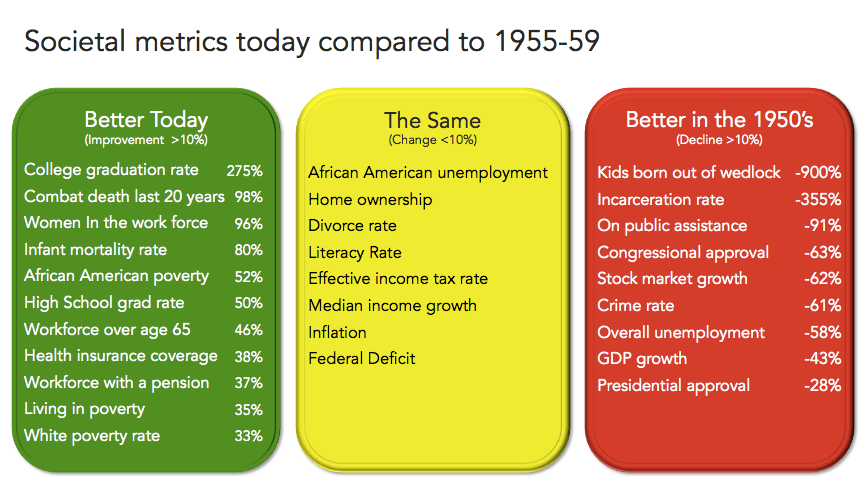
Screen Shot 2015-12-05 at 5.44.36 PMTable-1. Data compiled form the U.S. Department of Justice, Department of Labor, U.S. Census Bureau, The Pewe Research Center, The Brookings Institute and Gallup

You’ve heard it.  At some point someone you know has said it.  It may have been you.  But you’ve heard someone somewhere longing for the better times of the past.  A time in America where “traditional” values were embraced by all and we lived in a harmonious utopia, swimming in the perfectly temperate waters of civility that could only come from a simpler life.  A time when people treated each other better. Where we were safer and less exposed to the horrors that our modern world bestows upon us.  A time before the treacherous “next” generation had infected our stoic wisdom with dangerous thinking, loose morals, and a tragic lack of work ethic.  A time where America was great.  When today, she is something else. You know the tone.  It’s one part nostalgic and one part condescension.  It’s a sentiment that’s been around as long as our collective conscience as a species has spanned more than our own immediate horizon.  It’s what we do.  We long for the past.

For Americans, that time we long for is actually quite specific.  It still lives in the distant memories of our older two generations.  The “golden age” of America, the 1950’s, is that time that represents the zero, zero grid on the Cartesian graph that is America.  It was the post-war origin of our greatness.  The Garden of Eden before the apple.  But was it really that great?   Are we really that worse off today?

Taking a contextual look at the data can help.  So we did.  We took 28 societal metrics that were clearly measurable during the second half of the 1950’s and today and did a comparison.  Our findings, in Chart-1 above, were extremely interesting.  Of the 28 items, 11 were measurably better today than in the 1950’s. Eight were about the same, within 10% better or worse.  Nine were measurably worse.  Of the 28 metrics that can be directly compared, less than 1/3 of them were measurably better in the “golden age”.   The data alone isn’t enough to tell the story though.  But it certainly gives us a few places to start to look.   And it’s important that we do.  Because having an informed perspective about “what’s wrong with America” is a responsibility that requires more than whimsy and nostalgia.  It requires more than a bumper sticker or a snappy hat.  It requires fact in introspection.  Here’s what we found:

Family Life

Contrary to popular belief, marriages aren’t falling apart any faster now than they were 60 years ago.  The divorce rate is slightly lower today than back then.  Which is one of the more surprising metrics.  One thing that is happening is that less people are getting married.  Which has contributed in some part to what is the largest difference in all the data used in the comparison, children born out of wedlock.  In 2014, 42% of all children born in America were born to unmarried parents.  This is nine times the rate that they were in the 1950’s.  One of the more commonly politicized metrics is the present level of African American children born out of wedlock, which was 74% in 2013.  That’s a striking number.  There’s more to it than race though.  The issue is actually not being driven by any ethnic or culturally specific trend.  Since 1965, that rate that African American children are born to unmarried parents has tripled.  During the same time, the rate that children are born to unmarried white parents has increased by a factor of ten.

Peeling back the onion a little more, we see that in previous decades from the 70-90’s, the increase in unmarried births was in teenagers, which correlated to the decrease in the “shotgun marriage” practices.   More recently though, the increase is in women in their 20’s during the last decade and now women in their 30’s in the present decade.  Couple that data point with the fact that less people are getting married, and we see that the traditional American family structure has gone through a radical change over the last sixty years, most specifically because the institution of marriage is in decline.  And there’s a very sound argument that it’s not good.

A massive increase in children born to unwed parents is at a minimum, not great.  Not from a morality perspective, though for some, that is where most of the energy is spent on this topic.  It’s not great because of the outcomes it yields.  I’m not a big fan of statistics pointing out how children of single parents have lower graduation rates, higher crime rates and eventually higher unemployment.  That data is more correlation than causation because single parent rates have a perfect correlation to socioeconomic levels.  There’s an easier way to get to that conclusion though. It’s this.  Married parents are less likely to split than unmarried ones. That results in more single parents and reduces the resources a child has for income, care, involvement  and an almost unending list of parental requirements by 50%.  Which increases the amount of instability in a child’s life.

All this leads you to the hard fact that children born out of wedlock have less consistency and less income during their formative years then those born to two married parents.  And from an outcomes perspective, child development experts uniformly agree that consistency is the single most important aspect of a child’s development.   Which means that we really were in a much better place from a family perspective 60 years ago than we are today.

So what do we do about it?   I don’t really know.  As a person who appreciates liberty and limited government involvement in things like my family and personal choices, I’m not a fan of trying to legislate our way to increasing marriage rates.  There are many “free market” forces in play here, from workplace opportunity for women to daycare availability to cultural norms that are causing headwinds to the institution of marriage.  And one thing that I am certain doesn’t help is limiting who can marry who…in any way.   If we’re interested in growing back a family structure, let’s try not painting the institution of marriage in the irrelevant light of exclusion, bigotry and tradition.  You might find that the next generation of Americans value it more.  And that’s really the goal.  More people living within the structure of a family.  Anything else, really doesn’t help.

The Workplace

This one isn’t really even close.  We have more women and more diversity and more inclusion in the workplace than we did 60 years ago.  After decades of shifting from a manufacturing economy to a services and technology one, we’ve managed to maintain wage growth above inflation and delivered work environments safer than at any time in our history. We went through the great recession and that hurts our last decade worth of numbers.  Though unemployment over the last ten years was higher, comparing the great recession to the economic boom created by the post war reconstruction environment was a tough compare.  We’re back today from an unemployment and wages perspective where we were in a relative sense to where we were in 1959 though.  One of the things that jumps out is that we actually had a higher percentage of people working over 65 in the 1950’s than we do today.  Which is counter to the notion that no one can afford to retire today.   We even have more people receiving a pension today then we did before, though that growth is entirely in the public sector.  We have more people living longer after they’ve left the work force independently than any time in the history of our country.  This is good.  But as we’ll see in the next section, it doesn’t come for free.

Entitlements and Taxation

Almost all of our federal spending increase over the last 60 years has been used to sustain social entitlements.  Whether it be social safety net services, retirement income or medical expenses, government growth has been largely focused in this space.  This is one I’d actually prefer to explain with a needs and outcomes discussion, instead of a rhetorical rant about the evils of government.  Here’s how it goes.

In 1959, there were 177 Million Americans with a median age of 29.7 years old who lived to be 71 years old.  Today there are 320 million American with a median age of 36 years old that are going to live to be 82 years old.  That means that, as a society, we have to account for about 1.6 billion years more of retirement than we used to.  And we have six years less per person, to accumulate funds for it.  I know that’s a lot of numbers and confusing math.  But you can probably agree, 1.6 billion years of retirement is a big number.  So it stands to reason that we’ve got to figure out how to do that.  I’d love to say that the answer is to ask Americans to save more money.  And if you hear people talk today, they point to some time when that happened.  The problem is that history doesn’t support that option.  Americans have never saved to fund the type of retirement we think of in our aspirations.  When you look beyond the rhetoric here, you see that the notion of an independent, decades long retirement is something that never existed in any large scale sense in our country before the advent of social security in the 1930’s.  And even after that, it  existed in pockets of affluence and circumstance.  But not as a whole. So the answer to this problem has to involve some function of entitlement reform or increased investment.  The math is too clear for anything else.    And the problem of caring for our aging population is one side of this problem.  There’s another.

It is true that we now have close to double the amount of people receiving public assistance than we had in the ’50’s.  But we also have almost an exactly equal population living above the poverty line that lived below it 60 years ago.  That’s probably not coincidental.   Which likely means you likely have to be comfortable with one out of four Americans living below the poverty line, if you are comfortable with eliminating public assistance. I am not. There are however, pockets of our society that don’t seem to be moving past the choice of poverty or public assistance.  Our urban poor, which really means minority population, is disproportionately dependent on government assistance.

In 1959, 55% of African Americans lived below the poverty line.  I use that population as a proxy because we had no other reliable minority data that tracked back that far.  So what we’ve done, is move our urban poor out of poverty, which is good, we’d admit, and into dependence.  Bear with me here because this next sentence is going to bother some people.  I’ll take dependence over poverty.  Which I get is a heated debate.  I’m not interested in the risks that come with dumping a quarter of the population below the poverty line. Because large populations of poverty are bad. Really, really bad.  And not just for those in poverty.  They destabilize nations, they ruin economies they do a lot of things that I’ve witnessed first hand to make life and progress hard for  countries around the globe.  Massive populations in poverty are to be avoided at all costs.  What we have today is better than what we had.  But it’s not good enough.  And it’s not sustainable.   So something needs to be done.   But what?

When it comes to the social safety net, we should be prepared to dynamite the whole system in the name of something that works.  I’m not saying cut it out. I’m not saying make it less.  I’m not saying make it more.  I’m saying make it different than what it is.  Because what it is does not solve is our massive segregation gap that we have between our urban, minority poor and everyone else.  This will take some very “non-governmental” thinking though.  But please, let’s get past the two choices that we have now.  More of the same…or cut it all out so they can stand on their own two feet.  We need to disrupt the status quo.  And we can do that.  We’re Americans and we’ve invented or perfected most of the useful things in the world today.  Let’s get out of our own way politically, and aim the same passion that put us on the moon using slide rules and pencils at revolutionizing our social safety net.

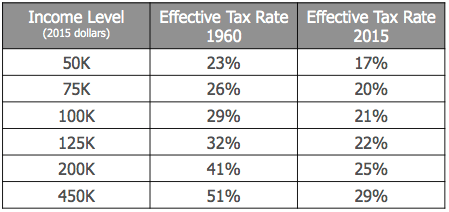
As for the retirement  problem, the math behind this is extremely difficult.  It’s hard to imagine how in the world we solve for this without changing it.  Either our retirement age has to increase or our investment does.  Or some function of both.   I understand that when we say investment, that means taxes.  And Americans have an allergic reaction to taxes.  So much so that we’ve told ourselves, with great certainty that a dollar earned today doesn’t go as far as it used to.  Which means that inflation is out of control.  Or taxes are.  Well, inflation isn’t, compared to wages.  So it must be taxes.  Actually, it turns out it’s neither.   Let’s take a look at the federal income tax rates from 1960 and compare them to now, as a function of income.
Screen Shot 2015-12-04 at 9.36.51 AM

Table-2. Data compiled form the Internal Revenue Service

It’s clearly, unarguably less today. When you take into consideration payroll taxes though, those things that we have to pay to fund social security and medicaid, it actually closes the gap between our 2015 and 1960 tax payments.  But it still doesn’t put us in a situation where the government is taking a bigger chunk out of our paychecks then they used to. Which is why taxation falls into the “same” bucket in our comparison above.  But we are asking them to pay for twice the social safety net programs than we used to and 1.6 billion years of retirement that simply didn’t exist before.  So something has to change.  This is one place where, from a quality of life perspective, things are much better today than they were in the good old days.  But from a sustainability perspective, we’re in a heap of trouble if we stay on our current path.  And trouble that is going to land squarely on my generation when it’s time to retire.

Crime

There’s more crime today as a percentage of our population than there was in the 1950’s.  According to the data from the U.S. Department of Justice,  you are 2.5 times more likely to be the victim of a violent crime today then you were 60 years ago.  The increases in property related crimes was more slight.  But oddly, the murder rate is the same.  Which means we’re assaulting and raping each other a lot more than we used to.  But we’re not killing each other more.   There’s actually an encouraging trend here in the data though.  Our violent crime rate in America hit it’s historic peak in the early 90’s.  Since then we’ve seen a dramatic decrease reducing modern violent crime rates to the levels of the mid 1960’s and trending towards the previous decades.  Despite the amount of high profile gun violence, we’re safer today then we’ve been in about 50 years.  With twice the population living in the same amount of territory.  So we should feel pretty good about it.

The issue that compares least favorably than any other issue besides children born to single parents is our incarceration rate.   We have 3.5 times the percent of our population in prison today than we did in the 1950’s.  And our population has nearly doubled.  To put it in even clearer perspective, we have 4% of the world’s population and 25% of the worlds prison population.  We have more people in prison than China and Russia combined.   And it started when we started putting people in prison for drug offenses.

In 1984, President Reagan signed into law the Sentencing Reform Act as part as the Comprehensive Crime Control act that mandated sentencing minimums and consistency federally.  This was a “tough on crime” bill for which two very clear data patterns followed.  The first was our incarceration rate almost immediately doubled. The second, was an immediate decrease in non-violent crime and an equally steep decrease in violent crime within a decade.  Mind you, one may not have caused the others but it’s important to call out data patterns because it allows us to say at least that the legislation did not make us less safe. And though it may not feel right, it does correlate to a period of decreased crime.   Which tells us that massive populations of incarceration are not a crime or safety problem.  They’re a societal segregation problem.  Because right now, when you go to jail, you clearly aren’t likely to commit a crime against society while you’re in jail.  But you and your family have opted out of most of the American dream going forward. Which is a problem for the last section.  Our social safety net.  I’m not sure the data supports reducing sentencing limits or legalizing drugs from a safety perspective.  But it does tell us we have way too many people in jail, and it’s contributing to the segregation of our country.

Global Stability

We can solve this one pretty quickly.   The first half of the 20th century was the most dangerous time in the history of mankind.  The second half, continuing on into the early 21st century has been the most peaceful.   Though the second half of the 50’s was free from war, we were about a decade removed from WWII and a few years removed from the Korean War.  During those two wars, we lost just under a half a million Americans. The world lost 60 million people.  Including the terrorist attacks of 9/11 and the 14 years of war that about 1% of Americans contributed in, and we’ve lost a little over 10,000 people to combat.  We’re not without conflict.  But no matter how it feels, the world is safer.  And it’s not close.

So What

There’s a lot of metrics that you could track down and a lot more that you could add to try to make a point one way or another.  But the bottom line is this.   Things were different in the “golden age” of American than they are today.  In some ways they were better.  But in more ways they were either worse or simply different.  Right now there is a large part of the American public, our media and our overall consciousness that believes that we’ve wandered off of a path to greatness and that we are far worse off today then we were then.   And that we need to return to “better times.”  I would issue a word of caution for those that hold that sentiment.   Both the data and the historical context are clear.  For a very narrow portion of our society, healthy white men, things were better.  If by better you meant you had no competition for work in an economy that was booming because of the impossible to duplicate post WWII reconstruction.   For everyone else, things weren’t better.  They were far, far worse.  I’ll play this out in a real world experience, mine.

I’m a pushing 40 white man with a graduate degree.  By all rights, I should look back at the 1950’s as a time that would have suited me fine.   But a closer look tells you different.  My wife, half Latina, would have faced some level of segregation in primary and secondary school for her ethnicity. Even if she made it past it and completed the two graduate degrees she has today, she would have no place helping homeless veterans as she does now, other than administrative support in the mental health profession. My mother’s four year battle with ALS that rendered her incapacitated for the last three, would have bankrupted my entire family.  My non-verbal, autistic child would be locked away in an asylum, the doctor’s would be recommending a lobotomy as his best path for treatment.   When I returned from war and struggled with anxiety and depression, I would have turned to the bottle and soldiered on in silence.  This is would have been my reality.  And I’m a healthy white man.  Which means I’m in the best shape out of any one.  If I were black, I would be in poverty and not allowed to eat or attend school with white people in most states.  If I were gay, I would be a pervert.  If I were handicapped, I had no path to independence or contribution in society.  This was the reality.   It was cruel and unforgiving.  And it makes for a bad bumper sticker.

As for the next generation, they’re fine.  They’re more educated and more technical than ever before.  And we’re right.  They wouldn’t last a minute on the assembly line in a plant.  Which is good.  Because we don’t have many of those these days.  Which is fine.  Because we’ve adapted to our role at the top of the global economic food chain as a services and consumption economy.  That’s how it works.  But they wouldn’t last a minute 60 years ago.   Just like their parents wouldn’t have lasted a minute in the coal mines and blast furnace of the generation before.  Just like that generation never would have lasted a minute scratching out a living off the land in an agricultural society.  Just like that generation of farmers wouldn’t have lasted a minute blazing a trail from sea to shining sea.   Just like that generation never would have had the guile to throw off an unjust government.

That’s how this thing works.   One generation judges the next on their ability to exist in the past.  And that generation learns the skills it needs to survive for the next fifty years.  And doesn’t learn the ones it took to survive in the last. But they’re fine. The kids I served with in war and now show up at my door in the big time technology industry can do things I can’t.  What I know, would not have gotten me hired at 22 today.  But instead of being scared of that, I learn what I can from them and help bridge the gap between what I know and have experienced and what they do so that we might walk across it to a collectively brighter future.  It’s called mentoring.  And when you do it, they listen. And when you whine about “kids these days” they don’t.  So give it a rest.  You sound old and scared.

So what does it all mean?  Well, as far as the political discourse it means this.  If you’re a progressive elected official, you can stand back and admire the social progress that you’ve help engineer over these last 60 years that has made life, liberty and the pursuit of happiness more attainable for more groups of people.  But there’s one thing that you can’t say and it’s that the social safety net that we have in place is moving people out of poverty and into financial stability.  It’s not working.   And you need to own that and help drive solutions in an economy where urban middle class jobs do not exist any more.

If you’re a conservative, you can congratulate yourself that we’ve managed to shoulder the massive load of providing government and services for 320 million people without taxing our constituents to death or crippling capitalism.  But what you haven’t done is find a way to do that without deficit spending.  And when you’re realistic about our aging, longer living population, you need to own doing something about our current revenue gap, or when my generation retires, the draw we will have on the broader economy will cripple us.  It’s simple math. And please stop with the “let’s go back to Mayberry” rhetoric.  Because it’s not real.  And for most of us we just hear thinly veiled bigotry and close minded thinking.  It’s not helpful.

For those of us who still suffer from the burden of free will with our votes, let’s keep an ear out for anything that starts to resemble that kind of discussion.  Until then, just keep tuning out the fear-mongering or blind compassion.  It’s not worth the mind space. We’ve got real things to solve.  And getting back to the “good old days” doesn’t solve any of it.


The Struggle of Conviction

War is a struggle of conviction.   It demands things of a people that nothing else can.  When we wage it, it is the ultimate expression of our collective wills.  More than our technology or our budget or the size of our standing army, our conviction determines the outcomes in armed conflict.  If it runs out before our ability to sustain arms, we lay them down.  If our ability to fight runs out before our conviction, we find a way to fight on in other ways until the flame of fury goes out.  History is lined with proof of this.  The German’s after WWI, growing in anger and dissatisfaction in its outcome would conquer most of the continent in retribution one generation later.  The conviction of the Confederate army, once destroyed,  lived on in the Jim Crow south for another hundred years.  The conviction of the Japanese people was so ingrained in their culture that it took the detonation of two nuclear weapons over hundreds of thousands of their citizens before they capitulated.  Right now we find ourselves once again engaged in a war with a group whose conviction runs deep.  As history tells us, there’s much work to do before we’re out of it.

There’s good news though.  We’re at war with a group that actually has  little power to hurt us. Though they certainly seem to have the ability to scare us, when we think of war and the potential outcomes that a people face when they are engaged in one, there’s not that much at stake for Americans these days.  That may feel wrong.  But it’s actually not.  How wrong it feels is a function of how effective the terrorists we’re fighting are at their core task of creating fear.  And this group is good.  This is where context is immeasurably important.

I don’t mean to devalue the sacrifices of those who have given their life in this conflict.  Loss of life has no minimum acceptable toll for those touched by it. But it’s important to help put them in historical context. When we talk about the impact on a collective people, it’s important to understand what the score is. During the six years of heaviest fighting of WWII, the world lost 60 million people to combat or the secondary impacts of it.  That’s about 27,000 people a day.   And it went far beyond just military personnel. Every aspect of life was affected.  Great Britain was on war reparations until the 60’s. 60 million people is a Paris attack every day for just under 1,3oo years.

In direct action, when you think about the ability of our enemy to hurt our armed forces, our relative safety is even more compelling.  After 14 years in active combat in Operations Iraqi and Enduring Freedom, we’ve lost about the same amount of Americans as we did in three days at Gettysburg.  In context, anyone living at any other period of war in American history, would view our current predicament as peace.

So why do we care about it?  Well, though it’s not Stalingrad, it’s still war and it matters. Those we’re up against are awfully good at the fear and mayhem game.  So it needs to be addressed.  But how?  It’s been a long time since I worked in the region that is generating our problems and I like to keep my opinions informed.  So when it comes to what to do about the Middle East, in Tom I trust.  As in three time Pulitzer prize winning journalist Thomas Friedman who has forgotten more about the Middle East than any ten people on the street will ever know.  Here’s what he said in his column in the N.Y. Times this past week.

“I believe U.S. foreign policy out here should progress as follows: Where there is disorder, help create order, because without order nothing good can happen. I will take Sisi (Egyptian’s military strongman president) over the Muslim Brotherhood. But where there is order, we need to push for it to become more decent and forward-looking. That is where Sisi is failing: His vision is just order for order’s sake, with no positive slope. Where there is decent order, like the U.A.E., Jordan or Kurdistan, encourage it to gradually become more open and constitutional. And where there is constitutional order, as in Tunisia, protect it like a rare flower.”

If you subscribe to Friedman’s point of view, “creating order” in areas like Syria and the al Anbar province of western Iraq, is a priority.  And that priority might require large scale military action. It also might not. I actually don’t know.  Like I said, I require my opinions to be informed and I’m not close enough to that world to know what right looks like any more.  My experience in a war in that exact place with the exact same people would lead me to believe that military force is required. But there’s something else that won’t address, and that something is the point that both Friedman and I are trying to make.  We’re at war with an ideology. And the conviction to define and wage war against an enemy is what you’re addressing by the commitment to establishing and fostering order and progress in the region.

But that’s the long game.  There’s something else we can do to help that. Something we can do immediately with no investment whatsoever. Something we have to do. And it’s simple. Be America. Not the one you’re seeing in our political discourse in 2015.  The America founded by the great disrupters of western civilization and the immigrants that flocked to her shores. The America made rich by her diversity and countering points of view. The America we were and still are capable of being.

That America is more tolerant and accepting of different cultures than any other place on the planet. That America was built by immigrants at every part of her history. That America has stood firm and sacrificed much more in the face of dire odds than we are asking of our people today. The amount of xenophobic intolerant rhetoric we’re seeing from our media, our current and prospective civic leaders and the painfully uninformed masses on social media is alarming. It’s not alarming because it’s incompatible with our values as a nation, though that’s true. It’s alarming because it is the engine of conviction that the enemy we are facing is relying on to strengthen their resolve and grow their force.

Every anti-Muslim meme, every racist tweet, every ounce of rhetoric is wind in the sales of our enemy, urging them onward. I have no idea what it feels like to be a young Muslim American right now.  I can’t imagine the conflict they must feel. But I can imagine, if you were sitting on the fence and maybe thinking of doing something radical as a homegrown threat, your social media stream probably isn’t doing any of us a favor. If this isn’t resonating with you,  I’ll offer you a different more direct challenge.

About 1% of Americans served in the two wars our nation has been engaged in these last 15 years. During the time that I did, every operation that I participated in was supported, led or entirely executed by Muslim allies, fighting alongside of my teammates in a combined struggle against the extremism that was destroying their society. I would ask those that choose to paint the 1.7B Muslims in the world, (1/4 of the world’s population) with the broad brush of extremism, a simple question. What were you doing when my brothers and sisters in arms were hanging it out there against the forces of evil these last 15 years?  Not as much as they were, so stop the noise. It’s not helping.  If you’re a civic leader, you’re supposed to be helping.

As for the Syrian refugee crisis, presently, 31 of 50 governors, both Republican and Democrat have openly voiced opposition to giving safe haven to refugees fleeing the conflict that we as a country helped create with our invasion and destabilization of Iraq.  No terrorist plot, hatched by Syrian refugees, for which there is no precedence for ever having happened in America, makes us less safe than rejecting these people in need. I’ve seen their plight first hand in that region and in Africa.  If you can look those people in the eye and turn your back in the name of a limited, low scale risk to Americans, how could any of these elected leaders look a service member in the eye, and send them off to war and into harms way? How far can our fear drive us from our values? I guess, when it’s an election year, pretty far.

One of the 31 governors, John Kasich is running for president.  He recently said that if elected, he would commission the creation of a Judeo-Christian government organization to help communicate the benefits of our “American” lifestyle to foreign countries in an effort to promote progress and stability.  He did this within days of voicing his opposition to accepting Syrian refugees. Many of those most deeply opposed to opening our door to these refugees hold true to the belief that our culture is a Christian one, though they also believe we have no requirement to open our door to those outsiders who may, in some future date, do us harm. I am a Christian.  One who ground to his faith by the hard consequences of war and disability. So I’ll use the words of my Savior in response.

The book of Matthew:   Truly, I say to you, as you did it to one of the least of these my brothers, you did it to me. 

or…

The book of John,  In this world you will have trouble. But take heart! I have overcome the world.

My faith is fearless and  charitable. And if my nation is too, the forces of hate and destruction stand little chance.   If we aren’t, we’re going to be doing this for a long, long time…


Paris in Fall

“You expected to be sad in the fall. Part of you died each year when the leaves fell from the trees and their branches were bare against the wind and the cold, wintery light. But you knew there would always be the spring, as you knew the river would flow again after it was frozen. When the cold rains kept on and killed the spring, it was as though a young person died for no reason.”

            Ernest Hemingway, A Movable Feast

Paris is an ancient city.   People have lived in the geologic formation known as the Paris Basin since man lived in Europe.  The Romans conquered the Celtic tribes living along the Seine two thousand years ago.  She would be conquered many times since.  Conquered by the Franks,  by the rule of Charlemagne, by the plague.  Conquered by the Catholic Church, by the absolute monarchs of the house of Bourbon.  Conquered by the Rights of Man that led to their bloody revolution.  Conquered by military genius and one last time, by Nazi Germany.  Paris is no stranger to crisis and defeat.   But there’s something very different about her, for she cares little about it.   Paris’ conquerors have conquered Paris the way a bird in flight conquers the sky.  They are sudden and limited while she is vast and enduring.  They are changed much more by her than she is by them for Paris is different than other places.  She is the city of lights.  Lights illuminating all that is beautiful and artistic of our kind.  She is the romantic conscience of our species.  She is our right brain.  And those that attacked her last night, are something far less.

This disease, this scourge of reckless hate won’t end easy for any of us. But end it will. It always has. The cause of hatred and destruction is a losing one whose fate is marked for the distant memory of the past. Briefly for the present. Never the future.  For we are sentient beings.  Our capacity to create and innovate and grow and  love and care is our most powerful, defining characteristic.  Our ability to hate and destroy is, like those that perpetrate that cause, something far less.   There are more of us than there are of them.  And I don’t mean something as basic or simple as race, creed or nationality.  I mean those that have goodness and love and wonder in their heart far outnumber those whose light of progress and conscience have gone out.  From time to time, that group takes territory in small gains that feel much larger.  But always, they are beaten back and destroyed by the will of mankind.  The past 15 years is one of those times.  But we must remember our numbers.  Remember our force and will is stronger than theirs.  The end they desire will never come.  Our resolution is a function of time and our ability to cross the bridge of doubt and despair to a place where we understand that this too, will pass.  Perhaps not on its own and perhaps with harsh and costly action.  But it will pass.

When Hemingway wrote about Paris, he spoke for all Americans who envied her illusive and incomprehensible beauty.   What happened there last night, doesn’t change any of it.   His words ring truer still.  ” “If you are lucky enough to have lived in Paris as a young man, then wherever you go for the rest of your life, it stays with you, for Paris is a moveable feast.”   It still is.

Coming Back

In the ten years I spent on active duty, I spent a little less than two of them in an active war zone.  That may seem like a lot.

Or maybe it doesn’t. I don’t know, my frame of reference is broken.

I have friends who deployed eight or nine times in the last fifteen years.   I was never wounded.   I never lost any men.  Though I went into harms way often, nothing that harmful happened to me.  As far as I know, all of the men and women who served under me are still alive, except one. He died of cancer. The handful of times I didn’t think I was going to make it was because of the elements or the laws of physics or a bad decision that I made. I have no purple heart. No combat action ribbon. No “V” for valor on the bronze star I was awarded. I saw some dead bodies.  I know people who have been killed. But I’m whole. That’s my war story. No movie deal to follow.

About 2.5 million people have served in Operation Iraqi and Enduring Freedom.  Most of their experiences look like mine.  For every “Lone Survivor” there are dozens who had a different experience.  Those who served well but got out whole. Or at least we thought we did.  It doesn’t work that way though.

For many of us, more than any of us will tell you,  our return was a dark one.  We struggled to make sense of the world that was poorly designed for assimilation from war.  It was hard to concentrate. It was hard to care about things that didn’t seem to matter.

When we left the military, the jobs we took felt like a waste of time.  Our families, no longer a distant burden, were unmanageable.   We operated at a level of precision for too long in an environment where variance was handled with swift action or threat of violence.  Our children bore the brunt of our frustrations.  They didn’t and won’t ever understand why we were different.  Our environment regulated us for so long we lost the ability to regulate ourselves.

We acted out, self medicated, engaged in at risk behavior.

We created the crisis we craved.

And the worst part is we all knew people who had it much worse.  People who lost more.  People who lost everything.  People who had better reason to feel the way we did.  People who earned it more than we did.  And so we crawled into a dark despair made worse by shame.  Shame that we couldn’t handle it.  When others handled more.

The human mind struggles to sort out the types of stress we feel.   We don’t do a great job of categorizing the stress that comes from direct trauma and the stress that simply comes from long periods of vigilance.  I know this because a counselor told me.  A counselor I sought out after months of panic attacks, sleeplessness and a never ending feeling that something terrible was going to happen.  It wouldn’t go away.  It was always there.   It was exhausting and I almost didn’t make it out of it.  But I was lucky.  Lucky to have people in my life that helped.  I leaned on my friends and my faith.  My wife was as forgiving of my behavior towards her and my children as she was insistent that I get help.  And when I did, my journey to normal began.  It’s been four years since I returned.  And I’m still not completely whole.  But I’m close.  And close is as good as anyone can hope for, war or not.

It’s Veteran’s Day.  Today our world will be filled with messages of gratitude for those that served.  Those always feel good.  I will never get sick of hearing, thank you for your service.  But there’s something I needed more than thanks not too long ago.  I needed help. So my ask this Veteran’s Day is this.  Most of us know someone who served.  Instead of tagging them in a post on Facebook today, try this.  Give them a call. Send them a text.  Knock on their door.  Ask them how they’re doing, and be ready to listen.  Far too many of us are suffering in silence.  Far too many of us are too buried under our shame to talk about it.  No medals.  No war stories.  No heroism.  Just silent pain.  And sometimes, all it takes is for someone to ask that one question to turn us from the darkness to the light.   And if you’re like I was, in pain, get help.  It won’t go away on its own.  The cold lonely truth is that  you’ll never fully return until it does.  And we want you back.   All of you.

The Executive

The American political debate predates the political parties that have gone on to organize  the centuries of scripted opposition that we have been conditioned to believe are required for successful government.  It wasn’t always that way-almost, but not always.  For part of one brief administration, we stood united as one political party, aligned in the celebration of our new found self governing zeal.  Our days of unity were numbered though.  The forces of division had already begun. The embryo of political opposition had embedded itself within the cabinet of our first president by way of two men whose collective ideas would chart the course for the first 50 years of our nation’s government.  Tempered, they were critical to responsible governing.  Un-tempered, they would have destroyed us.

The first Secretaries of State and the Treasury, Thomas Jefferson and Alexander Hamilton respectively found themselves at irreconcilable odds.  They weren’t at odds because their political parties required them to be or their special interest groups funded them to be.  They were at odds because they believed very different things about government at a time when the pavement of the walk that was our government was still wet.  And the thoughts that would guide the path that would leave their footprints for all time to follow were important.  Jefferson believed fiercely in the democratic republic who’s ideals he so clearly outlined in the Declaration of Independence.  He was the voice of our Revolution and the voice of the enlightened government it gave birth to.  Hamilton, on the other hand,  advocated for a government much more similar to the British form we had just cast off.   We were in uncharted territory at the time.  And many, like Hamilton believed that our new form would not work.  They viewed Jefferson as an ideologue who’s vision and philosophy lacked practical application. We were new Americans at the time. Some believed in Hamilton’s view.  Others, Jefferson. But those on both sides believed something else though.  Something much more tangible than a philosophy of government. They believed in a man. They believed in George Washington.

George Washington was better than everyone at everything he did.  At least it seemed that way.  At 6’2 he was a giant for colonial America.  He was the best horseman anyone who ever rode with him had ever seen, which for the day was the most important thing that a man could do well in the eyes of other men.   He survived smallpox in his youth-forever inoculating him from the disease.  He walked fearlessly among the sick, giving him an air of immortality. There were stories of his invincibility in battle as well, having had four holes shot in his red coat and several horses shot out from under him as a captain fighting as a Brit in the French and Indian War.

His daring conquests against the British Army had made him the most famous man in the new world.  After being beaten out of New York and across New Jersey, losing half of his Army against the same British he once served, he launched one last resolute attack across the icy Delaware River from Philadelphia into Trenton, giving the colonials a daring victory to feed the spirit of our revolution for the winter of 1776 into 1777.   He had every reason to retreat and regroup.  He did not.  He had bested the most powerful army the world had ever seen and won our freedom.  He had rode out as president, the only president to ever do so, with an Army to put down the Whiskey Rebellion.   He was the human embodiment of our executive branch.  And though he allowed his cabinet to explore the left and right limits of progress as a nation, mostly in the form of Hamilton and Jefferson’s bickering, Washington ensured that the footprints in the pavement that dried behind them would, at all times, be traveling forward.  Writing to Jefferson in 1792, Washington rebuked,

“How unfortunate and how much is it to be regretted then, that whilst we are encompassed on all sides with a avowed enemies and insidious friends that internal dissensions should be harrowing and tearing our vitals. I believe it will be difficult if not impracticable to manage the reins of government or to keep the parts of it together for if instead of laying our shoulders to the machine in which measures are decided on.  One pulls this way and the other pulls that, before the utility of the thing is fairly tried it must inevitably be torn asunder and in my opinion the fairest prospect of happiness and prosperity that ever was presented to man will be lost, perhaps forever. “

This was Washington telling Jefferson to quit his partisan bickering and keep his eyes on the prize. It was not given nor received as a request. It was an order.

It was this resolve that the American people assigned their fates to.  And in all things, it was Washington who they trusted.   He begrudgingly signed on for a second term to see the thing through lest all that they work for be “torn asunder”.  But even for him the politics and outcries of our national discourse would grow, and his second term, found him more open to criticism, yet stoic and resolved as ever to lead his people to stability, all be it miserable and exhausted.  Jefferson would resign as Secretary of State the following year and run for president unsuccessfully at the end of Washington’s term and then successfully four years later.  Hamilton would be killed in an 1804 a duel with then Vice President Aaron Burr at the age 49.  Within two decades, the Federalist party he founded, which advocated for a strong executive and a national bank, would be gone.  The debate moved on to other issues.

Throughout our history, America has had great variance in our experience with the heads of our government.   The one’s we remember well, tend to come in two flavors. Some serve, by chance, at a time of great significance and their character, intellect and executive savvy serve as the fulcrum for which the American people lift themselves from crisis or pivot towards social change. This is Lincoln. This is FDR. This is JFK. These are men defined by crisis and change whose will and guidance have preserved our nation when perhaps our future was not so certain. Others we remember are the great leaders, above the political fray, whose astute judgement moved us forward, away from crisis and on to a stronger future. This is Jefferson, Jackson, Eisenhower and of course Washington. Though many of these men lived through crisis prior to taking office, something about their experience enabled them to wield power effortlessly with an unquestioning obedience from the American people and in turn from their government. What they had is what we so desperately crave now-the unwavering trust and allegiance of the American people.

As we assemble to pick our new head of state this next year, we must measure our options wisely, though I fear we’ve already lost this contest to the same forces of dissent present in Washington’s cabinet 230 years ago.   The great leaders of crisis mean hard times, death and war.   Those are the leaders you can’t and hope never to choose.   So in our hearts we long for the transcendent leader who can stay above the fray and unite us in our march forward towards continued peace and prosperity.  The leader who, though forces at work move to pull the very fabric of our discourse apart, stands silently above it, holding watch over our government and our people, as Washington did when Jefferson and Hamilton had their  earthly squabbles.  This is what we long for.  And for those of us not imprisoned by the dangerous vigor of blind ideology, this is what we vote for.

There’s a problem though.  And it’s not going to fix itself over the next 12 months. The fray today is too big.  Our political factions are more polarized than we have been since the Civil War, arguing with great passion, things that simply don’t matter any more.   Our all powerful media knows no other way than to fan the flames of outrage and discontent, providing heat and oxygen to a flame that, if it were up to the people alone, would have long died out.   And those who might rise above it, the great men and women of our day, understandably, aren’t interested.

Things look dim.  We are hungering for someone, anyone, who isn’t poisoned by the sickness of our political discourse.  We want it so badly that we’re clinging to candidates, the “anti-establishment” ones on both sides, that are comically unsuited for the title of leader of the free world just to stave off accepting that we are exactly where we are.  We are stuck.

Though I commend our current administration for driving needed progress in narrow, long overdue areas, I also regret that the division in our nation has grown.  Our executives over the past 30 years have operated within the fray, not above it.  Which leaves us where we are.  For four more years at least, bumping along the seabed of our potential through the irrelevant debate of the last 50 years.  For the last ten elections, there has been a Bush or a Clinton on the general or primary election ticket for President of the United States in nine of them.   We are stuck in not just an ideological loop, but a literal one.  One that, because of its incessant focus on “shrink vs grow government” leaves us paralyzed and incapable of addressing the critical problems of our government insolvency, entitlement reform and urban decay.   We are incapable of addressing the impact our transition from manufacturing to services and technology  has had on our workforce-a change that started 40 years ago.  We’ve been flatfooted for decades. Now the sickness has seeped into our foreign policy, an impassable barrier that once stood to ensure we faced our external problems as a united front of American will.  Head’s of state now address our congress without the consent of the president.  Things are dim.  But fear not.  There’s a light on the horizon of our long, dark political night.  Change is on its way.

The 2012 Presidential election was the first one, by law, that my generation would have been able to participate in, as a running member.  My generation, the one that had internet in college.  The one that was too young to care about the color of people’s skin or their sexual orientation.  The one that spent all of our 20’s and most of our 30’s fighting the longest war our country has ever seen, only to likely have to fight it again in our 40’s.   The generation whose social security checks won’t be there when we retire at the trajectory we’re going.  My generation who will live to watch our children grow up in the global climate impacted by three hundred years of industrial growth. My generation who has participated in a workforce whose wages haven’t increased since we’ve been in it. My generation is coming.  It may be a bit.  But our votes count.  And soon we will be there with more than our votes.   Not those of us who rushed into the political life because we were drawn to it as a vocation.  They’re already there, driving the churn of the irrelevant debate.  But those of us tried by something else.  Tried by the crisis and failure of those that came before us.  Tried by decades of war and economic struggle. We are coming.  And real change will come with us.

The Seventh Party System

Change is frightening.  It’s disruptive and mysterious.  It’s also constant.  Embrace it or shape it and you can survive.  Ignore it or resist it and you won’t.  As it is in business, technology or climate, change in American politics is also constant. And more rapid than you might think.

Though political change can feel like it moves at a glacial pace, it can move fast—sometimes violently. And often. Political historians will tell you that America has experienced six distinct political party periods in our 240-year history, each one ushered in by fairly swift changes, usually within the course of a few years.

We refer to these periods as “party systems.”

What makes them distinct actually varies. The creation of a party—we’ve had presidents from four—the arrival of a new issue, the enfranchisement of a group of people or just a general shift in social or economic consciousness can all contribute to what signals the birth of a new and the death of an old party system. It happens about every 40 years.   And it will happen again, without question.

The current one turned 50 a few years ago.  Straight math tells you, we’re due.

As humans, one of the things that our nature makes us susceptible to is the tendency to overstate the permanency of our current environment. Unless we have a concrete reason to believe something to the contrary, we assume things have always been the way they are, fundamentally.  We also overstate the resiliency of current circumstances and underestimate just how different the future may look. Because we haven’t seen it yet. Projections are exactly that; views of what the past might look like in the future. They’re dangerous that way.

If you ask most people, they’ll have some sense that though the specificity of political issues has changed over the years, our political history has always broken down along conservative or liberal lines and always will be. And in America, the land of the free and the home of the brave, conservative means small government, liberal means more government. Which would imply that we’ve been locked in a 240-year struggle over “as little as possible” vs. “as much as it takes”, when it comes to government that is.

It’s a fine narrative.  One you could probably support with dozens of quotes from our founding fathers about the dangers of government infringement.

It’s also mostly false.

Here’s one of those times where context and history can help us understand the past in a way that will lead us to the conclusion that we really don’t understand the future. At least not the way we think we do. Because tracking a distinct line of demarcation between conservative or liberal views throughout the six American party systems is a pretty frustrating exercise. I tried. You can’t. And for good reason. Because the idea of liberal or conservative is something that we didn’t actually get around to arguing until the 20th century, and not really in the way that we do now until the last 50 years.

Hard to believe…I know.

What about all those quotes from our founding fathers about the evils of government? Jefferson, the man who wrote “life liberty and the pursuit of happiness” also wrote. “The best government is that which governs least.”  Right?

Well, there’s a few things to consider there. The least of which may be the fact that he never actually said that. The first appearance of that quote in print was ten years or so after Jefferson died. But never mind that. There’s something more important. It’s what our founding fathers actually meant when they spoke of tyrannical government overreach. It’s vastly different than what we think of today, and not just because it’s adjusted for technology and culture. Because it was fundamentally a different debate.

So let’s unpack it.

When it comes to revolutions, the American Revolution is a big one. When it comes to impact on Americans however, one could make the argument that it’s actually a runner up to another one that happened 90 years earlier in England, the Glorious Revolution.  That one’s a long complicated story that we won’t get too far into that involves a civil war, religion, the collapse of a monarchy, the rise of parliamentary power and all kinds of things in between that took decades to sort out. But the key takeaway from the blood and battles of 17th century England was that there was an ongoing and growing struggle over the balance of power between the monarchy and parliament. It’s a straight line to our founding fathers.

Ninety years later when the enlightenment movement migrated to the colonies and the “Rights of Man” became the battle cry for our revolution, that other revolution was still front of mind. And for our bristling revolutionaries, parliament had become synonymous with the interest of the people (which people would take another hundred years to sort out) and the monarchy represented the interest of centralized authority.

For context, it’s important to remember that tragically few people in 17th and 18th centuries were granted the ability to elect their representatives. Nearly all of mankind was still governed  in some form, absolutely. So for the most part, when our founding fathers lamented government, they lamented the crown, because it was absolute, ordained and not democratically elected.

Our original “ask” as a colony was for representation in Parliament. Had we gotten it, history may have been different. The expansion of the distrust of all government, even representative government, was still a good century away. And it really only cranked up when that representative government started to tell people that they weren’t allowed to do things that they wanted to…like own other people. Which wasn’t really about government. It was about owning other people and the economic and cultural dependency on the practice in one region relative to another. It was fundamentally different though.

The debate is flexible. And it changes.

The true political debate for the first 75 or so years of our country, the first two of our six party systems, had nothing to do with the size and power of the government as a whole.  It was actually an ongoing debate between the power of the president and the power of congress, our version of the crown versus the parliament. The formerly English white land owners continued the argument from the previous 150 years because they didn’t really know any better. And they were scared to death that we would slide back into monarchy. It had very little to do with the role of federal government as a whole. And everything to do with the relationship of Congress and the President.

The next few systems would show us wander even further away from big government concerns. The third party system was a debate over slavery masked in state’s rights propaganda. Following that, the fourth party system was an interesting transition into trust busting and the elimination of corporate influence in government. By the end of the fourth party system, the Republican party, born at the dawn of the third system had ridden a wave of equal treatment of minorities and big business reform to eighty years of political dominance.

Try to find today’s Republican Party in that message.

It’s fair to ask the question, if conservative values are anchored in tradition, which traditions are we actually talking about here? The answer is entirely dependent on what point in time to choose to discuss.

So what?

Once we dismiss the notion of a permanent debate of big government versus small government, we are now freer to investigate the roots of our current situation. Which can be found in two significant events of the 20th century. The first was the great depression and the dawn of the “New Deal” Democrats of the fifth party system which focused, for the first time really, on the needs of the modern American working man at the expense of corporate shareholders and general taxpayers. The second was the final enfranchisement of African Americans that resulted from the Civil Rights movement of the 1960’s that ushered in the 6th and current political party system. These two events that happened within a generation of each other served to do two critical things.

The first was that for the first time, we created an immediate risk that those who possessed wealth, could be impacted by the need to support those that did not.

The second was to create a need to sustain a cultural, ideological racial divide that once was satisfied by law.

And the overall impact is this. On two impossible to change levels, we’ve created the “we’s” and the “they’s”.  And if there’s one thing we generally struggle to get past in any large scale, it’s the fact that the we’s are always right…and the they’s are always wrong.  Which is why our current political discourse sounds like Red Sox and Yankees fans debating who sucks more. It’s not getting sorted out. And it’s painful to watch.

We are now in the time of identity based politics.

But we don’t have to stay there.

If we decide to look at the problem objectively, a social safety net and the overnight enfranchisement of a minority group that will disproportionately require that safety net, raises a very real concern that we may grow our government programs at a level that will require disproportionate funding from the people who need it least. And it’s a fair concern, logically.

It’s not going back to the old way though. Because there never really was the old way without legal segregation or other unacceptable poverty and social justice issues. And people tend to forget those things when they think of the Mayberry they so desire. So we need to take the next step. The step that no one is interesting in taking just yet. The step that will likely kill the sixth party system and give birth the seventh. That step is to ask ourselves, if it’s not going back to the old way, and the old way is a subjective term relative to how old and what color or what gender we are, is this debate still relevant?

The reality that has been building over the last 30 years is that that it’s not.

We’re not shrinking our government. Both Democratic and Republican regimes over the last thirty years have increased the size and scope of government. We haven’t had a balanced budget in twenty years and when we did it came under the party that is supposed to spend too much. We live to be eighty years old. Technology and communication have shrunk the world to the point that our requirement to defend ourselves is enormously expensive. Most of the medical treatments we use today to provide our quality of life didn’t exist forty years ago. The burden to educate our youth requires them to graduate from 18th grade before they’re competitive for employment because the things we make today are made with science and technology, not sweat and commitment.

The list of current issues could go on and on. None of these things are good or bad. They simply are. We adapt to or shape the change and survive. Or we ignore and resist and you don’t.

Nothing about the reality of 2015 America would have you believe that shrinking the government alone is the most effective strategy to advocate for in order to navigate the next fifty years, unless you were stuck in the irrelevant loop of the sixth party system debate.

On the other hand, growing government with ineffective social programs that don’t work is a lousy plan to.  So we need to stop talking about either of those things and start talking about something else; solving 21st century problems, not complaining that the 20th century ones didn’t go your way.

If you’re a stalwart of political parties, I understand that this is hard. But don’t worry, the parties, as they exist right now, are terminally ill. And history has shown us, they’ll eventually die, if not in name, in form and function.

So be wary of hanging on. History is generally not too kind to those who stay too long.

42% of our voting population identifies as independent. Which means that presently 58% of the voting population, registered Democrats and Republicans have weakened their relevance as members of the electorate. That sounds harsh, but when our elected officials have increased their partisan voting records over the last forty years to levels not seen in modern political times and no one will address the meaningful issues discussed in the previous paragraph in a productive way, that’s where we are.

Don’t mistake one party owning the government for winning. Winning is effective governance. And that’s not happening right now.

People who blindly vote the party line, are soon to lose their relevance. We’ve seen that you can trot anyone out there with they’re party and they’ll vote. And the outcomes are unacceptable. Which means that we independent minded people have all the power. We also have all the obligation to drive change. And history shows, change comes swiftly when it does.

So, in service to making our country as great for the next 100 years as it has been for the last 240, let the seventh party system be the system of outcomes. Where we debate the how of our outcomes, not the if.  No congress and no president can get elected without our consent. We are the king makers. So let’s choose wisely. Let’s choose those who stop debating climate change and start talking about solutions.  Let’s choose those who are willing to throw out the current social safety net in service to creating one that actually works.  Let’s choose those who talk about how our government can fund itself without beating around the same debates of taxes or debt. The change is coming.  The 42% of the electorate identifying as independent voters, by the way, is the highest it’s ever been since pollsters started asking that question. And it’s growing.  The winds of change are blowing.

The Choice of Life

There’s an eight year old boy in my house who can’t speak in full sentences. He’s a beautiful child but something’s a little off with him. We have cameras in our home, special alarms and  locks on our doors because he likes to wander off without a firm understanding of time or the environment around him. He wears headphones to block out the sound because it bothers him and he needs a one-on-one aid to help him get through the day at school in his special education class. He’s my son and he’s autistic. Not mildly. Not the way that makes him quirky or awkward or a mild discipline problem in school. He’s autistic in the way that it’s likely he will never live independently and will require care for basic needs his whole life.

Before I left my unit in Iraq, where I was when I found out he was diagnosed, I let the officers that reported to me know that I was leaving for a few weeks and why. One of them, a kid lieutenant in a distant outpost sent me an email I’ve thought about almost every day since. He was a million miles away from anything normal, in a war zone, but he was compelled to tell me something about his older sister. He told me that she was severely mentally handicapped. And that though there have no doubt been troubles and hardship, his life and the life of his family have been truly enriched by their experience with her.

It was a simple, beautiful, iron truth message.

Today, nearly six years later, my life is more defined by my membership in the special needs community than by any other aspect. My profession, my faith, my marriage, nothing dictates more what I can, can’t, must or will have to do in any circumstance than the fact that I have a special needs child. Those of us on this journey who have made it through of sound mind and body have gotten there by clinging desperately to one key thought; the thought that young lieutenant gave me.

My life is a richer and fuller experience as a result of loving and caring for my special needs child.

It’s not an easy thing to embrace. You have to say it before you believe it. You have to believe it long before you see it. Which is why so many of us find our way to that belief through the comfort or discovery of our faith. But once you get there, it’s a powerful enlightenment. And if I could snap my fingers and make my son “normal”, I would.  But I wouldn’t change the impact this journey has had on me. It has given me a sense of humility, service and respect for human life in any form or function it takes. It is a sense that I did not always have and one I personally could not have without my experience.

It is a personal belief of mine.

In the Spring of 1760, William Small, a Scottish born academic, taught as the professor of natural philosophy at the College of William and Mary in the English colony of Virginia. Small was a product of the period of enlightenment. He taught the sentiments that would eventually be expressed in Immanual Kant’s 1784 essay on the Origins of Enlightenment.  Kant wrote:

Enlightenment is man’s emergence from his self-imposed immaturity. Immaturity is the inability to use one’s understanding without guidance from another. This immaturity is self-imposed when its cause lies not in lack of understanding, but in lack of resolve and courage to use it without guidance from another. Sapere Aude! [dare to know] “Have courage to use your own understanding!”–that is the motto of enlightenment.

Sitting in his classroom that spring, listening to the Socratic method of teaching Small introduced to the college, was 17 year old Thomas Jefferson. Years later, Jefferson would mention the profound impact Small’s teaching had on him.

“Dr. Small was …..to me as a father. To his enlightened & affectionate guidance of my studies while at College I am indebted for everything.”

To be the focus of Jefferson’s attention at such a formative age is to be the fulcrum lifting man’s thought on government from absolute, to enlightened humanist. You can draw a straight line from those teachings of enlightenment and personal freedom of thought to the heart of the notion of liberty and personal freedom that lit the flame of revolution in the colonies 16 years later. It is the foundational belief of liberty.

Personal choice.

Jefferson’s Declaration of Independence, his two terms as president and the fact that four of the next five presidents, save John Quincy Adams, were considered Jeffersonian disciples  show that no man and no philosophy of thought has had more impact on the creation of our national identity than Thomas Jefferson and the concept of personal enlightenment and choice.  We are a nation built on the principal of personal choice and personal belief.

Personal belief.

If you have a strong point of view on the pro-life, pro-choice discussion, you owe it to yourself and others who may one day be effected by how you exercise your democratic duty to read the majority opinion of the Supreme Court’s 1971 decision in Roe vs. Wade.  It’s a few dozen pages with a reasonable amount legal jargon to get through before you get to the meat of it. It will take you less than an hour. You will find that the argument is grounded in conservative interpretation of the 9th Amendment and is bolstered by the 14th Amendment notion of equal protection of all persons under the law. It also accounts for the notion of human life before birth by establishing a limit on late term abortions.

It is balanced and logical. I agree with every single part of it with the exception of one. And it’s the most material part.  It’s the implied notion that human life begins in the third trimester of pregnancy. It’s a belief I don’t share. That’s not because anyone else has convinced me not to.  No political ideology or campaigning could compel me to come to that conclusion. I’ve come to this personal belief because of the journey I have walked with my family in the loving community of others who’s children were the outcomes of decisions not to terminate pregnancies. Who’s children with Down Syndrome are higher functioning than my son, despite the fact that 92% of parents who receive a Down Syndrome diagnosis in the womb, chose to terminate. I spend my life amongst parents whose children represent a burden that no one is capable, without faith and community of bearing.

Yet we have.

And in doing so I have anchored my life to the belief that all human life has value. And the thought that anyone’s expression of their point of view would move me off that belief is wrong if not insulting.  This is one of my core personal beliefs. William Small would tell me that my enlightenment would depend on my ability to maintain that personal belief without permission of others. Thomas Jefferson would tell me that my country was built on the notion that I am allowed to do so.

So What?

What should my government do with the emotion and conviction that I feel for the value of human life? You may find my answer at odds with my tone. I expect my government to do nothing.

I am grounded in my belief by experiences that no one could change. But most Americans do not share my belief. Only 44% of Americans consider themselves pro-life in a 2015 poll conducted by Gallup. And though my own personal conviction will not allow me to agree with the present interpretation of the Constitution as it pertains to abortion, I believe that first and foremost, we are a nation of people, but a government of laws.

As a result, the people actually have the power to change our reality by constitutional amendment or by revisiting the 1971 ruling through the judiciary. Both things in the present environment are highly unlikely. They may always be. But until they’re not, the words of enlightenment that informed our forefather’s vision of my country, “Have courage to use your own understanding” will guide me. Actions to the contrary were not their intent.

Our laws are brought about by the process of political actions that change the minds of the American people. And this is one instance where no minds are changing. So perhaps this debate needs to move on and stop defining so much of what side we get to take for so many other important things.

The Second Amendment in Today’s America

A long time ago I swore an oath to “support and defend the Constitution of the United States against all enemies foreign and domestic.”  Originally, the words meant little to me.  They were a tradition, an obligatory ceremony to enable me to do what I really wanted-to lead men and women in the service of arms.  I’ve been places since then.  Seen things that others perhaps have not-things perhaps I wish I had not.  As a result, my appreciation for that document and the society that it provides the working framework for have grown over the years.   With that appreciation has come a more developed need to understand it.  To understand not just the literal words that it includes but the important context in which it was written, amended and interpreted over the years.  To understand what exactly is foundational, and what is less so.  Because there are times when we, as a function of our civic duties, have to answer for our votes.  Times like the one we’re living in now.

In the last  15 years, there have been over 300 thousand people killed by firearms in our country. There have been 247 mass shootings in 2015 to date.  Presently, the ownership of personal firearms is protected by the Second Amendment.  As a result there has been no substantive federal legislation passed to address any public safety risk caused by the existence of firearms in our country.  Though the impact that meaningful legislation would have had these last few years is debatable, it is hard to imagine a reality where there would be none.  Which means that Americans are giving their life, every day, involuntarily, to preserve the Second Amendment.  And so we owe it to them to explain our unwavering support for it.

“A well regulated Militia, being necessary to the security of a free State, the right of the people to keep and bear Arms, shall not be infringed.”

This ambiguous, grammatically clumsy 27 words is at the heart of one of the most publicly argued debates of our times.  Though there’s plenty of room for interpretation of what the words mean, the Supreme Court has repeatedly interpreted its meaning to be at a minimum, focused on personal ownership of firearms.  I’ll leave the debate of interpretation to the lawyers, because for once, I am satisfied to take present rulings at face value.  When it comes to the Bill of Rights, interpretation is less important then understanding the role it has had in our national identity.   If the seven articles of the Constitution are the backbone of our government, the first ten amendments, the Bill of Rights, is its soul.

When you spend time in a place where most of these rights are in question, you find yourself saying things like, “if only they had a free press…if only they had due process…if only the government just didn’t take whatever they wanted from their people…if only these people didn’t fear the knock at the door in the night…”  You really get a sense of the power of the Bill of Rights by witnessing what happens in its absence.

There is one thing that I can’t ever recall saying though.  It’s this.  “If only these people had their own guns.”   Which tells me that as far as I have experienced, in a modern world, the Second Amendment’s utility holds a different value then some of the other amendments.  Which is fine.  Not all ten amendments in the Bill of Rights are created equal.  Most people outside of the legal profession couldn’t begin to tell you about the Seventh Amendment.   No one is dying over the right to a jury in a federal civil case though.  But arms that we have the right to bear are killing people every day.  So what were our founding father’s thinking when they passed it?  Thankfully for us, they left us a well documented explanation.  One that is a clear and unambiguous case for its re-assessment in our modern world.

In May of 1787, four years after the Treaty of Paris ended the American Revolution and six years after they were originally ratified, delegates from each of the 13 American colonies met in Philadelphia to improve the Articles of Confederation.  Four months later, the 55 delegates emerged from their secret meeting with a signed draft of the Constitution of the United States of America.  Which was not their tasking.  Professor Robert Ferguson of Columbia University writes:

“We forget how controversial the Constitution was in the moments of its birth. The document that now governs the United States was drafted in secrecy by men who knew that they had acted beyond the mandate given to them…they junked the Articles of Confederation altogether and wrote out their own document of fundamental principles. When they were done, they had substituted a much stronger ideal of union than the suspicious compromisers of the original Confederation had contemplated or would have allowed.”

It was as if today’s congress had formed a committee to review our congressional term limits or budgetary processes and had returned with an entirely new proposal for government.  You can imagine, the people of the day needed some convincing.   Enter Alexander Hamilton, James Madison and John Jay, also known as the Federalists.  Over the next year, these three men would publish 85 essays in the press aimed at convincing the American public that the newly drafted Constitution was a good idea. The essays would be called the Federalist Papers.  They represented one side of two major schools of thought at the time; union or confederacy (yes we would fight this out for good four score and seven years or so later).  Support for the Constitution meant you supported stronger central government than the present confederacy allowed.

Within a year, the campaign hit its mark and the Constitution would be ratified by all 13 colonies with one stipulation from Hamilton’s home state of New York.  A “bill of rights” must be added.  In 1789, James Madison, one of the three federalists introduced the “Bill of Rights” that would be signed into law  two years later.

This walk through your freshman year civics class is helpful because of context.  We’re trying to add some meaning to the Second Amendment, more meaning than the 27 words written into law.  People are dying.  And it’s important.  And the same men that wrote those 27 words, also wrote 85 essays advocating for their cause.  85 essays that cover 480 pages to be exact.   And you can find your answer clear as day in #8.

Alexander Hamilton wrote 51 of the 85 essays.  In #8, titled The effects of Internal War in producing Standing Armies and other institutions unfriendly to liberty we see some of our founding father’s most currently relevant thoughts on the Second Amendment.  In it Hamilton outlines two distinct types of nations.  Ones under constant threat of invasion and war and others that aren’t.  He references Great Britain as the latter and the other European countries as the former.   His argument is of course for Union because as one country, we are less likely to be at odds or threat of war with each other.

In such instances, Hamilton writes, “The army under such circumstances… will be utterly incompetent to the purpose of enforcing encroachments against the united efforts of the great body of the people”

On the other hand, if we remained a confederacy, our loosely affiliated states would leave us constantly defending our borders from each other.  Leaving a nation in which “The continual necessity for his services enhances the importance of the soldier, and proportionally degrades the condition of the citizen.”

Hamilton was selling the Union by highlighting the benefit of the small standing army it would require.  And with a small standing army, the power is always in the hands of the people, even when it comes to battle, just as long as no one decides to pass a law that prohibits us from owning our own guns.  Enter the Second Amendment and we’ve come full circle.  There’s one problem though.  We stopped being that nation that Hamilton had in mind a long time ago.

Eight days short of the 150th anniversary of the adoption of the Bill of Rights, the Empire of Japan bombed Pearl Harbor.  Thirty years of draft, four major wars and a defense budget that dwarfs any other country on the planet and we live in a very different world than the one Hamilton envisioned in 1788.  We have become the nation that he warned we would without our strong union.

Hamilton could not have predicted the path of globalization and technology that has shrunk the world to the scale that he viewed Europe or a North America of disagregated states.  But he did predict the outcome clearly.  “Our liberties would be a prey to the means of defending ourselves.”   Hamilton was not advocating for a small standing army at all costs.  Instead he was advocating for a union that would avoid the clear necessity of a large one.  Our union alone cannot do that today and though there are arguments for shrinking our military and a more isolationist approach to foreign affairs, a reality where individual gun ownership protects us from the force of our government has long since past.  And with it, so has the original intent and utility of the Second Amendment.   So why haven’t we changed it?  The answer, unfortunately has much less thought behind it than our forefathers put into drafting it. It’s not the NRA either. In a word, it’s tradition.

For 224 years, the same document that has given us our freedom of speech and assembly, our right to due process and worship, has told us it’s our right to be entirely unimpeded in our pursuit to own firearms.  Guns have been a part of our culture for much longer than we’ve been horrified by mass shootings or had murder rates in our inner cities on par with war zones.  We’ve bought guns to protect our homes, no matter how statistically less safe that makes us.  We have political activist groups whose sole purpose is to preserve it, though like I said, don’t blame them.   The NRA is an expression of our traditional mindset and frankly by itself, couldn’t make a dent in the media market that competes for our consciousness. In the 14 years before Sandy Hook, the NRA spent in total $81 million on congressional campaigns.  The annual media market in America is $288 billion.  The NRA, its small money and 1.5% of the population that are members are virtually inconsequential.   It’s not the NRA our politicians are afraid of.  It’s the media storm that comes with the suggestion of change they fear they won’t survive.

The gun advocates are the voice of tradition and principle. Which sounds and may even feel right.  But when we’re honest with ourselves, the intent of the Second Amendment as written, to keep the government powerless against and armed populous, has long since past it’s utility.  It’s not guns that keeps the government in check in 2016.  It’s information.  And organization.  And an aware population.  When we really get down to why we care about guns, it’s tradition.  And a part of our identity.  And I don’t want to minimize that without a reason.  But I think we’ve got a fair reason.

Something  happens when a tradition that is hurting or excluding people loses its utility though.  It dies. Like slavery, segregation, male privilege and marriage inequality, its time eventually comes.  My children won’t remember the “good old days” where people treated people right and you could have guns without problems.  They’ll remember mass shootings though.  They’ll remember a world where they can’t walk into anywhere with more than a few people without walking through a metal detector.  They’ll remember armed guards in schools.  They’ll remember never driving anywhere in the city after dark.  And then eventually, they’ll remember when someone somewhere decided enough was enough, and made a difference.  It may not be tomorrow. It may not be any time soon.  But it will happen.  And though I’m sure that means that our country is headed towards ruin, I’ll respectfully take this opportunity to point out that future generations have been ruining our nation with progress for centuries, just like those radical 55 delegates ruined the Articles of Confederation with the Constitution.

When I raised my hand to support and defend that document, that meant keeping it relevant too.  Right now part of it is in question.  And the consequences are unacceptable. We owe it to ourselves not to stop the discussion with the hand wave of the Second Amendment.  There’s too much at stake.  There’s a process to change things.  And one day, if we don’t allow room for incremental change on purpose, sweeping change will happen to us.  And that’s likely to be a far less desirable outcome for those who oppose it.

The Lesson of Context

When I was in 8th grade, my music teacher played the Beatles’ Sgt. Pepper’s Lonely Hearts Club Band album in it’s entirety in our weekly one hour music class.  She preceded it by explaining that, though it was 25 years old, what we were about to hear was the most important rock and roll album of all time.  When it was finished, I looked around the room and saw a combination of confusion and disappointment.  There were some catchy songs, even some that we recognized. As far as the “most important rock and roll album of all time” was concerned, we weren’t hearing it.  Most of us thought that our music teacher, like most of our parents, likely stopped listening to music in 1970.

Context is an important concept.  When you’re 14, you really don’t have much of it.   None of us understood what we were listening to. We didn’t understand what music sounded like before 1967.  We didn’t understand that the album we were hearing was the first rock and roll album released without a single.  That it was the first album composed with the express purpose to be listened to in it’s entirety.  That it would never or could never be played live any more than Da Vinci intended to repaint the Mona Lisa for a live audience.    As a result, for the first time, people would begin to view rock and roll artists as artists instead of entertainers. We didn’t get any of that. All that we heard was music that sounded like the music that we had been listening to our whole lives; like someone today watching Citizen Kane or reading the New Testament or watching Johnny Unitas throw a football.  Those are all examples of immensely different importance yet analogous all the same.  They represent the genesis of the norms in our life that we’ve become accustomed to.  And in our minds, somewhere the seed was planted that they were important, though for many of us, we lack the context to understand why.   Having conviction that something is critically important, without understanding why can be problematic.  If you’re talking about the basis for your government, it can be down right dangerous.

For most of the history of organized mankind, we have been ruled by self serving, intolerant, autocratic entities.  Living gods, pharoahs, caesars, monarchs, for thousands of years, we were ruled, not represented.  In 1787, when our forefather’s met to create the Constitution of the United States of America, the four most powerful nations on the planet were England, France, Spain and the Netherlands.  All were either constitutional or absolute monarchies.  All had narrow limitations on class and religion of people who could hold government office.  None allowed a single vote be cast to help establish their head of state.  You could pick any point in time over the preceding two thousand years and the countries might change, but those defining characteristics of governing would not.  That is the context in which our founding fathers wrote our Constitution.  228 years later, democracy and human rights is now the expectation for our first world countries.  The Constitution of the United States of America is the genesis of our modern global governmental norms.  Which is one of the reasons most people can tell you that the Constitution of the United States is important.  Many, like me, even swore an oath to defend it against all enemies at risk to our own lives.  But understanding what makes it important is critically more important than understanding that it is important.

Like the music I ignorantly listened to in my classroom 25 years ago, context helps us if we endeavor to truly understand why the Constitution is so important to mankind.   Amongst the backdrop of a world that had always been ruled, where the lesser privileged existed to be exploited, where empires were built on the backs of the downtrodden for the benefit of the few, America, in it’s infancy, stood apart and demanded to be represented; all of us, or at least as much as all of us that 1787 could handle.  Never more would we be satisfied by a government that would do any less.  On Friday, Pope Francis addressed a joint session of Congress and reiterated, in better words than I ever could, the resolute aim of our founding fathers.

“Your own responsibility as members of Congress is to enable this country, by your legislative activity, to grow as a nation. You are the face of its people, their representatives. You are called to defend and preserve the dignity of your fellow citizens in the tireless and demanding pursuit of the common good, for this is the chief aim of all politics. A political society endures when it seeks, as a vocation, to satisfy common needs by stimulating the growth of all its members, especially those in situations of greater vulnerability or risk. Legislative activity is always based on care for the people. To this you have been invited, called and convened by those who elected you.”

It’s been a long time since many of us thought of Congress as the face of our people, charged with defending our dignity.  But if we seek context, and remember that the Constitution was drafted with the express purpose of creating a government more representative, more inclusive and more aimed at serving its people than anything else the modern world had ever seen, we can actually understand its importance.   The Constitution of the United States of America is not a document that granted license to stop caring about our fellow man in the name of liberty and freedom.  As the Pontiff pointed out, it was, in fact the opposite.  It was and still is a charter to include and serve.  The first the world had ever seen, and that though every American alive today has known no reality without it, it wasn’t always this way.  And keeping it takes a type of work we’re in danger of losing the appetite for; the virtuous work of caring about others.  Thank you Pope Francis for the reminder of why our great nation did what it did when no one else could.