Stupid and In Charge: The Anti-Fragile Experience of the Junior Officer

I recently finished reading Jonathan Haidt and Greg Lukianoff’s The Coddling of the American Mind: How Good Intentions and Bad Ideas Are Setting Up a Generation for Failure. The title and sub get you pretty close to the point of the book in which authors Haidt (psychologist) and Lukianoff (lawyer and writer) explore the impact of the modern American sociopolitical environment on today’s college aged adults.  In it, Haidt and Lukianoff build on a term coined by Nassim Nicholas Taleb in his 2014 book Anti-Fragile: Things that Gain From Disorder.

The anti-fragility idea starts with the common adage, that which does not kill something, makes it strongerThings that are fragile are easy to break or can be permanently damaged when stressed. That which is anti-fragile will not break, but instead benefits or even depends on stress.

The world around us is made up of the anti-fragile or it wouldn’t have lasted is the core of Taleb’s broader message.

Humans, especially children, are anti-fragile, within reason of course. Assault, abuse, actual physical trauma are exclusions. We learn and grow in resilience by living through the stress of trial and error or relying on ourselves to face things in our environment we find disagreeable. If denied the opportunity in youth, we lack the ability to cope with the world we’ll live in as adults. The point isn’t to make things unnecessarily hard for young people. Or to be intentionally cruel in hopes to toughen them up. The goal is a focus on preparing the child for the road, and not the road for the child.

Haidt and Lukianoff argue that is not happening today. More specifically, it’s not happening on college campuses. And we’re all going to be worse off for it. It’s a broad claim; one better served to sell books than to solve a material problem. But the notion is worth some reflection.

A  reflection on my own experiences with the grand anti-fragility experiment that is military service brings the term down to a more manageable example. Narrowing even more, the example of the junior officer, or JO as we called them, is exemplary in a way that is worth unpacking a bit.

Those in the hiring business would do well to find a former JO and file the justification under proven anti-fragile. A few decades removed from the experience and with some time outside the uniform behind me, I can’t help but thinking that what I did was both crazy and critical to my development as a well formed human, proving, to some small degree, the anti-fragility thesis.

The JO shows up wherever he or she is, with some vetting, some basic schooling and zero practical real world experience at the job, war or life in general.

None of that is particularly remarkable for any 23 year old in any walk of life. What’s remarkable about the JO though, is that someone puts them in charge of complex, important and dangerous things.

Immediately.

It’s neither prepare the child for the road nor the road for the child. It’s drop the kid off at the edge of town and hope for the best.

I’ve not found the same boldness of process and trust in young leadership outside of the military. Hundreds of years of doing the same thing has enabled unique resolve in a less than intuitive execution of a critical function. Such is much of the military in a nutshell. When I transitioned into the corporate world, I found it strange that people cared whether or not I had experience doing something before they paid me to do it for them when clearly it never mattered to my employer before.

For the first four to six years of life as an officer, the JO is assigned to lead men and women with much more experience in dynamic, high risk environments they’ve never seen before and within which they have no idea how to live. By the time a JO wanders out of of junior officer territory and into mid-grade, where one has actually started to get one’s arms around things, they’ve been all over the planet, leading people through ridiculous things for the better part of a decade.

A pattern persists:

Monumental screw ups. Many.

These failures are not a problem to fix. They’re a tool to depend on.

The common stories of the JO are not of glory and heroism. They are long lists of things they’ve broken or crashed, exercises they ruined or times the old man ripped him or her a new one for doing something stupid. These stories perpetuate because the JO lives to fight another day, better and wiser than they once were. The self inflicted scars aren’t black marks on a record. They’re badges of honor and critical learning experiences. It is one of the purest example of anti-fragility one can find. The common encouragement that one day they will laugh at this over a beer is proof. The downside, failure, is priced in. Learning is the upside. And what’s learned is pure personal development gold.

Things like, how to fake not being overwhelmed. Just talk quietly and move slowly no matter how crazy things get. It’s an art.

Or how to deliver the bad news. Because there is lots and it’s all your fault. Always. The facts + a plan = getting out of the room alive.

How to know what the boss needs to know. How to know what the boss doesn’t need to know. And just how fun it is when you get that wrong.

That lying actually is one of the worst things you can do. Turns out the silly honor code they jammed down my throat at Annapolis was right. Because stupid, motivated and honest actually is useful. Stupid, motivated and dishonest is a roadside bomb. And the truth always comes out.

Related…don’t do things you or the mission won’t survive if the truth came out.

How to be in on the joke. Because you are one. You’re in charge of people smarter than you at their job, more experienced in life and work. And they’re allowing you to lead them. Let them know you get it. Let them give you the answers. And let them know you know you’re stupid. At least relatively in their domain.

But you’re still in charge.

Vulnerability strengthens your hand. Corporate leadership books will tell you that but I learned it by being laughed at behind my back as a JO. The only choice I had was to laugh with them a bit.

Lastly, and most importantly, you learn, that even though you’re the leader, you’re not better than they are. In fact, you’re often worse. Way worse. As a JO, it’s not close. But everyone gets that someone has to be in charge. And that to some degree, you’re just the stiff that got stuck with it. Most you lead are happy it’s not them. Pretending you’re Captain America gets you duct taped to the ceiling…I’ve heard…

This list isn’t exhaustive. There are more. And some that should only be shared between bar stools.

I don’t miss much about the old life. But I do miss being “The LT”. It taught me to look at the world differently. To roll with the punches more. To appreciate the small gains and not sweat the failures. And to be less sensitive to criticism. If it’s possible while being terrible at so much of the job anything is. I’ve watched things go so terribly wrong, shrugged, looked at my chief and said, “that’s about right…”

As strange as it sounds, I do miss that

We’d do well to insist on more of that mindset in the world today.

I make it a point to ask in hiring interviews, what the worst thing a candidate ever screwed up at work was. And if there’s a flash of excitement or a twinkle in the eye as he or she leans in to give me a great story then follows it up with what they learned, I know I’ve got something. If they can’t come up with anything, then maybe not.

If Haidt and Lukianoff are right, there aren’t many products pushing anti-fragility as a core principle for people development these days. For what it’s worth, I’m not sure anywhere ever has or ever will to the extent that the junior officer experience in the military does.

If you’re hiring, maybe hire a JO with a little less domain experience than you otherwise would. Odds are, you won’t regret it.

If you’re not, than go try something hard. You’ll probably fail. Or let the rope out a bit on your kids…and they’ll probably fail too.

But the world moves forward by those who have ruined a thing or two in the past and lived to try again. And it needs to start moving again.

An Essay About Bradley Cooper and Lady Gaga

It can’t be all politics and economics. There’s just not enough blood in it.

There’s more than there used to be, for sure. But not the right kind. So, from time to time, when it matters, I need to write about something else.

This is that.

There’s a story comedian Andrew Dice Clay tells about one of his early experiences as a performer. That you may find Dice’s brand of comedy offensive isn’t material to the story. That the story reveals a truth of the human experience is. So, stick with me.

In the late 80’s, after his act started to catch on, Dice was given the opportunity to perform at a closed benefit that included major power players in the entertainment industry.  It was a make or break type of opportunity. Twelve thousand dollar a plate dinners weren’t really his scene though. And the crowd wasn’t really his crowd. His manager painted a clear picture. Things were going well. If the gig went well, he was in. Famous for 30 years in. If it didn’t, he was out. For good.

Dice turned to his father, who he trusted most, for guidance. His advice? Take the gig under one condition. Don’t hold back.

“Let em fuckin have it.” as Dice tells it.

Later, staring out at Hollywood royalty, from behind the podium of a closed fundraiser, the Dice Man, leather jacket, fingerless gloves, slicked back, overdone hair, started his act the way he always did. With a cigarette. A flash of sulfur from the match. A long, exaggerated drag. A cloud of smoke. Long, awkward silence.

He was nervous. But he remembered his father’s advice.

Then he delivered a classic profanity laced, Dice Man one liner to an audience of old rich men and their wives.

There was no awkward pause. Only hysterical laughter.

Let em fuckin have it.

I didn’t really like Dice’s act that much. I didn’t think it was that funny. But I love that story. I tell it often and follow it’s lesson.

If you’re gonna be a bear, be a grizzly bear. Don’t hold back. That inertia is the only shot you’ve got in this world.

This essay’s not about Andrew Dice Clay though. It’s about Bradley Cooper and Lady Gaga, of course. It says so in the title.

On Friday, my wife dragged me to the movies to see something I didn’t want to see during the Red Sox/Yankees playoff opener. On Thursday she reminded me that I committed to seeing the movie A Star is Born with her and that I never did any of the work of planning dates.

So, we went to the movie. It was my only way out alive.

Then, something unexpected happened. With the Sox up 5-2, and the bases loaded with Yanks, there was a scene in the movie that evoked an emotional response that I almost never have. To anything. One reserved for funerals of friends that unexpectedly pass or in the quiet moments after I said goodbye to my family when leaving for a six month deployment.

This response happened during a Lady Gaga/Bradley Cooper movie. I feel I need to make that point clear.

I’ve got no business belittling the immense talent of either. But I can’t name a Lady Gaga song. And my favorite Bradley Cooper role is the Raccoon he voices in Guardians of the Galaxy. Yet, the truth remains. I was overwhelmed. So much so that days later, if I hear the song that played during the scene, it still effects me.

Something has clearly, even recklessly, broken loose. And I think it has something to do with the story I just wrote about Andrew Dice Clay.  He’s in the movie too, by the way. Still famous…30 years later.

If you’ve seen the move, you likely know what I’m referring to. There’s a scene in which Cooper’s character, Jack, a world famous music star, urges Gaga’s character, Ally, a waitress, onto the stage at one of his concerts to sing a song she’d sung a part of for him in the parking lot of a grocery store. It’s the third time that the movie’s been done so there’s not a huge risk of spoiling the core plot. Even so, I won’t spoil what can be by telling the backstory of why they’re there. All that matters is this:

He’s the star.

She’s a waitress.

And she wrote the song.

And he wants her to sing it in front of tens of thousands of people and the rest of mankind via youtube.

All she has to do is trust him.

He starts by singing a verse of it himself. When it’s her turn, she wanders out, takes the microphone and nervously begins. A slight cheer from the crowd returns. The song is good. And so is she, but still a bit nervous. Tentative.

And then it happens.

She explodes with a voice from another spiritual plane.

“I’m off the deep end…watch as I dive in…”

The crowd goes nuts.

She’s a once in a planet talent. And she just let em fuckin have it. All of it.

Over her shoulder, off focus, Jack smiles.

It’s something to see.

So much so that I’m still not sure how I feel about the rest of the movie. I’m sure its fine. It gets a bunch right. The music is right. It gets living with a fall down drunk right too. It’s more sleep and embarrassment than drama. I’m sure it’s all good. That scene, though, was a hell of a thing.

I’ve spent a few days on it. And I get it now. I get why it hit me so hard. And why, even now, writing about it evokes an emotional, even physical response. If you’ve got an ounce of creative in you, or if you ever wondered or hoped that you did, every part of that uniquely human experience is laid bare in a five minute scene. The guts of it are right out in the open. There’s nowhere to hide.

I’m sure there are those among us who will tap dance on the high wires of life, without a net, and never think twice about it. My guess is there’s less of those than most of us think. And more of the rest of us.

Because in the creative world, there’s a fear. It’s more than a fear. It’s a reckoning of self worth. To dare to believe that what’s inside of you is worth something outside of you is a hell of a thing.

How foolish, how self centered and egotistical to think that anyone would ever care about any of it. If we keep it inside, where it’s safe, we can at least imagine. We can dream of a day when it escapes, not of our own doing, and the world rejoices. But if I dare to put it out there, and they reject it, then the dream is dead. And with it, some part, the best part perhaps, of me, is dead too.

It’s a rare animal that does it on their own. No matter how good we are. We need someone to believe in us. Someone who has seen what’s inside. And what’s outside. And can do the math. Someone generous enough to share the secret and to urge us to do what we know is our only hope.

Don’t hold back. Let em fuckin have it.

And when we do, when we bleed words onto a page or sing them to a crowd of strangers, and they accept it, there is no experience in all of existence quite like it. And if what we are giving them is not just great, but is true and honest too, if it is not just by us, but of us, they accept more than the art. They accept us.

To be accepted as you are is the stuff of religion. And apparently Bradley Cooper and Lady Gaga movies too.

Niagara Falls Frankie Angel.

Now do yourself a favor and go see the movie.

A Generation of Fear

It takes a generation of living with something before it changes the way we live.

When the electrical grid was first installed and factories shifted from steam to electrical power, very little changed. The plants were organized the same. The tools and workflows were the same. The training and experience of the laborers was the same.

In time, simple changes led to bigger ones. Machinery was laid out differently. New tools were developed. The knowledge required to run the plants spun off ideas for different machines, capabilities and even industries. Soon the world didn’t just run on electricity. The world was electric.

The internet was no different. For a decade we tried to figure out the best way to do the things we did in the world of atoms in the world of bits. We had mail delivered, filled out forms and  made travel reservations. We paid bills. We applied for things. We ordered things.

Now our collective consciousness lives online; our social lives, our entertainment, our social proofs, our security and financial infrastructures. Our presence is nearly entirely online. The internet is no longer a tool. It’s where we live in ways we could never have imagined at the dawn of the information age.

There’s something about living with something for a generation, that changes the consciousness of a people. The young don’t know any different. Their parents learn to live with it. And the elders learn to fear it.

It’s a pattern.

Today, children born on 9/11 turn 17. The 2018 election cycle will be the last one where the entirety of the electorate drew breath in an America where the Towers hadn’t fallen. A generation has come to age in post 9/11 America.

The young don’t know any different. Their parents learned to live with it. And the elders learned to fear it.

Like any change, at first we simply tried to do the same things we did before, in a different way. We changed the way we traveled. We changed the rules around how we hunted for criminals that might perpetrate attacks. We mobilized our military to keep us safe; to fight them over there, before they could hurt us over here.

We did the things we did before. With less regard for our founding principles, but still the same things. We called it vigilance.

See something say something. For a little while.

The damage was done though. Something had seeped into us, like water into cracks in the pavement, waiting for winter to come to split us open. That something was the notion that we were not safe. And that small things, things we never thought could hurt us like a few determined religious fanatics from a different country could hurt us like we’d never imagined.

We were mighty and built to stand up against any power. But we were helpless against the stateless disease. A disease that could attack from within.

A generation later, America is very different. What started as a more vigilant America is now one rotted from within by fear. Our social trust has eroded. Our political factions speak of each other the way one unified American voice once spoke of foreign enemies. Our police force is militarized. Our soldiers are worshipped. Our religion is a wedge to be driven between us. And our great American diversity, once viewed as a strength, is now openly spoken of as a problem to solve.

It takes time to change a culture. It took time for 9/11 to change us into what we are now, a shadow of a once strong nation; an imperfect people, leading the world to peace and prosperity. A nation of ideas, striving to be more inclusive, more diverse…more perfect.

We weren’t perfect. But we were moving slowly towards it. And we weren’t so damn scared.

It will take time to change it back. A generation, perhaps. But we have no choice. America has no choice. The path back to where we were can’t be found by traveling further down the path we’re on. That path is well worn through the centuries of wars and persecution in the name of nationalism, ethnocentricity and economic isolation.

There will always be those who seek power through fear. Chaos, after all, is a ladder. Eventually though, it becomes clear that the safety they promise is an illusion. It’s a swamp to wade into, not to drain.

It’s 56 days until election day. Perhaps it’s time we head back home.

The Gods of War

It’s not easy to articulate precisely how America’s decades long wars have impacted Americans. Wars that aren’t won or lost, but instead simply carry on, produce few concise accomplishments to celebrate and few points of distinct failure from which to learn. The modern American is left to wonder what we should have done or can do about it in the future. We may ask who we can hold accountable for wars that last a generation. And we may find few useful answers.

Accountability is best aimed at failure or success. It’s an ineffective tool for perpetuity. We go to war to forward our interests. We stay at war for complex reasons. What we have to show for these wars likely won’t be obvious in our time.

Our wars have produced at least one thing very real and very American though.

The 21st Century American voluntary veteran.

We vets hold sacred ground in modern America. We are the standard for the American ideals of sacrifice, toughness and strength. Excluded from American appreciation or even maligned by cultural norms are the likes of government institutions, the dynamism of industry or the endurance of American infrastructure, built these last 200 plus years to create the great American life we all live. All that’s left now that’s worthy of appreciation is the American war fighter.

The argument we will have isn’t whether or not vets were used justly in our service or if we ought to exist in any other scope or purpose. The argument is whether or not any issue pleases us. Or offends us.

The American veteran has become a political deity.

Service members do have a monopoly on the expectation of ultimate sacrifice in the face of the evils of foreign foes. The argument follows that all other sacrifices warrant little credit. First responders may get honorable mention. But no one else. My brothers and sisters in arms are the sole American creditors to American freedom. And so, we are the logical stewards of America’s symbols.

Or so my Twitter feed tells me.

The idea that the flag and the national anthem are the unique domain of the roughly 1% of Americans serving is something I’ve always found odd. I also struggle with the notion that protesting in their presence is an act of disrespect that falls squarely on American people like me. It leaves me wondering a bit about what type of actions we should be thinking about that may be disrespectful to the other 99% of Americans not serving. Or the 93% that never served.

NFL players protesting during the national anthem while millions of Americans watch a game that would not exist if not for the players protesting in a country that would not exist as it does if not for the right to protest, should be, on face value, something that most Americans can tolerate. Yet, it is not. The debate that should follow is whether or not the cause to protest is just. Yet, that debate does not follow.

The debate that follows is whether or not the protest is disrespectful to people like me who served.

Do the protests honor or offend the gods of war?

There are no gods of war though. Just people who chose a good and honorable profession. And like any other good and honorable profession we feel the way we feel about things as a virtue of our own personal beliefs. Binding us together as one consciousness to please or offend is political nonsense.

America’s political debate presently stands where conservative ideology holds nationalistic views of America as territory and resources to be protected at most costs. Progressive views hold the individual dignity of all Americans as what needs to be protected at most costs. And so, protesting during ceremonial appreciation for the symbols of that land and resources on behalf of the personal dignity of the marginalized among us is an issue that breaks squarely along political lines.

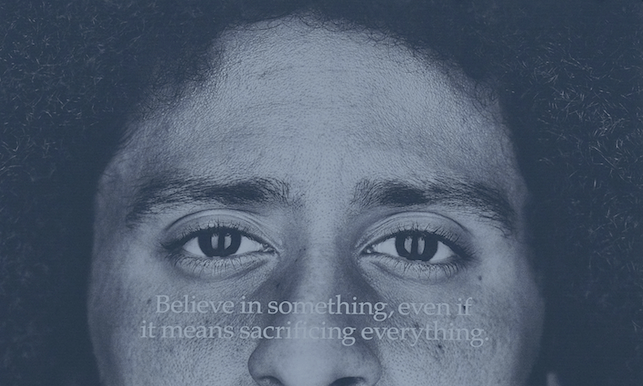
Conservative vets don’t like the protests. Progressive ones will tell you that they fought so that others may protest. As someone that doesn’t identify with any one political ideology, I’m free to decide for myself. I can both understand Nike’s selection of Colin Kaepernick for their ad campaign and be critical of the specific creative content they chose to use when claiming he sacrificed everything.

In reality, Colin Kaepernick didn’t sacrifice everything. He sacrificed some portion of an NFL career, no small deed, to stand up for what he believed in. I can both appreciate Kaepernick and what the Nike campaign is trying to accomplish and call BS on Nike at the same time for overstating their tag line and opening up the campaign to unnecessary criticism.

As for my Nike gear, I don’t burn clothes I’ve already paid for. But I also won’t tell the parents, spouse or child of a fallen service member to believe that Coin Kaepernick sacrificed what they have either.

In time though, we’re going to have to find something else to universally honor besides the American veteran. We once viewed the rule of law to be the one thing we refused to argue but instead argued whether or not an issue pleased or offended it’s sensibilities.

Here’s to hoping we find our way back.

Can We Question Someone’s Service?

We’ve already had a few dust-ups over the claims of service that some veterans running for congress have made. Over 400 have run or are running in this year’s midterms, a significant surge over previous years. It’s bound to come up again.

Most of the issues raised so far have been around the specifics of slogans like “combat proven” or claiming to have “fought in Iraq.” It’s mostly semantics. It does raise a reasonable question though.

Is a candidate’s service record fair game for political fodder?

My answer? Yes…but it’s complicated.

If a vet is going to pursue office, a noble but voluntary endeavor that comes with prestige, privilege and platform, that vet’s time in service is open to scrutiny. I also believe that the degree to which one’s service is central to their campaign platform matters too.

If one is touting oneself to be a war hero, one ought to be a war hero in broadly accepted terms and be willing to field challenges to that distinction.

If one’s opponent is touting themselves as a war hero, one should feel free to challenge that distinction. All the common risks of political strategy apply. Service distinction shouldn’t inherently hold sacred ground.

What gets complicated, though, is what we find when we actually try to apply scrutiny to early 21st century American military service. We’ve been at war with global, non-state actors for nearly twenty years. The result is that the details around one’s service can get a little murky. Fighting ambiguous wars against ambiguous enemies in ambiguous locations leads to ambiguity that opens up holes large enough for political operatives to drive a straight talk express bus through. Those running on their service records should be wary of both political opponents and the campaign advisors pitching them. It’s extremely easy to slide into exaggerations.

Last year, I wrote an article for the Washington Post. It was my first for that platform. The draft byline referred to me as a combat veteran. I asked them to strike the term combat veteran because I wasn’t comfortable with the distinction. I wasn’t comfortable with it because I don’t really know what it means.

The most obvious definition of a combat veteran would be someone who received a combat action ribbon. Even that gets murky though. The criteria for that award is relatively narrow and has limitations on communities and rank. A combat nurse working on combat wounded in a combat zone on a location regularly attacked would not qualify unless their precise location were targeted.

How precise? Somewhat. I think.

It’s possible that the award alone is too narrow a definition of combat veteran for modern warfare.

Like I said, murky.

The result of me erring on the side of understatement was hundreds of comments on the article about my opinion not mattering because I never saw any “action”.

Now, I’m reasonably confident stating that I’m a combat veteran is some level of exaggeration, though I led combat elements on combat missions in combat zones. Part of the point, and what we’re likely to get a heavy dose of in the coming months, is that I don’t know how to accurately describe my service in a way that either is inaccurately over or understated.

For Example:

I conducted the initial air strikes into Afghanistan in October of 2001. My team fired the first shot in the war. This is a true statement.

I was a surface warfare officer on a ship that happened to be in the Arabian Gulf on 9/11. We were first on station off the coast of Pakistan and fired the first Tomahawk into Taliban territory. I was on the bridge of the ship when we launched. My roommate was in the combat information center planning and actually firing the missile. We literally conducted the first air strikes in the war. True.

We then ate bowls of ice cream and watched Joe Dirt on the MWR channel in our state rooms and were asleep before the missiles reached their targets. That last detail probably isn’t making it into a campaign speech but it’s an important descriptor of my experience.

On my second deployment, after transitioning to a special operations community, I didn’t deploy to a combat zone or even one that entitled me to hazardous duty pay. I was nowhere near Iraq or Afghanistan. I received no awards or formal recognition.

That is a true statement.

The following is also true.

My team was the first one on the ground in the area and DOD had not yet classified it a combat area because there was no one there before us. Months after we left it would be.

While there, I was on-scene tactical commander for hundreds of hours of operations “outside the wire”. Though we took no confirmed fire from enemies, we were under regular IED threat. I was in constant danger and risked my life and the lives of my men more times than I can count. I was even emergency med-evac’d out of a remote location after suffering kidney damage do to lack of water.

I separated from the navy two months after returning. No time to process awards.

Still, not combat proven.

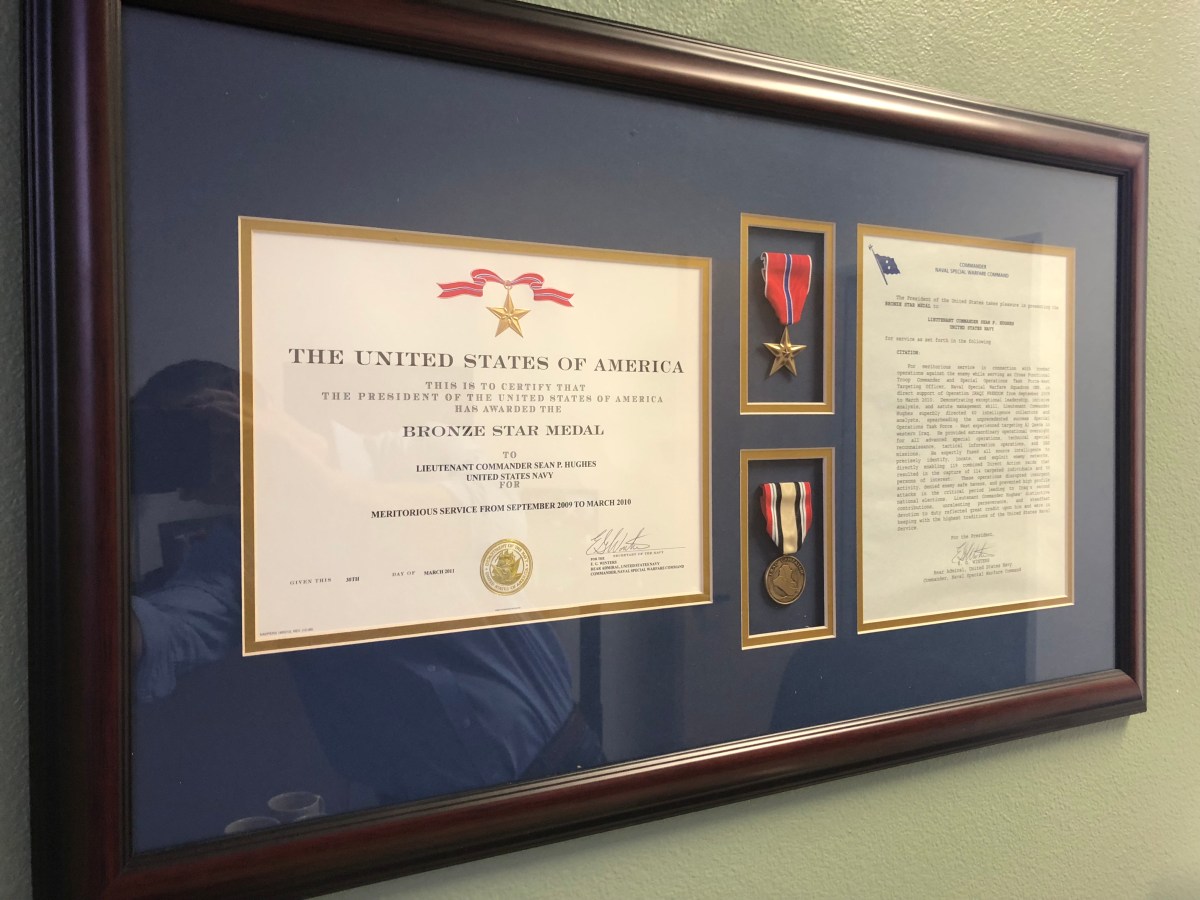
On my last deployment to Iraq, after being recalled to active duty, I was awarded the Bronze Star for leading a team that executed over a hundred successful direct action raids against enemy insurgents. I served in Ramadi on a base that was attacked while I was there.

That is a true statement.

The following is also true.

As a Lieutenant Commander, I almost never left the tactical operations center, my duty station, during a single operation. I watched a lot of football on the Armed Forces television network and ate ten thousand Thin Mints.

All true. Still not combat proven.

This level of ambiguity is not unique to my service. My record doesn’t look that different than many others. Now, imagine trying to explain to an excited campaign manager or speech writer, that you ought not say you “fought in Iraq”.

Additionally, try to explain to a woman who, at the time, was not technically allowed to serve in a combat status but was in dozens of convoys through the bomb laden streets of Fallujah, that she didn’t serve in combat because none of the bombs hit her exact vehicle.

The reality is that service in these wars breaks down in a few ways. There were rare, no shit action hero war experiences that have mostly been made into movies or self help , corporate leadership books by now. There were larger groups that served in the earliest three to four years of the wars where there were regular combat operations experienced by the broad population of those that deployed. And then there’s been about a decade of low intensity conflict where troops went away to war zones, were less exposed to conventional combat, but were regularly exposed to things like roadside bombs or sniper attacks for long periods of time and have no idea exactly how to express the experience they had to others.

This ambiguity leads to more than bad campaign slogans. It contributes to the struggle of transitioning out of the military as past service members can’t pinpoint the cause of the emotional trauma the service and ultimate separation caused, since they did not, in fact, “see combat”.

One of the secrets we vets know about being a hero is that the most significant variable that leads to heroism is circumstance; something that has little to do with the hero in question. There is no choice in it. The choice, the one that matters, the one that makes one worthy of representing other Americans in government,  was in the decision to serve. The decision to “go”.

If running for office, applying for a job or simply sitting in a bar stool at your local pub, it’s sufficient to simply say that you went. And that you did what was asked of you for your fellow American.

That message holds up. I hope to see many candidates say it. And then lead in congress with the lessons they truly learned.

RIP John McCain. We Have The Watch

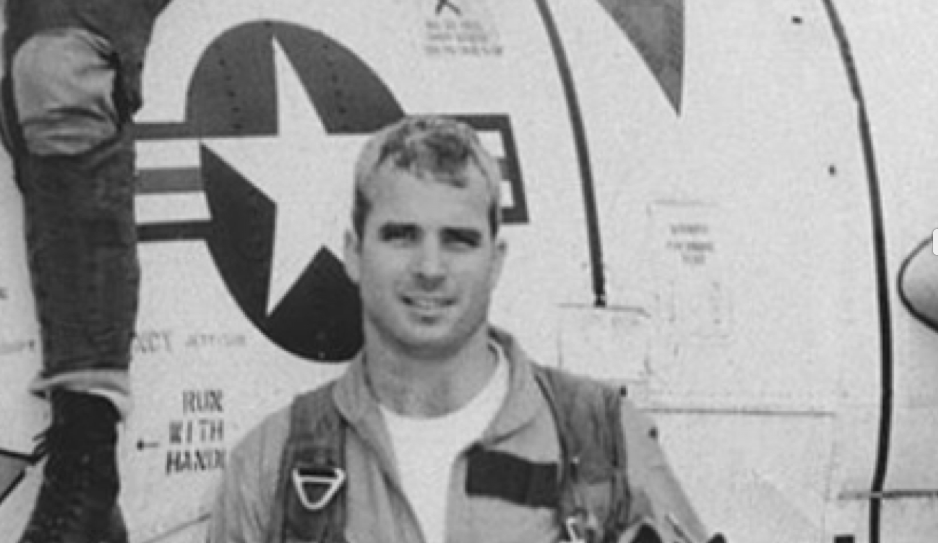
In 1995, my Freshman year at Annapolis, Robert Timberg’s A Nightengale’s Song was published. It was a chronicle of the lives of five Annapolis graduates, John Poindexter, Bob McFarland, Oliver North, Jim Webb and John McCain. Timberg wove a narrative of their experiences at Annapolis, their time in Vietnam and their lives in government. It was unofficial, mandatory reading for us; the type of book that one day, someone will write about my class, our time in this war and the lives after we are all about to start.

“They are secret sharers, men whose experiences at Annapolis and during the Vietnam War and its aftermath illuminate a generation, or a portion of a generation – those who went. They shared a seemingly unassailable certainty. They believed in America.”

The coming of age. And the tragedy of war. The consistent story of man.

There’s something about the specificity of a likeness in someone distinguished that draws you to them. A place like Annapolis is sharp with detail and consistency. We wore the same uniforms. We went to the same classes. We lived in the same building.

We put up with the same crap.

We felt the same cycle of emotional torment, boredom and longing. And so, in some not insignificant way, we became a part of each other. Whether we wanted to or not.

That’s the point of a place like Annapolis. To cut down on human variance. To hold a standard.

McCain and I were more alike than most. At least that’s the narrative I told myself. I lived in his room in Bancroft Hall. His roommate, Chuck Larson served as Superintendent of the Academy when I was there. He wandered up to our deck one afternoon, found my roommates and I screwing off and told us who once lived there.

We shared more than a room though. We’d both gotten in to Annapolis because of our fathers. We were both screw-ups, finishing near the bottom of our respective classes. I told myself that John McCain probably felt just like I did. That somewhere deep inside he knew he didn’t deserve to be where he was. Or that he didn’t belong because he was lousy at following the rules. But when people told him time and time again that he wasn’t fit to serve, or lead men, it lit a fire in him that’s never stopped burning.

John McCain gave me a story to tell myself.

Not just me, but generations of “screw-ups” that dared to take on a place like Annapolis, despite the lifetime of people telling us we couldn’t or shouldn’t. Screw-up is the name for people who can’t follow the rules and fail. Maverick is the one they give you when you succeed. There was enough shared space and mind between the two of us to give me reason to believe in myself at a time when perhaps that was the only thing standing between one life and another.

Over the last year, since he was diagnosed with brain cancer, John McCain has given Americans a story to tell themselves too. In the face of a recession of western liberal values and a surge in isolationist, ethnocentric nationalism, McCain has reminded us of what we once were. And what we could be again.

81, dying of cancer, McCain explained in his acceptance speech when he received the Liberty Medal last November.

“We live in a land made of ideals, not blood and soil. We are the custodians of those ideals at home, and their champion abroad. We have done great good in the world. That leadership has had its costs, but we have become incomparably powerful and wealthy as we did. We have a moral obligation to continue in our just cause, and we would bring more than shame on ourselves if we don’t. We will not thrive in a world where our leadership and ideals are absent. We wouldn’t deserve to.”

Like he did for me, 20 years ago, I pray his example is enough to give Americans reason to believe in ourselves at a time when perhaps belief is the only thing standing between one America and another. Yesterday, John McCain announced that he will forgo any further treatment for his illness. Today he passed. He’d had enough. It’s time for those who remember what he stood for to carry on from here.

We have the watch.

Vets, Protests and Politics

Two things are certain to happen this fall. The first is the start of the National Football League’s 99th season. The second is the first Trump era mid-term election cycle. We can be nearly certain that something else will be happening too. 24 hour news cycles filled with talking heads debating NFL players protesting during the national anthem.

There’s already a Beto O’Rourke video that’s gone viral and won’t leave my Twitter feed. It’s only August.

One of the most commonly used arguments against the players protesting is that they are being disrespectful to service men and women who make tremendous sacrifices to protect the liberties that allow men like NFL athletes to earn millions of dollars playing a game.

As a vet, I’ve spent more than my fair share of time thinking about that particular argument. It’s both problematic and indicative of the divided political environment we live in.

The idea that the flag or the national anthem are the unique domain of the roughly 1% of Americans serving is always something I’ve found odd. And it leaves me wondering a bit about what type of actions we should be thinking about that may be disrespectful to the other 99% of Americans not serving. Or the 93% that never served.

As for how most vets feel about flag protests, we’re simply a cross section of the rest of America. If we identify conservative, it bugs the hell out of us. If we identify progressive, we admit that protesting is one of the rights we serve to defend. If we’re neither, well then, it depends.

Broadly speaking, the service member community has a conservative tilt. It’s not quite as steep as it seems. Most service members are younger. And many simply don’t consider themselves political at all. But it’s fair to say that the protests bother many vets. Those that take deep offense to professional athletes protesting during the national anthem don’t do so over some tangible value inherent with the sacrifice of service though. They do so as an extension of their political beliefs.

One of the central debates in modern American politics is how comfortable one is at admitting that America’s deeply troubled history of how we’ve treated people of color still matters to America today. As the only industrialized nation to allow the racially specific enslavement of humans into the latter half of the 19th century, and one that only legally eliminated racial segregation 50 years ago, its hard to argue that our past is problematic. Whether or not any of that matters to someone is the question.

Whether or not any of it matters enough to one to look at the flag and have serious questions about what it meant, means and can/should mean in the future, is a question that breaks down political lines. Additionally, since the protests, as described by those protesting, are aimed at bringing awareness to the issue of police violence against people of color, the law and order aspect of politics is also in play.

Like our views on protest, law and order is a legally definitive yet politically subjective term. For example, whether one feels that the misdemeanor of entering the country illegally is more serious than the felony of tax and bank or campaign finance fraud is actually not a legal debate. The justice system is clear. Serious financial felonies have sentences of decades to life in prison. Entering the country illegally is, as stated, a misdemeanor. And protesting the flag is, unquestionably, a right granted by the Constitution of the United States of America.

In a literal sense, there is no debate. In a political sense though, it’s as big as ever. And it’s not going away any time soon.

There Can Be Heroes

I first saw Trevor Hoffman pitch in person during the Spring of 2001. I had just moved to San Diego on orders to a ship set to deploy that summer. Before we left, I caught a game at then Qualcomm stadium. Hoffman came in for a save in the 9th with his signature “Hell’s Bells” experience.

If you never had the chance to see it in person, you’re a little worse off. The ominous bells leading in to the AC/DC classic would ring, slowly. The crowd would hush. Digital flames would whirl around the stadium’s electronic score boards. As the slow lead in of Angus Young’s lone guitar drifted into the stadium, Hoffman would begin a slow walk out to the mound. By the time his warm up pitches were done, the crowd was in a frenzy.

If you’ve seen it in person, and it didn’t stir something in you, I can’t help you.

When I called the girl I’d met a few nights earlier at a country bar to see if she wanted to get together, she was excited that I had gotten to see Hoffman pitch. Two things made an impression. Trevor Hoffman was clearly a big deal around San Diego. And she liked baseball.

We were married a year later.

Last night they unveiled the Trevor Hoffman statue at Petco Park. Hoffman, elected to the Major League Baseball Hall of fame this summer, played 16 seasons with the Padres. He and Mariano Rivera are the only pitchers with 600 saves. No one else has 500.

Amidst the backdrop of the emotional ceremony that ended in Hoffman taking the field one more time, in uniform, to watch a fire works display, sitting on the mound with his wife Tracy, it reminded me of the importance of the Trevor Hoffman’s of the world.

In a time where many believe that the only people we are allowed to call heroes are first responders or servicemen, last night reminded me there are more. As a vet, I get to say that a little more freely than most.

Trevor’s path to the Hall of Fame wasn’t standard. He was drafted as a short stop. When it was clear he wasn’t going to make it, he moved to pitching from the bullpen where he found a future. After he injured his arm shortly after the switch, he lost the high end of his fastball, something that would have ruined most careers. Hoffman wasn’t done though. He developed a second pitch, one of the most devastating change-ups the game has ever seen. Then he worked his way over two decades into the record books.

The quote on his statue is “There is no shortcut to true success.”

Hoffman was known as one of the best teammates and most influential leaders any locker room could have. He never embarrassed himself, his team or his family with his behavior on or off the field. He was the pro’s pro.

I try to stay away from hero worship as much as I can. But sometimes, it’s important to remember why we have them.

Hoffman’s story is one I’ve told my boys. It’s one I’ve told myself when I’ve run into road blocks in life. It’s a story of persistence, humility and character that helps people. And that’s the point. I understand it’s just baseball. And it may sound trivial when there are men and women laying it on the line everyday in more serious jobs. I was one, surrounded by others, not long ago. But the magnificence of the human spirit and the power of example isn’t limited by context. And when we refuse to acknowledge it, we’re left with few lights to turn to for example.

I get to walk past Trevor Hoffman’s statue, with my three boys, and tell them that talent gets you stats, but character and persistence gets you a statue.

Things like that matter. And so do people like Trevor Hoffman.

The Breakdown of Social Trusting

An American political framework might look like this:

One faction advocating that those with agency over others must recognize their responsibility and act in good faith, sustainably so, and make decisions that benefit not only themselves, but the broader society as a whole. This may include pursuing their own interests as competition driving development is an accompanying belief. That view holds that there should be little coercion required to accomplish that end and therefore limits on personal liberties only serve to stifle dynamism.

The other faction aims to identify asymmetries between groups that yield disproportionately high levels of agency for some, and disproportionately low for others. That group advocates for changes, through government or other social action, to the institutions that are responsible for the asymmetry in agency.

In theory, both factions should be able to exist with reasonable friction. Both sides believe that agency over one’s own outcomes is the goal. Both aim to enhance the benefits of agency. Both believe that agency comes with privilege and responsibility.

This framework is, of course, a naive one. It doesn’t really work that way, though it should. Naive frameworks are useful though. They help expose why a thing could be a way but isn’t. As best as I can tell, the application of the framework breaks down because of two assumptions that feed on each other and throw the balance of discourse off.

The first is that not all people behave with good intent towards society as a whole. The second is the lack of trust between factions that the first assumption yields.

When too many that behave outside the bounds of good societal intent assume agency over others, the levels of trust between factions lowers. The goal is for social trust to exist within a band of reasonable discourse. We’ll always believe that others are simply out for themselves or maybe for even worse nihilist causes. But we believe they don’t have enough power to drive the direction of society. Therefore our trust, though measured, stays within the acceptable band.

Both the appeal and the truly harmful characteristic of Trump-ism is that it aims to expose a reality that everyone is a fraud. And though flawed, the leader of the message is at least honest about it, and therefore can be the only trustable person.

This view perpetuates a toxic environment of distrust. Nothing can be trusted. Not the media. Not the intelligence community. Not the Justice Department. Not the courts. And not Congress. Though we already believed we couldn’t trust congress, the others are new. We’re now far outside our acceptable band of social trust. And so we shouldn’t be expected to function effectively as a free and open society.

The following belief is important:

Not everyone is a fraud. And few people rise to positions of power who care only for themselves and not a sustainable, harmonious society. They may get the details and actions wrong, but not the intent.

True or not, when we don’t believe that any more, it allows us to tolerate, in plain sight, those that don’t hold the standard. There is no positive end to a free and open society where we don’t have basic trust for those in power.

One question to ask is, what is the goal of sowing so much distrust?

An effectively functioning society can’t be the answer. So what is it?

Once and Always Friends

An old friend of mine passed away a few weeks back. I hadn’t seen him in 30 years. For a time, in grade school, he was my closest friend. We lost touch with each other the way kids do. Something as simple as a schedule change in school or a bus route makes all the difference at that age. Then you’re strangers.

Like most people, over the years I’ve had to deal with the phenomenon of losing people I know. The most common, simply because we know few people well and many at a distance, is the passing of someone we we weren’t close with. From time to time though, it’s someone we knew more than that once. But not any more. And we’re not quite sure how to feel about it. There’s an urge to feel some guilt that we’ve let the relationship slip. And that now it’s too late to make amends.

I’ve come to think of it a bit differently.

We were once familiar.

One of the amazing things we humans do with those we’re familiar with is store bits of ourselves in each other. We see it with teams in sports or at work or in the military. When we are together long enough, there’s a sort of formed, shared consciousness. We call it chemistry. It’s deeper than inanimate elements mixing together though. It’s other people’s skills, awareness, even feelings as an extension of ourselves. When familiarity lasts, we often end up storing our whole selves in others. We’ve all heard countless stories of long married couples. When one goes, the other follows shortly. They took too much of the other with them for the other to go on. .

And so it is, to a lesser extent with brief or distant familiarity. Somewhere inside my friend and I is parts of each other. Small things that come from playing hundreds of hours of video games or watching cable movies we weren’t supposed to or playing pick up football games in the snow. And though I haven’t seen him for 30 years, it’s still there. It’s permanent. And it’s honest and good to mourn it.

RIP Tommy. We were once and always friends.