Lions

My son Aidan likes to hike.

When he gets out on the trail, he just goes. He never worries about where or how long or what it’s going to be like. He just sees the trail and he goes.

My other boys can’t keep up with him. He doesn’t run. He doesn’t even walk fast. He starts right off. And he never stops.

Persistent.

Relentless.

He never complains. He just walks until the walking is done.

When he gets too far ahead of his brothers, he stops for a moment, looks at me and asks, “Friends?”

His mouth says the word. But his eyes ask the question. Are his brothers ok? Can I go make sure they’re not too far behind?

Aidans eyes do the talking for him most of the time.

He wasn’t three before the light started to flicker on and off in him. By his third birthday, it had gone dark. No talking. No connection.

He was gone.

For months, even years, he was full of fear. He’d broken connection with the world outside of himself. As he slowly came back to us, he collided with that world head on. It was terrifying for him. Daily outbursts. Constantly escaping, trying to get away.

Every experience was something that didn’t make any sense to him. He didn’t know what things meant. Or where we were going. Or what anyone was telling him. He couldn’t see the end of anything he started.

He was terrified.

But everyday, he picked himself up and did it again. He had no choice but to find the courage to wander out into a foreign and terrifying world. And everyday, he got a little braver. And everyday, the world made a little more sense to him.

He’s just a boy.

But he’s stared down a thousand lifetimes of fear by now. And he just keeps walking.

If there’s one thing my journey of parenting an autistic child has taught me, it’s that courage comes in all shapes and sizes. And I’ve never seen anything like what these amazing children go through just to fight for the chance to do it again the next day.

They’re lions. Every one of them.

If you know someone on that journey, or if you’re on it yourself, it’s good to find others that are too.

That’s why my wife Annette and I started Care For Us. Check us out at www.care4us.org. All services are free. All connections are an honor.

Life on The Border

I can see Mexico from my backyard. It shows up as a bright band of twinkling lights on a hill to the south a few miles away.

I live on the east side of a suburb on the southern side of San Diego called Chula Vista. I’ve lived here about twenty years; my entire adult life. San Diego was my first duty station in the Navy. I met my wife here and stayed, like thousands of veterans do every year.

On the border.

There’s a wall between those twinkling lights on that hill and my home. But like any border town on any border in the world, the wall divides the material much more than it does the cultural. On the other side of that wall is Tijuana, one of the most dangerous cities on the planet. There’s a drug war raging there right now. Murder rates are soaring. Poverty and the drug and sex trade paint a picture of life very differently than where I live as outcomes on the two sides of that wall diverge. There is not much of a sense that the people are different there. Just the opportunity. And the outcomes.

About 60 percent of the people where I live are Latino. My wife is one of them. I’m just as likely to hear the cashier at the Target down the street from my house speaking Spanish to a customer as I am English. They switch back and forth seamlessly.

The food here is amazing. I grew up in a place where there was a family owned pizza place on every corner. Here it’s burrito shops. The restaurants serve beer in the morning and have raucous crowds for soccer games more often than they fill for Monday night football. But make no mistake, they love their Chargers, even if they did move 100 miles up the I-5 to LA.

It’s not obvious to me that I’m close with anyone that’s here illegally. In fact, the way one normally finds out that someone was, is that they get deported. The fallout is brutal. They have kids that go to school with my children and spouses left behind. The negative outcomes are more obvious when they leave than when they were here. That’s not a political statement. It’s a material reality. The pastor of the Tijuana branch of my church is one of them. After he was deported and spent time in prison, he found faith. And planted a church on the other side of the border where he lives now. It serves in some of the poorest parts of one of the poorest cities in the world.

People have homes and families and businesses on both sides of the wall. To them the wall marks a boundary of expenses. And institutions. And laws. Something to be crossed for their benefit.

The U.S. Customs and Border Patrol is present the way normal police and first responders are in other places. People generally don’t view them with fear. Most of the border patrol where I live are from where I live. I once watched the coverage of the caravan “crisis” on the TV in a burrito shop with my friend Jose who had just finished his shift near the wall.

There isn’t much unique border political tension. Some people are conservative. Some are liberal. Here, though, where most identify ethnically as Latino, the lines are less clearly divided along culture. There are progressive Latinos. And there are conservative ones. And they think the same way about immigration that conservative and progressive folks do. It’s not about race here. It’s about control of who enters or doesn’t enter where you live.

Some want strict. Others want liberal.

Few here think much about the wall that divides the two economies and legal systems in philosophical terms. I’ve never heard anyone say it was immoral. I’ve never heard anyone say it needs to come down. I’ve never heard anyone say it needs to be higher. It’s a geographic function that defines parts of the culture and economy here, the way the beach or the mountains do in other places.

The main concern is that the border crossing stays open. The economy here depends on it. I have friends whose livelihoods depend on the orderly passing of people and goods through the port of entry.

There is crime and there are gangs here. Less than where I grew up, 2800 miles to the northeast. Some of it comes from Tijuana. Most does not. It’s safer now on our side of the wall than it has been for decades from a crime perspective. The contrast across the border is clear though. Things are murderous down there right now. They are not here. And in that regard, the physical border matters.

Last night the President addressed Americans in a live address from the Oval Office. He expressed that there was a humanitarian and national security crisis at the southern border. He delivered a list of statistics. And read a list of crimes that “illegal aliens” had committed and then he asked me to”imagine if it was your child, your husband, or your wife whose life was so cruelly shattered and totally broken.”

There’s volumes to be written about the state of political decay in America. And how two sides are fighting for two outcomes–to build a wall or to not build a wall–that matter far less in the grand scheme of things than the choice to shut down the government or signal to the world that we’re the type of democracy that simply doesn’t work any more. Many others will take that to task. For me, down here on the border, it’s sufficient to say that the crisis isn’t obvious. And that it’s not much different now than it has been for 20 years.

And as for the question of how I would feel if it were my child or my wife so cruelly shattered? It’s not obvious how much more broken my heart would be if whatever happened to them involved someone who was not here in America legally. It’s a bit of an odd question. The type asked by someone unfamiliar to personal hardship and loss. I find no comfort in the horrors committed every day in America being committed only by Americans.

Presently the American government has been partially shut down. And our leaders are reserving prime air time to address America they way it does when we go to war. Or when we take emergency government measures to avoid economic crisis.

And it’s not obvious to me why. And for the reasons stated, it should be.


Review: The Dawn of Eurasia

“A bump in the road for America’s longstanding march of progressive Western Liberalism or a pivot back towards ethnocentric nationalism, Americans find themselves at a crossroads.”

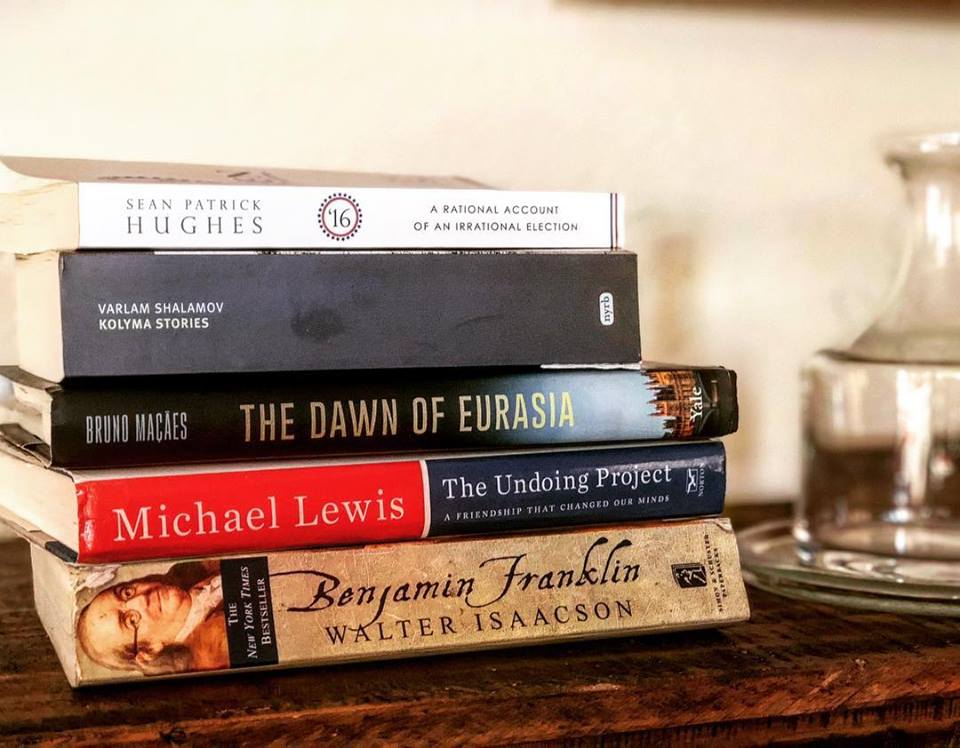
That’s from the blurb on the back of my book, Sixteen, published this past summer. It was a collection of essays I wrote as the 2016 election unfolded. More than anything else, the book is an anthology of rational thoughts that, once compiled as a foundation of belief, led me to the wrong conclusions about early 21st Century America. The spirit of the book is to spend some time with the contrast. “A Rational Account of an Irrational Election” as the subtitle says.

Added to the growing list of things about the world I assumed over the last few years that were either incomplete or plainly incorrect is that quote from the blurb on the back of the book. In this case, wrong is too strong. Directionally, it isn’t. Incomplete is more accurate. It lacks context. Context Bruno Maceas’ 2018 book The Dawn of Eurasia: On the Trail of the New World Order can help provide.

Published this past January, it’s the best book I read this year.

Maceas, a Portuguese political strategist who served as the Secretary of State for European Affairs in Portugal during the height of the European financial crisis, had a front row seat as the cracks in the European Union, visible to critics but seamless to those of us swept up in the globalist strain, began to widen in the face of the EU’s first global financial crisis. Clearly informed by experience, he has an interesting perspective as to the order of things.

What’s significant to me as an American political writer is that Macaes wrote a book about the world order that does not include, in fact even scarcely mentions, America. Moreover, the exclusion is not to be taken as a criticism or even an indictment of America’s future. But a shift in focus to somewhere else. Somewhere more dynamic. A search for the middle of the world, if we were simply not allowed to say anymore, that it was universally understood to be the West.

The book is beautifully readable. The story is told through a journey over land from the ends of the Eurasian super continent. As a veteran of America’s 21st century wars in Middle East and Afghanistan, my eyes and energy have been focused elsewhere. So, Macaes journey took me to places I couldn’t find on a map that I knew nothing about. He believes they will be at the center of our next hundred years of the world’s economic and political development.

Macaes opens the door, lets you in and invites you to consider that perhaps, you’ve been thinking about shape of the world the wrong way.

He doesn’t believe that the world is heading in a singular direction. That Fukuyama’s end of history, the place where all civilizations meet in democratic liberal hegemony, is not a thing. Instead, the world is entering into a different phase of integrated competition, where the tracks laid down by globalism–trade, capital flows, technology, the internet, social media–all remain in place as a new sort of battle ground. The wars of the future will be fought within those domains. And the spoils will not be of territory or the subjugation of others, but through dominance of regional influence and markets.

Within this definition of future conflict, the division of states no longer lives along the fault lines of East and West. But instead along the delineation of modern or traditional. In a world where the line of demarcation from Europe to Asia was not one of geography but instead a difference in modernization of technology and culture, when modernization is uniform, so is the dawn of one unbroken region.

Eurasia.

Russia, China, India and the EU all will engage in a grand struggle of integrated competition for dominance. Somewhere, America will fit in. But it will not be the center of the world. Nor will Europe. Nor China. Where exactly, is the stated purpose of the journey of the book. The unstated purpose reads, at least in some part, that the future we will be many things. One happy global family is not one of them. And it’s time to start figuring out where that struggle will play out. And by which rules it will be played by.

This is the diagnosis Trump-ism got right. This was the illness Obama/Clinton and the other American Neo-Liberals ignored in hopes that the world simply moved towards the destination they believed it would. Like the medieval physician though, who knew the symptoms and the end result of a terminal disease but not the cause, the cultural leaches and blood letting Trump-ism applies to modern America are more likely to kill the patient than the disease itself.

It’s hard to see how xenophobic rhetoric, deprecation of state institutions and division within an already diverse population make America a more competitive player in this integrated game.

Which brings me back full circle in the journey of ideas Bruno Macaes started me down. The Dawn of Eurasia paints a plausible and beautifully described picture of a new world order. One that, based on current events, cultural trajectory, economic growth and population demographics seems nearly certain. A future of integrated competition is upon us. Trade wars, cyber espionage and democratic meddling are here now. And they’re not going away.

Perhaps we can take some solace in the fact that the objectives of World War III will be to win a trade war instead of Nuclear Holocaust.

As an American, the cautionary signal is in the wind though. In a world where the powers of the future don’t want to join our club and simply behave themselves in order to gain the good graces of the founding member of the liberal democratic fraternity, we need to figure out how to insist on effective execution of our state responsibilities; a task  difficult to envision with existing management.

Bruno Macaes has given us a different thought to think and delivered it to us from places most of us have never thought about. In understanding the world of the future, or at least understanding the rules in which the game will be played, one would do well to start with The Dawn of Eurasia. 

Read List 2018

There’s an argument to be made that the most significant development to come out of the digital age is the democratization of high quality entertainment.

I don’t have a flying car. But I do have the cell phone and internet of a billionaire. And so does just about everyone I know. Bill Gates uses the same apps I do. We have mostly the same television channels. We spend our time on the same internet. Youtube is Free. Netflix is cheap. And Amazon, well, I’m pretty sure I pay something. I’m just not sure what it is.

You get the point. Anyone with anything, in some domains, has everything.

In a world filled with free entertainment options and nearly endless things to do, one thing from the days of old has stayed pretty consistent though. At the margin, there’s not really any better way to spend $20 than on a great book. For the cost of a movie ticket and a soda, one can get days to weeks of entertainment, depending on your pace and keep it for future readings. Audio or digital books bring that price down even further.

Books, in several forms now, still sell.

The hardest choice one usually has is to figure out exactly what’s worth reading. A bad book is a truly bad investment of time. So, I’ve found people sharing read lists to be one of the most valuable types of information sharing out there. A good read list can be a year of entertainment. And like most things, those are free now too. So, in the  spirit of holiday season sharing, here’s my gift to you. My 2018 read list.

It’s a mix of history, economics, politics and technology that I’ve separated into three categories:

1-Books started but not finished. I’m learning to not finish books that I don’t like.

2-Books finished. This is some level of endorsement if I hold true to the principles implied in #1.

3-Books that left a mark. These are the books that changed how I saw something or added particularly important context to the things I write about today .

Books I Started and Didn’t Finish:   

Books I Finished: 

Books That Left A Mark

One other I guess….If I’m going to plug a few dozen other authors, I may as well plug myself.

Books I wrote

Sixteen: A Rational Account of an Irrational Election by Sean Patrick Hughes

Enjoy. And share away.

Some Thoughts on George H.W. Bush

Our lives aren’t stories.

Not the way we like to think they are; like three act plays following a tight narrative as the twists and turns of decades come to some culminating end. Our lives are a long–hopefully–messy series of events, decisions, actions and coincidences. It’s more mess than story. Yet we tell the stories. Because we have to. One finds little motivation in living a slightly better mess.

We think of the stories of our lives, before they play out or as we look back and reminisce. As hopes. As fears. As regrets. But the story is never really experienced in real time. And the true cause and effect of things is lost in the complex systems of the mess.

So much of that question, how did our life play out, is answered by the grand cosmic equation of chance. Privilege. Or circumstance. Luck, if you believe in that sort of thing. We’re not really interested in the truth about how much of any single human life is determined by chance.

It’s a scary thought.

Odds are, the greatest quarterback that ever lived wasn’t born in America in the 50 years that it would have mattered. So no one knows his name. The difference in the story we tell about him and Johnny Unitas has little to do with the type of men they were. And everything to do with the times and places into which they were born. And so the question to ask, the one that matters, when one passes from this state of being to the next, is not what type of story one’s life tells.

The question to ask, is what they chose to do with the life they had.

Yesterday, the government of the United States of America shut down to honor the passing of George H.W. Bush, the 41st President of the United States. The story of his life has been told countless times since his passing this weekend.

He was born, by chance, at a time and place that would give him a life of privilege during the Great Depression to the type of family that gave their children three last names because there were three last names worth telling. He lived the life of a naval aviator during the greatest naval battles in history. He lived a life of a politician during the darkest hours and greatest triumphs of Western of Democracy. And he lived the life of elder statesmen during his son’s presidency.

This is the story of George H.W. Bush’s life. The chronology reads more like an American Tolstoy novel than a mortal life. The timeline, though, is not the measure of a man. The measure is the choices he made during the time that he had.

George Herbert Walker Bush chose, when most the rest of his countrymen were going to war, to be an aviator, the youngest in the fleet, during a time when single engine prop planes were taking off and landing on wooden deck aircraft carriers.

He chose to enter a life of service in politics.

He chose to vote for integration of schools as a Republican Congressman from Houston in 1968.

He chose to run clean campaigns against his opponents.

He chose to take the roles Presidents Nixon and Ford asked of him; random, thankless roles. Ambassador to the UN. Chairmen of the Republican National Committee. Director of an embattled, CIA. And he chose his reason for doing so. Because the president asked him to.

He chose hard, unpopular decisions as president that saved the legacy of his predecessor Ronald Reagan, who made no such hard, unpopular choices. It cost him a second term as president.

He chose to go to war liberate Kuwait. He chose not to invade Iraq.

He chose to be loyal to one woman his whole life, and never embarrass her.

He chose to be a present father to his children.

Nixon thought Bush was the perfect Vice President, but not the right man to be president. Of Nixon, Bush said, “Deep in his heart, he feels I’m soft. Not tough enough, not willing to do the ‘gut job’ that his political instincts tell him need to be done.” That opinion of George H. W. Bush was held by a man whose downfall was predicated by a weakness of character and an inability to confront any of his aids face to face because of a crippling fear of personal conflict.

That which Nixon lacked, Bush had in spades. And our nation benefitted greatly from his brief but immensely important presidency.

The story of Bush, relative to Reagan, was that he was a “wimp.” The reality was that Bush chose to do the things in real life that Reagan put make up on, wore costumes and pretended to do as an actor. Even as president.

Such is the problem of stories. And such is the risk when we believe them instead of view the players in them for how they used the agency they had, often at great personal cost, to forward what they believed in.

It’s hard to find people who had much negative to say about George H.W. Bush as a man. This was true before he passed this weekend. He chose to live a life of decency and fairness, at some cost to power, reputation and legacy.

He loved his family, his God and his country.  Not just with his words. But with how he chose to live his life.

I’m not sure there’s much else to this thing. And there’s something beautiful in that.

This is the Review I Want to Write About Tyler Cowen’s Stubborn Attachments…

A few months back, my roommate from Annapolis sent me a text that marked a distinct waypoint on the arc of our relationship over the last 25 years.

He’s a combat decorated, navy jet pilot, who, for my wedding gave me a framed map annotated with all the places in America in which we’d had a beer.

There were quite a few dots on it.

Between the two of us, there are a half-dozen war time deployments and countless carrier landings and special operations missions. We’ve lived all over the world and seen, first hand, many things people write books and make movies about. And now he was bragging to me via text about something he knew would impress me to the extent of appreciative envy.

It was a picture of him with an economist.

Clearly things for the two of us are not what they once were.

The military life, especially during a time of conflict, allows one to experience things at an accelerated pace. By the time I was 32, I’d been on every inhabited continent, lived off the economy in Africa and fought wars in two countries. Many of the things discussed in intellectual circles–failed economies, authoritarian regimes, intersectional class systems– I experienced in utility, without the veil of narrative.

As things slow down and we get around to constructing those narratives in arrears, the nasty business of figuring out what it all meant, we often find that we’ve got a bit of catching up to do relative to those who dove right into academic or policy life. Ours was the kinetic world. The world of atoms, force and energy. If we are to get to work on the abstract, the world of words, bits and neurons, it’s good to find some thinkers to fast follow.

Economist Tyler Cowen is a good place as any to start. That’s what my roommate texted me; a smiling picture of him with the George Mason economist at a speaking engagement.

Cowen, the Holbert C. Harris chair of the economics department at GMU, co-hosts the blog Marginal Revolution with fellow GMU economist Alex Tabarak. He also hosts the interview podcast Conversations With Tyler.

I  started following him after I found an old Ted Talk of his telling me to be suspicious of simple stories. In it, Cowen warned that we have a propensity for narratives. They feed our biases and often obscure useful truths.

The thought squared with my experience chasing terrorists abroad. If one of my analysts started his target package brief with a story of who the target was and why they mattered instead of where they were and what they were doing, I cut them off.

Or so the narrative of my time doing that work tells me at least.

True to the message, some part of Cowen’s appeal is how easily he wanders out of the picture of his own narrative.

The blog, Marginal Revolution, is the best source I’ve found for eclectic societal, cultural and economic discussion that’s easy to consume, understand and use as a springboard for deeper learning. It’s a daily read for me.

The ideas on the site are usually not Cowen’s. A one-line commentary or a stand-alone post that highlights higher thinking on a topic here and there are all one gets from Cowen himself. It’s mostly a distribution hub for the better thoughts and thinkers of our time on a broad scope topics. The Podcast is a long form interview format of the same spirit.

Cowen’s value to the intellectual domain is less of the great man or transcendent thinker and more of an exceptional machine learning algorithm. The effectiveness of any ML algorithm is mostly dependent on two things: the accuracy of the base algorithm itself and the speed at which good data can be fed through it for it to improve.

Cowen’s capacity to consume and process information approaches the savant. And though impressive, simply knowing and understanding things isn’t the value he adds to the discussion. What’s of value is the perspective spit out on the other side of the Tyler Cowen productivity function. Which means there’s something to the base code itself.

Cowen’s specialization is that of a generalist, insistently so. Poured on top of that broad focus is an insistence on travel and cultural experience. All politics are local and personal. And how we see the world is deeply influenced by how we’ve seen the world. These more human undertones set Cowen apart from other economists like GMU collegues Robin Hanson and Bryan Caplan, whose work, while important and deeply interesting, feel to be somewhat motivated by a need to bludgeon us with chants of “logos over pathos”.

Cowen’s work has more blood in it.

More human than Hanson and Caplan is still not that human though. There’s a disciplined calculus to Cowen, so much so that there’s a predictability to his positions. The machinations of that calculus, the ML function itself if you will, are on display in Cowen’s latest book, Stubborn Attachments: A Vision for a Society of Free, Prosperous, and Responsible Individuals

Stubborn Attachments isn’t Cowen’s most readable book. But it might be his most important. It’s short, (160 pages) to the point and more technical than some of his more recent efforts. A good companion to help some of the less economically literate would be to listen to the two hour interview  of Cowen about the book by Rob Wiblin, to conversationally fill in some of the blanks.

At it’s core though, Attachments is a sort of permission giving message, to the usefully pessimistic, to think about the future, value it appropriately and do the right things. And to all agree that there are certain things we simply should not do that don’t require an epistemological burden to show we ought not do them.

The Straussian interpretation, the one Cowen doesn’t actually write and therefore is heavily informed by my own interpretation and biases, is a message to a world growing increasingly incapable of exploring hard truths because of political correct backlash, that says, don’t fear, explore the hard questions, seek truth. We have limits to what we’ll trust to our utilitarian motivations. And we can still be trusted to do the right things, protect the right people, avoid the great evils of the world and make a difference.

But we won’t if we stop insisting on honest answers to the right questions.

Stubborn Attachments is full of  Cowen’s version of the right questions. And some of the right answers.

The answers:

We’re capable of making rational judgements about what is better for society.

There is an idea of what is objectively good. And it’s based on the idea of supporting sustainable economic growth.

The valuation of the future is central to the theme of the book. How should we think about the future? Is it something less valuable simply because it’s far away? If not, how does that notion materially impact our decision process?

What’s the right way to approach the answer to three critically important questions for a prosperous human future:

1-What can we do to boost the rate of economic growth?

2-What can we do to make civilization more stable?

3-How should we deal with environmental problems?

In 160 pages, Cowen does little more than seed the answers to the big questions with insights and some nudging on how to think objectively about these sorts of questions. This is, after all, the book about how to take small steps towards a better future that Tyler Cowen wants to write…not the one I want him to write.

It’s possible the one with the answers is the one you’ll have to write yourself, in whatever medium you find the ability to serve the future of mankind. Which is, I imagine, the point.

Thank You Stan Lee

I never once read a comic book as a kid.  All I did was play sports, talk to girls and fit in. It was a happy, easy path.

I’ve got sons of my own now. Three. And they’re all different. The path has not always been happy. And it’s never been easy.

My oldest is a teenager now. He’s a remarkable kid. But he sees the world very differently than I do. Or than anyone does, as best as I can tell. He can see details of designs and structures the way others can’t. And he never forgets them. He’ll walk past something lying on the sidewalk, pick it up, put it in his pocket and then build something amazing around it with junk lying around the house. He can fold a piece of paper into something that looks like a robot, or a spaceship or a basilosaurus like he were following unwritten directions.

He doesn’t like small talk. He’s fascinated by what he can see and make. And he wants to ask you what you think about it. And why you think that about it. And what if it were different. He talks like a 30 year old.

He’s amazing. And everything I’ve never been. And like most unique souls, he doesn’t really fit in too easily.

As a father I was an early failure. I didn’t understand why he didn’t just follow the path. Why he couldn’t just do what everyone else did. I tried the tools I knew. Tough love. High expectations…anger. None of it worked. It just upset him. Of the many regrets I have in this world, my early approaches to parenting my boy are perhaps my biggest. He was just so different from me. And I didn’t know how to connect with him.

One day, on a whim, I took him to a comic book store. And things changed a bit for us.

It’s hard to explain, but if you’ve got a kid like mine, a little quirky, awkward, marching to a different drum, one who sees the world at a cellular level, than this may make sense to you.

There’s something about comic books, specifically Marvel comic books, that made me see the world the way my son did. The exaggerated graphics and the detailed back stories and sweeping struggle of good and evil brought us to the same spot from entirely different planes. Everything has a place in the Marvel Universe. Every character has a power, but a power with limits. And the limits are really the story. Everyone’s flaws, everyone’s strengths, everyone’s scars and triumphs feed into the grand struggle in a connected universe.

Every good guy is good for a reason. Every villain has a reason for their villainy.

And somehow it all maintains canonical integrity through spectacular, cataclysmic, dimensional fracturing adventures.

It’s a designed universe. Top to bottom.

Where I finally met my son, the one I couldn’t access where he was, was when I started letting him explain the detailed expanse of the  Marvel Universe to me. From a third grader who couldn’t find anything vivid or detailed or spectacular enough to grab onto in the world around him, to someone who explained to me last week how the truly dangerous villains in the world, the ones you really need to watch out for, are the ones who believe the evil that they do, is actually right. The ones who believe that the world will be better if they get to do the evil they must.

Anarchists and despots are easy work. Misguided zealots, well they’re a problem of a different sort.

Not bad for an 8th grade school drop off discussion.

Stan Lee died yesterday. He created or co-created Spiderman, The Incredible Hulk, Doctor Strange, The Fantastic Four, Daredevil, The BlackPanther, The X-Men, Iron Man, Ant Man and Thor.

More importantly, he created a dialogue between my son and I where there wasn’t one before. And a dialogue between millions of misfits everywhere who found each other on common ground through Stan Lee’s creations.

RIP Stan Lee. Thanks for giving me a place to play with my boy when nothing else would ever do.

The Cost of Veteran Value Signaling

The 22-a-day number is not real.

The number publicized to show how many vets commit suicide every day is not real. The actual number is something less than that. And a deeper look into the data shows that the overwhelming majority of vet suicides are happening decades after service as men reach their 50’s and 60’s.

The hypothesis that military service is the primary driver behind that high number would not survive any serious analytical scrutiny.

That number is a part of a deluge of value signaling on social and mainstream media, corporate marketing campaigns and within personal relationships that washes over Americans, unchecked, every day. Often it’s well intentioned. Sometimes it’s fishing for praise. And other times it’s straight politics or marketing.

It generates a wellspring of good will. But it comes at a cost.

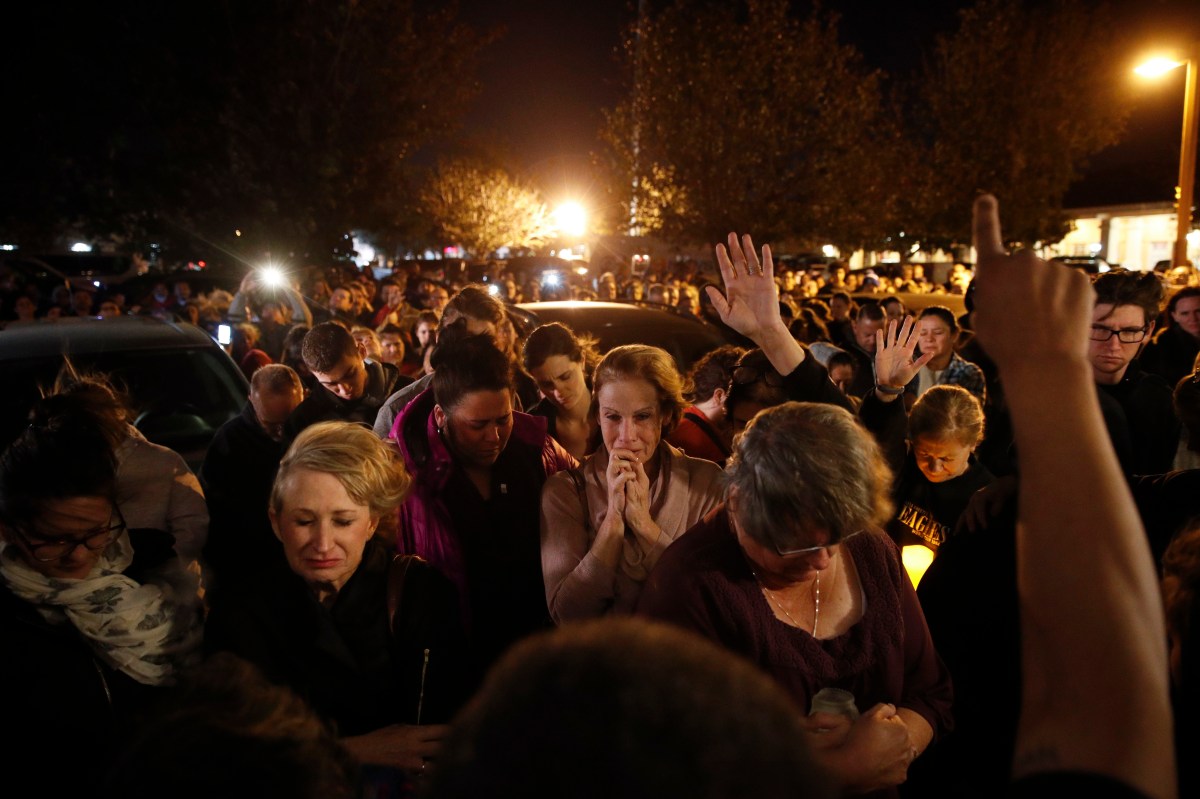
Yesterday morning a Marine Corps veteran charged into a country bar in Thousand Oaks, CA and murdered 12 people. This morning the President of the United States characterized him as a veteran suffering from PTSD. And now we’re likely going to have a national conversation about how to handle our unstable vets wandering around America.

This conversation will be the cost of years of veteran value signaling.

A lesser stated fact is that most vets haven’t, won’t and never have seen active combat. Our Vietnam vets are in their 70’s. The heaviest fighting in Iraq and Afghanistan has been over for a decade. We’ve been engaged in low intensity conflict for longer than there has been daily combat. An unpopular and perhaps insensitive reality is that our dearth of PTSD diagnoses are as related to the removal of the requirement for a specific traumatic event from the disability criteria as they are anything else. And while this sounds like I’m about to jump full throttle into a “we all need to be less sensitive” rant, I’m not. I am going to insist we remain sensitive. But be sensitive to the right thing or we’re going to do damage to those we’re trying to protect. And the right thing, is not millions of American veterans walking around America with PTSD.

It’s not the reality.

In 2004, I walked off a plane and out of the military after serving as a detachment commander of a special operations unit deployed to Africa. I had three weeks to transition out of the military. Six months later, Operation Red Wings took place, the mission that would eventually be made into the movie Lone Survivor. 19 Special Operations personnel were lost.

The day that it happened, the wife of a deployed friend of mine called me. She asked me if I had any information about the operation or who had been involved and if her husband were ok. I couldn’t tell her anything because I didn’t know anything. I was out of the loop. I was away from the life, getting my information from the news, just like her. I hung up the phone and went into the bathroom and vomited.

In the few years after that, I behaved in ways I never had before. I made bad decisions, developed destructive habits and nearly destroyed my marriage. In fact, if not for a graceful forgiving wife, I would have. In reflection on that time in my life, I was quick to assign my problems to PTSD. And I found welcoming arms and belonging in a world that valued my service, gave me sympathy for what I went through. And made me feel like I belonged again.

There was one problem though. I didn’t have PTSD. Not in any real diagnostic sense.

Years later, my wife did an internship as a counselor for alcoholic and drug addicted homeless veterans. These were not the lonely Twitter mavens signaling to others for belonging. These were people who had destroyed their lives and reached the last stop on the train.

My wife’s opinion of the root cause? Was it PTSD? For a few it was. But the one nearly universal theme was that all of them had some kind of mental health issue before they went into the service that they couldn’t manage after they got out. Anxiety. Depression. ADD…other.

For the first time in their lives, they were alone. And no one was responsible for their well being. And they spiraled off the tracks.

My truth was that I came from four generations of fall down drunks self-medicating their anxiety. And at 27, for the first time in my life, the training wheels were off from a personal behavior perspective. And I couldn’t handle it.

Turns out, the Marine who murdered 12 people yesterday, is alleged to have attacked his high school track coach. The trend is intact.

Which takes me back to where we are on the arc of the discussion. I’ll button it up with three quick thoughts.

1-We have to stop feeding the narrative that all vets are wandering around with deep hidden wounds. Some are. The overwhelming majority are not. While it may feel like we’re being respectful and appreciative, we’re perpetuating something that is not true and in turn doing harm by characterizing a broad group of people as something they are not.

2-The DOD has to focus on treating people’s mental illness while they are in the service and doing more to eliminate negative career outcomes for those who seek help…while they’re in. Transferring accountability of that to the “cost of war” and trying to treat people with a genetic predisposition to depression or mental illness by telling them they have PTSD leads to bad outcomes when they release into the outside world because they’re treating the wrong illness.

3-We have to be serious about how to transition veterans into the outside world. It’s the hardest thing I’ve ever done. It was a shock I was not prepared for. And our programs are window dressing. They are presently the least we can do without stepping on corporate toes or actually insisting on things from our citizens. Finding vets meaningful work is an investment that requires hard platforms of education, increased financial or legal incentives to hire and even entire government run companies to employ people and teach them skills. (Crazier than a 300million single fighter jet…?)

As much as I want to hire a vet, I can’t hire a computer engineer who can’t code, an analyst who can’t do data science or a product manager who can’t release a product. I say that as a vet.

And if you can’t find the right thing to put your energy into after war…you will find the wrong thing.

If you have PTSD and this rubbed you the wrong way, it wasn’t my intent. But there’s work to be done to get this conversation into a more productive domain. Because it won’t be long before one day, we’re not so appreciative of our vets. And it’s going to matter how much stock we put in just how damaged we all are because of our service.

On My Experience With Domestic Terror

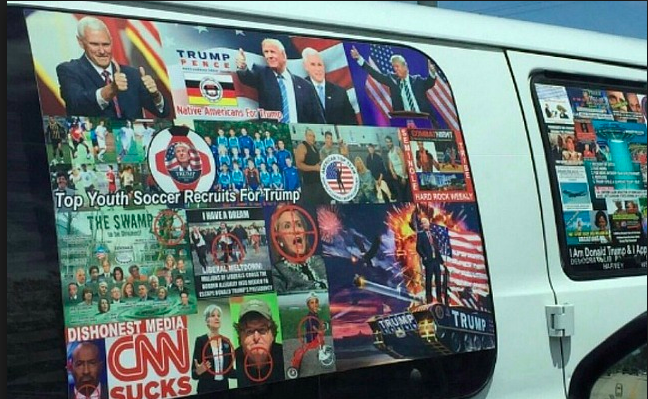
I originally wrote this as a Twitter thread a few minutes after the news of the shooting at the Tree of Life Synagogue in Pittsburgh broke this morning. I thought there was some more to expand on. So I’m posting the thread plus some more here on my blog.

It’s hard for me to get away from the things I learned in my old life when I see the behavioral patterns show up in America today.  There’s more rational thought in mass shootings and serial bombings than people think. That’s not to say that those committing them aren’t monsters or don’t suffer from mental health or other disturbing issues. It’s simply to say that there are patterns and causes beyond hysterical delusions worth understanding.

Random acts of violence, by definition have no pattern. If they do, they’re not random. And there’s work that can be done once the pattern reveals itself.

I used to chase suicide bombers for a living. My team was supposed to find them and stop them before they did what they did. One learns a few things about terrorism by looking at the problem through the unforgiving lens of only caring about stopping it that may not be obvious to others without the mandate of utility. When all that matters is stopping it, there is no right or wrong, no conservative or liberal, moral or immoral. There is simply true or untrue. What is true is useful. What is untrue is not.

What is true is that the only people at fault in an attack are those that planned, enabled or carried it out. What is also true is that assigning fault in my old life was someone else’s job. Fault is a matter of justice. And justice for those willing to die or martyr themselves simply isn’t in play. And so deterrence through consequence, which is useful in other activities, is a tool that has no purpose in terrorism.

My task was to establish cause, find the pattern and disrupt it. What was true about the cause, at the highest level, was beyond the bounds of reasonable control. Politicized Islam, poverty, inequality, all things not easily solved. The type of political fodder that lasts generations. What was also true about the cause was more than any other consistent thing, a group that would revere the actions of the martyrs was clear and accessible to the martyrs. This was an act of heroism in their eyes. And heroism has no value in a vacuum.

What is true about the 330M Americans we live with is that some are disturbed or susceptible to the influences of extreme ideology or both. As it was for the populations in which I worked.

It is still illegal. It is still taboo. And the acts will still be openly condemned by the leaders of the group individuals seek to impress. But what is also true, is that someone contemplating an act can now believe that behind closed doors, they will be revered, even honored. That may have been less obvious to the average American before. Or there may have been more work required to access that sentiment. Today, it’s everywhere, real and imagined.

As a result, what is also true in America is now, more than before is that a group has made itself known and accessible to those willing to act out in violence against opponents of that group. The vilification of political enemies, the suggestion of criminal prosecution or event violent acts against them, from the highest levels of government, is a sort of permission giving activity. And though the intent of the leaders of that group is likely to simply encourage political energy, excitement and base unity, the causal outcome, to those of us that have seen politically motivated violence before, is clear as daylight.

I believe sincerely that President Trump is not trying to encourage any right wing violence. And I believe and am confident he will pursue justice against those who do. That may be naive. But President Trump has been operating in the public eye for a long time. Violence isn’t his mode of operation, despite other glaring flaws. In my experience violence is a habit learned early, and used often, or not at all.

What is also true is that the Trump brand of politics is not at fault for the violence, in a literal, legally accountable sense. But what is also true, for instances of extreme right wing violence, is that it is part of the cause.

Saying otherwise is political nonsense.

The Synagogue Shooter who’s name won’t ever show up on a page I publish reportedly hated Donald Trump because he wasn’t quite right wing crazy enough. This proves instead of disproves the pattern. That there is a group being signaled to and they feel more recognized and emboldened than they have in a long time in America.

What is unclear is what to do about it. It’s likely that there’s been enough light and oxygen for the group to sustain beyond the current administration. Likely sustained insistence of different political norms, years and decades not months, is required.

We’ve got our work cut out for us in order to get this genie back in the bottle, where it needs to stay.

Identity Politics and Immigration

I am pro immigration.

I wrote a chapter in my book about immigration being a consistent political boogeyman throughout American history. I wrote an article in Playboy (yes they really have articles) about the reality of the underlying fears about immigration.

Spoiler alert: they’re ethnocentric.

Economically, culturally and morally, allowing people to come to America, assimilate and add to our culture is a societal positive. The American pie is not fixed. Our native population is aging. Our birth rate is too low. Immigration is a non-optional part of a thriving, growing, prosperous and free 21st Century America.

I live within clear view of our southern border with Mexico. I’ve observed, researched and written at length about immigration and I’ve come to a clear and unambiguous conclusion. America is not in the midst of an immigration crisis. Not in any observable way.

Full stop.

We are, however, in the midst of a political crisis. And our current immigration laws and border security make it worse.

For the last fifty or so years, the progressive political agenda has been to advocate for equality of opportunity and increased access for marginalized populations of Americans.  The conservative political agenda has been to advocate for decreased regulation, free trade and lower taxation to advance corporate interests. Working-class America, specifically white working class America, once represented by the the pro-union progressive labor agenda that predated the progressive shift towards advocacy for marginalized Americans, found themselves without political representation. They became, politically invisible.

And then, on the heels of deep economic crisis, someone noticed them.

Someone who wasn’t afraid to appeal to their specific in group characteristics. Someone who couldn’t be persuaded that advocating for that group, over others, in light of our country’s long and troubling past of the oppression of those others, was taboo. And now, we’ve got a political debate with identity politics on both sides of the ledger. A fixed pie, fight over the scraps, we win only when you lose political sickness.

The current administration didn’t cause it. But they know how to use it. And their temperament is uniquely suited for the kind of fight they’ve picked. It’s a fight that can’t be won; only marketed.

They have their targets.

The media leans left because that’s who pays to consume their content. Deep studies confirm their slant and their motivation. It’s not nefarious. It’s simply the market they’re in. Coastal, metropolitan areas insist on political correctness because we have to figure out how to live with different people and it’s better if we’re not pissing each other off all the time. Academia is full of left leaning academics because that’s who self selects into that profession.

And one other thing.

We have a two thousand-mile border with an entire hemisphere of poor people who come from homelands accurately characterized by extreme crime, drug trafficking and even communism. Presently our southern border is semi-porous. Our laws are extremely difficult to enforce. And we have 11Million people who have entered our country illegally and stayed.

We are not in crisis. But we’ve got some things to address.

Regardless of how you feel about immigration, it’s fair to concede there’s work to be done. We won’t do it though, because it’s a wellspring for identity politics. As long as we’ve got this sickness, we’re going to be having unproductive conversations about immigration.

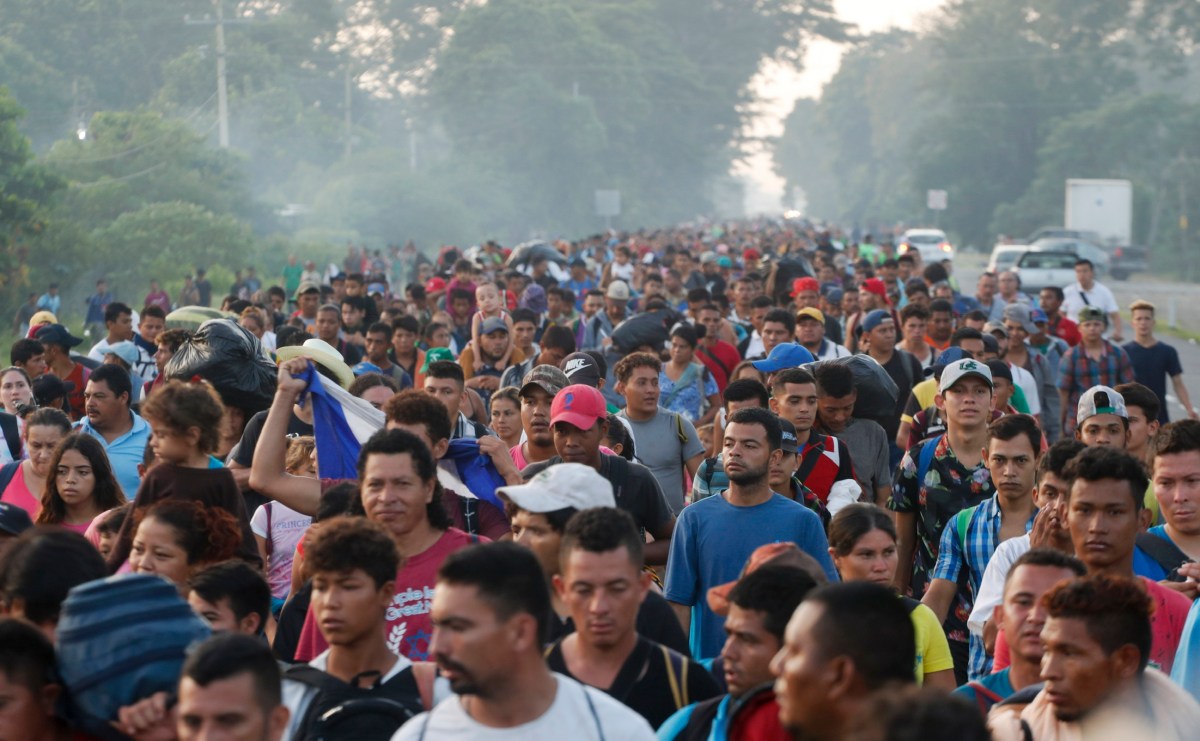
Caravans of thousands of people should not be let across our border. It’s actually one of the president’s stated charters not to allow it to happen. They also don’t need to be exaggerated or sensationalized at campaign rallies when they’re a thousand miles away and walking slowly away from violence and poverty in plain daylight.

Allowing for stronger border security and enforcement, within bounds of human decency (a wall is fine…caged kids isn’t) and providing a path to citizenship for those already in our country is a solution that meets both sides “stated” goals.

That we won’t ever attain either of those goals is a function of our political sickness.

If we can’t say border security, without confusing it with racism, we can’t solve problems. If caging children because we don’t care a Goddamn about anyone outside of the people who look like the people in our base, then people are going to credibly claim that what we mean by border security is caging children, and then they’ll be justified in calling us racist. And we’ll go round and round and grind our political will to do hard things down to the nub.

And the parts of the world who don’t embrace our principles of western liberalism will rejoice at our relative weakness.

One of the things I learned serving in places where people actually were fighting and killing each other is that if you draw rings around groups of people and make it a fight between the rings, all it takes to win is the biggest ring. And by win, I mean get the biggest slice of a fixed or dwindling pie that won’t grow for fear of strengthening the other rings.  The small rings don’t join forces against the big ring. It doesn’t work that way. They eventually just fight over what’s left over among themselves.

The only way out is to find the ring we can draw around all of us.  It used to be the promise of the American dream. Life, liberty and the pursuit of happiness. For the most productive times in America, that’s what we’ve been about.

When I started thinking about immigration as an issue, I originally believed it to be a fringe concern. One thrown on top of a populist rant to add some emotion. The fears aren’t grounded in reality after all. It’s marketing. Like rolling out Christmas decorations in the mall before Halloween. It’s annoying that someone thinks we’re stupid enough to buy into it and be influenced by the mania. But it’s not a real problem.

What I didn’t realize was how central to our political debate it is. In areas where border security is much more difficult, and laws are much more complicated like in the European Union, immigration as a central, defining political issue is producing extreme right wing candidates and political movements.

I’d like to see a candidate run on strong border security to ensure we maintain control over who/what enters our country but also insists on humane treatment of and a path to citizenship for those already in our country.

I understand why a Republican can’t beat that drum.

By why can’t a Democrat?