The Trap

About halfway through the first quarter of the Super Bowl this year I began to get the feeling that the American consumer, or at least the corporations that sell to the American consumer, were not big fans of the inward anti-globalism focus voted into office with the Trump administration. The global cultural mindset was everywhere. Coca-Cola ran an add with people from all over the world singing America the Beautiful in their native tongues. Budweiser told the story of Adolphus Busch’s immigration. And 84 Lumber (they sell wood) showed the first half of a story that had to be cut off and shown on the internet because it actually showed the dubious great wall of America.

The message was loud and clear. Americans associate positive sentiment with a modern, compassionate, global perspective. We feel warm and fuzzy about the idea of diverse cultures all longing for and participating in the American dream. That message was market tested and executed by multi-national corporations who spent $160K a second on air time to deliver it. It was not an unintentional endeavor.

There’s a trap that orbits around that message though. And it’s craftily set on both sides of the political debate to latch on to portions of the American electorate yearning for something they can’t define on their own. We independent thinkers, though, who strive to remain un-trapped in our thinking, have got some work to do to define our own views lest we get caught too.

Globalism is a pretty complicated thing. The commercials we were fed were about people and culture and diversity. And tolerance. Which is something as Americans, we’ve at least tried to be about, even if we’ve been grossly imperfect in our execution. That’s why the sentiment sells. And it’s also one side of the trap. It’s the progressive globalism trap. It pushes the notion that globalism is about people and tolerance. And if you’re about people and tolerance (I am), than you are about globalism.

Globalism is quite a bit more complicated than feeling warm happy feelings about including other people though. And in contrast, opposition to it is about more than protecting our culture and way of life from the infringement of outside forces.That’s the conservative globalism trap. That trap implies that if you are for protecting American jobs and having America first priorities, then you are for protecting our way of life from the external forces of diverse cultures and people who may come here with the intent to harm. You are therefore against immigration, legal or otherwise.

If you subscribe to either of those sentiments as a primary motivation for how you think politically, then you’ve been trapped.

In reality, globalism as we know it, the globalism that’s actually materially impacting Americans has almost nothing to do with people and cultures. And everything to do with trade and money. The standards enforced by the World Trade Organization and the outcomes that reducing barriers to free trade have ushered in an era of unprecedented global growth. They’ve drastically reduced inequality across nations. But at a cost. And that cost has been the re-distribution of wealth and the increase of income inequality within already wealthy nations like America. It’s a firm reality of economics. You grow other place’s middle class at the expense of your own.

That’s the trade side. The opening up of the international flow of capital over the last three decades has allowed money to move seamlessly from country to country. But that’s come at a cost too. And that cost has been a financial interdependence that fuels global recessions without alleviating the need for sovereign nations to bail out institutions deemed “too big to fail”.  And it’s allowed open competition for corporate earnings to drive the corporate tax rate down globally almost 50% in just a few decades.

That last one sounds like a good thing. Until of course you realized it just throws the tax burden back on private citizens while the corporations no longer paying it move their capital and jobs over seas.

The cases most politically argued for or against globalism mostly ignore these realities. They’re motivated by the polar perspectives of either caring for and tolerating all and any or protecting us from the evils and dangers of the outside. But neither one of them actually solves the pain that real hyper-globalism causes. So we’re using a “tastes great vs. less filling” debate to figure out which car to drive. It’s not answerable. And even if it was, it would get you the right answer to the wrong question.

I’m not a fan of protectionism. Historically, things like tariffs and border taxes hurt more than help. If you want to buy an iPad that was assembled by someone making union wages in Michigan, be ready to spend a lot more. And buy a lot less. But there’s a difference between full blown protectionism and allowing sovereign nations the freedom to dictate rules of trade and capital flow as they see fit to handle their domestic economic issues. And not usurping that responsibility to global governing bodies that don’t feel the impact when they go wrong and don’t have real authority to take measures to get the train back on the tracks when it falls off.

That’s the really good argument that the Trump White House could make relative to globalism.

I’ve got to hand it to them. Though I’d argue that leaving Trans Pacific Partnership is more of a signal to the base that they’re trying than a real live effort that helps, they’re on the right side of the tracks on trade. But they’ve got a deep political problem. They can’t seem to get America’s focus or energy on it. Because they’ve trapped themselves.

I once asked aloud on Twitter, where it’s easy to find the vocal Trumpers, what would be the thing that Trump could do that would anger his base to the point that they felt he had alienated them. Without hesitation, the response was clear and unambiguous. Go soft on immigration.

It’s pretty clear. In order to get a man like Donald Trump elected president, America needed to tap into the base psychology of nativism. It’s not new. It’s been around since Ben Franklin expressed concerns about the German immigrants muddying the English only waters of colonial America. It’s a bit of a political cheat button though. Because it will get certain threads of the collective American consciousness to love you. But it makes you focus on something that matters less to the material things causing the pain you promise to address. Immigration talk lathers people up. But it’s neither the cause nor the solution to the deep problem America has right now. Which is a growing income inequality gap between high skilled and low skilled labor.

Immigrants make up 13.5% of our population. And the jobs being taken by those immigrants, legal or otherwise are not the jobs responsible for the wage gaps between working class and white collar America. Those jobs have left America because of the spread of cheap global manufacturing and automation. And that is what’s driving the wage gap and the material impact on our lives and the economy.

Over the last 40 years, the world has seen globalization of trade and capital flows like no time in the last 150 years. But it has not seen a massive movement of people. No matter what any politician or talking head says. We are at our historic norms. Which means that hyper-globalization and the new modern red scare of foreigners are two distinct issues. But they’re argued like they are the same thing. When they are not. Which means the following two statements are true:

-You can argue for America first economic policies that are reasonably grounded in economic observation and reality, without ever mentioning immigration or the fear of foreigners.

-You can argue for tolerance and acceptance and inclusion of different people, without demanding lubricated free trade and movement of capital across borders.

Which means that the trap is a choice made by those who need to satisfy the already politically trapped in order to seek power. But it’s a choice that we in the middle, the ones who actually choose which ideologue sounds reasonable enough to support, don’t actually have to make.

I’ve been asked more than once if I’d ever consider running for office myself. And because I’d never be able to facilitate the kind of nonsensical idealogical circle jerk that would get me elected, the answer is no. And likely always will be. But if I were, and I were allowed to run on a reasonable platform related to things like the economy and immigration, I would say the following three things:

1- We as America, the largest economy in the world that drives the global consumption engine, absolutely reserve the right to dictate our own trade and foreign capital policies to other nations who want access to the richest economy in the world if current terms are not helping Americans.

2-Immigrants are welcome here. As are disparate cultures. But we need to account for the 11.5 million people in our borders here on an other than legal status. So they either have to go or we have to make them legal. I am for the latter for many reasons more than just cultural sensitivity inclusion and being a damn human. Which makes things like the entire sanctuary city debate irrelevant overnight.

3-America is allowed to enforce sovereign borders and sustainable immigration policy. It’s not inhumane to control who enters our country. Actually dealing with the 11.5 million undocumented people who live here humanely enables us to do this more effectively going forward.

You’ll never hear one candidate say all three. But listen hard for just how far off someone is, especially to number 1, and you’ve got a shot at picking the next leader of our country to actually get us closer to the great we think we deserve.

And watch out for traps. They work. That’s why they’re traps.


Presidential: The Great Abstract

According to theSOI.com, a web based questionnaire used by Fortune 100 technology companies to identify their leaders’ Styles Of Influence™, people have four major internal scales that dictate how they interact with others: cognitive ideas, relational emotions, goal forcefulness and detail order. Each bucket of styles comes with its own range of impacts.

Those who score on the highest side of the cognitive scale are considered to be abstract thinkers. Concrete thinkers are on the other end of the same scale. The assessment states:

“An abstract person understands the importance of an idea intuitively from a principle or value-driven perspective. Because of this, they are more likely to grasp how one idea can affect another, changing the meaning of both…This person will tend to speak in abstractions and metaphors in order to inspire or motivate.”

Writers tend to be abstracts. Lawyers too. And innovators. They’re blue sky thinkers who can connect thoughts with ideas to weave a reality in their mind that can define a world that exists or one that needs to be created. I scored a five on the cognitive scale. It goes to five. It’s not a measure of intelligence. It’s how you think. Not how well. On the other end, for details, I’m a two. Which is why I couldn’t tell you where my keys are right now if you gave me a thousand dollars to do it without wandering around to any number of likely locations.

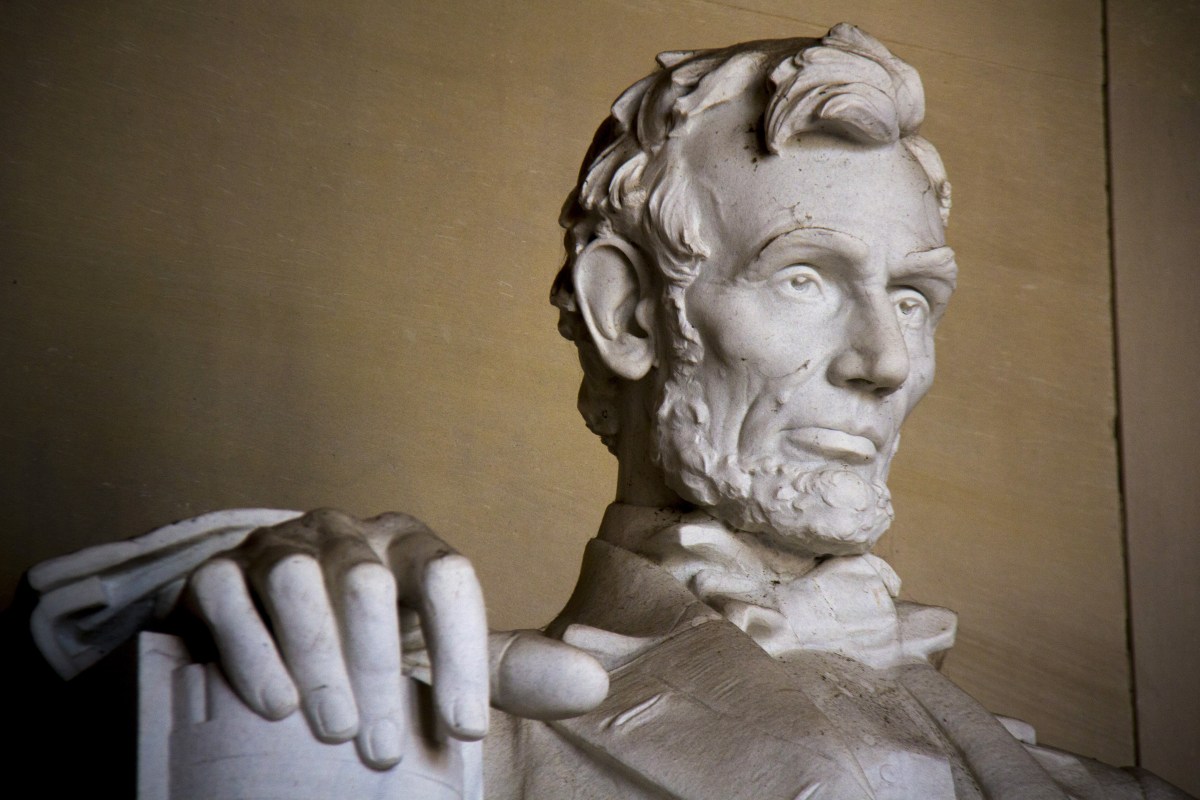
Abraham Lincoln was an abstract too. He existed almost entirely in the world of the big picture. He spoke incessantly in metaphors and stories. He almost never talked about a person without weaving them or their way of thought into a broader framework of a network of ideas.

Like Churchill, Lincoln had a savant like recall. From a young age, he would entertain whole parties late into the night by reciting, word for word, one of his favorite plays or chapters from his favorite books. He had the ability to keep an enormous amount of information in the front of his mind and recall it when it was most appropriate and attach it to something relevant and easily digested by the room.

Also, like the assessment’s description of abstracts, Lincoln had an unequaled grasp of the principles behind the ideas he toiled with and how they ran into and out of each other.

At Gettysburg, he lead with “Four score and seven years ago our fathers brought forth on this continent, a new nation, conceived in Liberty, and dedicated to the proposition that all men are created equal.” He called on the foundational ideals of our forefathers and linked them to the sacrifice of Gettysburg and even more broadly, the Civil War. He drove home the message that this effort was a continuation of the work of our founders that all agreed was virtuous.

It’s important to remember that the outcomes of that horrific war hadn’t been written into the textbooks then. And it hung more in the balance than most of us are comfortable with understanding. Less than a century after Jefferson wrote the words, the very notion of the viability of democracy and the principles of liberty were still in question. This America wasn’t permanent yet. Those tiring of war or politically opposed to the cause of Union or abolition needed to understand what was at stake; the very question of whether government of the people, by the people, for the people, shall not perish from the earth.”

The people of his time understood Lincoln’s abstract message, as has history. His ability to deliver it in a clear, succinct fashion in less words than I’ve taken to tell you about it was what made Lincoln so enormously effective. His mind, in a real and material sense, had a firmer grasp on the ideas of the moment than those who opposed him. And a way to express it so that all who heard, then and centuries since, could grasp what he wanted them to grasp.

He did all of this with no formal education. He taught himself to read. He passed the bar exam in Illinois when he was 27 and began to practice law.

In 1858, the uneducated upstart politician who had only held office as a one term congressmen a decade earlier took on Stephen Douglas, a titan of the Senate. Perhaps no instance in Lincoln’s life, or our history, shows more clearly the power of a superior mind. Douglas had been a member of the Senate for the better part of the past two decades and was a front-runner for the Democratic nomination for the 1860 Presidential election. Lincoln, was a nobody.

Imagine, if you can, the gravity of someone no one had ever heard of debating a Ted Kennedy or a Bob Dole and beating them so soundly on substance alone that it propelled him to national attention. Lincoln stood, awkward with his freakishly tall frame and ill-fitting clothing, delivering in his high-pitched voice words of heavy consequence.

Lincoln, on slavery in debate against Douglas:

“I hate it because of the monstrous injustice of slavery itself. I hate it because it deprives our republican example of its just influence in the world—enables the enemies of free institutions, with plausibility, to taunt us as hypocrites—causes the real friends of freedom to doubt our sincerity, and especially because it forces so many really good men amongst ourselves into an open war with the very fundamental principles of civil liberty—criticizing the Declaration of Independence, and insisting that there is no right principle of action but self-interest”

Slavery is bad, not just because it’s bad for those in bondage. It’s bad for what it does to even good men. It’s bad for the soul of liberty. And it risks all that we are by its very existence.

Argue against that.

He forced the recognition, and eventual reconciliation that ideas we hold true and dear to our culture were at deep odds with the nature of our actions. And that great hypocrisy not only was present but would eventually undo all that was done that made us who we believed we were. It can’t be overstated that the substance of his mind and his words were judged against such unfair standards, yet still are preserved for all history to see. He was a once in a generation mind. At a once in a generation moment.

Lincoln started in a dirt floor in Kentucky, lost most elections he ever ran in and was the third choice on the first ballot for the 1860 Republican National Convention. He won on a later vote with most voting against their first choice’s rival, not for him. He ended up on Mount Rushmore. Carved into that great granite facade, if Lincoln looked to his right, he would find men who originated from wealth and privilege and education, yet had no greater impact on their country or the legacy of America than he did.

It is literally accurate to say that no man’s arc of existence bent so far from humble beginnings towards the great impact of justice for all time.

And it was all in his head.

System One

Long, long ago, before the internet or television or electricity or even running water, the most complicated computer the world has ever known was already operating. It’s an incredibly old and incredibly common machine. It’s the human brain. It’s been growing and learning and creating efficiencies for thousands of years-millions if you count those that came before us sapiens. It’s responsible for more of what the world looks like today than anything that has arrived since the time of man.

It’s an easily fooled machine though. For as complex as it is, the shortcuts it takes to make us wondrous sentient beings what we are leave it susceptible to bias and blunder. Because over time, we’ve developed two systems that pull and push on each other at all times. And the fight isn’t always won by the right one.

The first one, system-1, was born somewhere in our lizard brains before we even made it out of the swamp. It’s automatic and uncontrolled. It’s our gut reaction to things. It see’s fire and runs. It assumes much. But understands little. System-2 is slower, deeper and more intentional. It feels turbulence on a plane but overrides our fear and reminds us that planes almost never crash and are built to shake. System-2 is deliberate. It’s where our best thinking on complex issues is done.

Some people are more system-1 than others.

Our brain plays games with us to manage these two systems. Behavioral economists like Richard Thaler call them heuristics. Thaler and co-author Cass Sunstein highlight three types in their 2008 book Nudge .

The anchoring heuristic is a fun one. We use things we know to be our first estimation of other things. If we don’t know the population of Kansas City, we think it’s much higher if we live in New York than than if we live in Daleville. A New Yorker’s population anchor is higher than a Dalevillian.

Then there’s availability heuristic. We assess the likelihood of something happening more frequently if an instant of it happening is available to our recent memories. Kidnapping, for instance, almost never happens. But every time it does, we hear about it. So we are less likely to let our kids play unsupervised at a park than we are to let them swim unsupervised in our own pool. Even though the latter is statistically, far more dangerous.

The representative heuristic makes us think that A must be B because A looks like B. We’re likely to think a large man in his early twenties in an expensive car is a pro football player. In fact, it’s more likely that he’s a lawyer. There are many more lawyers than pro football players. And therefore many more large lawyers in their early twenties than pro football players. But system-1, doesn’t know that. And it doesn’t care.

Things like advertisements and sales pitches try to appeal mostly system-1. You could argue that the best ones are all system-1, because system-2 advertisements take too much time. And maybe too much of a good product. So it’s just a short leap to say elections are greatly impacted by system-1. And the effective electioneers are most effective when they use these heuristics to tap into system-1 while appearing to be talking to system-2. When they target those people whose system-1 is largely in control, they are very effective.

Muslims are terrorists. And shouldn’t be allowed in the country. I can protect you—representative heuristic.

You’re all in danger. Only I can save you from crime and attacks from outsiders—availability heuristic.

America was once great. And you should expect it stay that way. And I can make it great again—anchoring heuristic.

For all of President Trump’s 40 or so years in the public eye, he’s been a system-1 guy. He’s about the brand. Find an idea, pitch that idea, provide some money, not yours if you can help it, and have someone else do the work. Slap the name on it that conveys the feel. Wander away and figure out how to do it again. It’s not stupid. But it’s not system-2 either. It’s all system-1.

Trump Plaza. Trump Marina. Trump Tower. Trump Steak. Trump University. It’s all about the brand. Branding is all system-1 after all. When I say Apple, you feel modern and elegant. When I say Haagendaas, you think of a foreign delicacy. Never mind that it’s made in Brooklyn. System-1 doesn’t care about the facts. Only the feel, facts be damned.

Running the government of the United States of America is a system-2 thing though. It’s early, but man does it feel like it’s being run by a system-1 guy. It’s been a bad week for the administration. But not for the reasons I would have thought. Not because he’s dishonest and motivated by selfish or unscrupulous ends, though that may be the case. It’s been a bad week because Team Trump has been inordinately stupid. I don’t use that word often. It’s a lazy criticism. But I don’t have a better word than stupid for using system-1 for system-2 things this much.

Michael Flynn was fired for cause during the Obama administration. Bringing him on was appealing to conservative system-1 and how good it feels to flip Obama the bird. But you need someone whose not stupid or crazy enough to talk to Russian officials and lie to your boss about it running the National Security Council. The original travel ban felt good to many scared conservatives. But it wasn’t legal. So much so that the White House isn’t going to push it again. They’re making a new one all together because the first one was a bad idea. Repealing Obamacare…system-1. Done. Fixing health care? System-2…crickets.

Hard problems are system-2 things. We’d all feel a lot better if we saw any proof at all that the Trump White House could work at all outside system-1.


When You’re a Hammer…

I few months ago I wandered into the Tucson airport bookstore, the victim of the dreaded and constant Tucson to San Diego delay, and saw four books on the “non-fiction” shelf by men I’d once worked with. They were war books. They were books on how to lead people differently, based on lessons learned in war. Or ways to live your life better, based on lessons learned in war. These men weren’t distant acquaintances. They were men I knew well. Men at periods in my life that I spent more time with than my family. They were my friends. And when I saw their work, and their stories in majestic hardcover form on the shelf, it made me happy. They deserved to tell their story. And others owed them a listen.

If there’s an upside to war, it’s the character that comes with the sacrifice of the generation that fights it.

You can’t turn on the television or scan your Facebook feed without a lead in that doesn’t say something like “A former Navy SEAL does X” or “this veteran has a message for Y”. There’s much to be learned from us and the experiences that less than 1% of America had fighting a never-ending war that took up all of the most productive portions of many of our lives.

So when we talk, you should listen. When we tell you about what it’s like to sacrifice years of our life to be a part of something bigger and more important than ourselves, then you should listen. And when we tell you what it’s like to serve in combat and fear for our lives and then pull ourselves past that fear to do things only we could do, you should listen. And when we tell you what it’s like to leave our family for years on end to go serve at the leisure of our national interests, you should listen. You should listen when we tell you what it’s like to watch our friends die to protect us. Or what it’s like to sift through body parts after a suicide bomb at a funeral. Or see dead children. You should listen. You should listen to us tell you what it feels like to slam a “Rip It” plug a wad of Copenhagen in our jaw and get your gear ready to go out the door on a raid with Titus Andronicus blaring in your ears.

You should listen to all of it. Because there’s power and wisdom in the lessons that life at war can teach you. Some of my friends have even written them down. I write them here.

When it comes to our opinions on things like politics or how the United States of America should behave towards other nations and other peoples, you should listen to us too. But you should also remember two critically important things.

First, the service of arms, in an all volunteer force, tends to attract a certain type of person. Good bad or indifferent, those that sign up and choose the path to stay against all available options tend to value certain things above others. And those things tend to align with a strong, conservative world view. And for we vets, that world view weaves itself into the fabric of our identity deeply. And sometimes, if we’re not careful, we’ll wrap ourselves in and wear it as a shield against realities that perhaps weaken the narrative we’ve told ourselves to help us live with the pain and sacrifice of our life of service.

It’s neither a good nor a bad thing. It simply is the way it is. And you shouldn’t discount what we say. But you should remember the things that shaped our perspectives.

The second is this. When you’ve been a hammer your whole life, the world starts to look like a nail. And the call of the one who promises to swing it, is the one you’re more likely to answer. So take what we say seriously, but also make sure it’s not the only voice your listening to.  If you try to build your house with just a hammer, you get a lousy house.

I’ve gotten asked a few times about the zeal that members of the military are showing for the new Commander in Chief. And whether or not it worried me. It doesn’t. In fact, it’s a good thing. Our military enthusiastically carrying out the legal orders of their Commander is a good thing. If you were looking to them to serve as opposition, look elsewhere. It won’t happen. And it’s not their job. That’s a problem for a different group to solve-the rest of us.

And if you’re worried about the uneven nature of the POTUS coupled with this new found enthusiasm for their leader resulting in the military becoming unhinged and sweeping the nation of the enemies of their leader, rest easy. I don’t have a ton of faith in Congress to do the right thing. I have a little more in the judiciary. And you may see some misguided junior military members doing stupid things like flying Trump flags from military vehicles, which is in fact against the rules, but don’t worry. They’ll be taken care of. Because the men and woman who lead them are perhaps the one group you can bet your ass, has the courage to stand up to the boss, when he’s out of line.

We all raised our hands and swore an oath to defend something for which  we were willing to sacrifice all we’ve had or all we were ever going to have. And it’s not a man. And that’s not changing anytime soon. No matter who’s sitting in that office.

The Trump Trilemma

Dani Rodrik, the Turkish born Harvard Economist states that a nation may have two of the following three things: national sovereignty, democracy, or deep, global economic integration. It can have any combination of two. But it cannot have all three.

This is “Rodrik’s Trilemma.”

The logic behind why is somewhat complicated but can be reasonably explained as three forces pulling on one rope. Only two can pull at once to balance it. The third has nothing to grab on to.

One force, economic integration or, globalization as it’s called in the political world, is created when we reduce the barriers for trade of goods and flow of capital between nations. In order to have it, we reduce transaction costs; tariffs, import/export quotas, etc. When we do this, we inherently weaken some aspects of the control of the nation state and strengthen the input of global regulatory bodies in the sovereign affairs of the participating nations. The two sides pulling on the rope in this scenario are globalization and the sovereignty of a state.

If a nation desires globalization, it has to give up some power in determining its trade policy. If it wants more control over trade policy, it should be prepared to lose bargaining power in a globally integrated economy. The ebb and flow can be rationally managed and balanced to meet the best outcomes of the nation.

The trilemma comes in to play when that nation tries to do this while maintaining the accountability of democracy. In a deeply integrated global trade environment, an electorate has to have a focus beyond the nation’s own borders to ensure that it governs and makes policy in a way that effectively facilitates the global flow of goods and capital. In order to do this, the electorate must be willing to surrender, through democratic process, some sovereign power to global regulatory entities. They need to be able to do this in all circumstances even when, or especially when, the near-term outcomes of trade policy negatively impact the outcomes of the electorate.

Rodrik maintains that electorates don’t do this.

As a result, a nation wishing to maintain global trade integration and democracy must give up sovereign power to the global regulating entity lest the unwashed masses of democracy break the global economy with a tariff to protect their jobs. The tug of war then transitions between global trade outcomes and democracy. The more power the democracy has, the less integration we’ll receive. Sovereign control sits it out, surrendered to the electorate or the global regulatory entity.

We could continue the analogy through all the potential combinations but the one material to the Trump-ism discussion is where we’ve insisted that global economic integration sit out the contest and let democracy and sovereign control of trade policy have a go at it.

Let the people pick the leader. Let the leader pick the economy that delivers for the people. Everyone else get in line behind America.

America First.

This path is sold easily after hard times like the Great Recession. Trump and Brexit are textbook Rodrik’s Trilemma occurrences. Globalism is the casualty.

Most economists agree, if not in magnitude at least in direction, globalism is a net economic positive. It increases GDP, decreases the cost of goods, and makes the world an “overall” more stable place. The global margin increases.

People don’t vote on the global margin. In America today, they don’t vote much on their individual outcomes either. They vote on their culture. And that makes globalism an easy target.

Much of the Trump-ism message is about transitioning the economics of globalism into a cultural message of nationalism. One of the great tricks of Trump-ism has been to align the negative economic outcomes for its political base with the culture of toleration.

About halfway through the first quarter of the 2017 Super Bowl, I began to get the feeling that the American consumer, or at least the corporations that sell to the American consumer, were not big fans of the inward anti-globalism focus voted into office with the Trump administration.

The global cultural mindset was everywhere.

Coca-Cola ran an ad with people from all over the world singing America the Beautiful in their native tongues. Budweiser told the story of Adolphus Busch’s immigration. 84 Lumber showed the first half of a story that had to be cut off and shown on the internet because it actually showed Trump’s dubious great wall of America.

The message was loud and clear. Americans associate positive sentiment with a modern, compassionate, global perspective. We feel warm and fuzzy about the idea of diverse cultures all longing for and participating in the American dream. That message was market tested and executed by multi-national corporations who spent $160K a second on airtime to deliver it. It was not an unintentional endeavor.

The commercials we were fed were about people and culture and diversity. And tolerance. They filled Americans with the positive sentiment ad companies love to attach to the brands they represent. Inclusion sells. The sentiment, though, is a classic example of a problematic progressive globalism trap.

The progressive globalism trap pushes the notion that globalism is about people and tolerance. And if you’re about people and tolerance (I am), then you are a fan of globalism. In reality, globalism as we know it, the globalism that’s actually materially impacting Americans, has almost nothing to do with people and cultures and everything to do with trade and money. The standards enforced by the World Trade Organization and the outcomes that reducing barriers to free trade have coincided with an era of tremendous global growth. It’s drastically reduced economic inequality across nations.

But at a cost.

That cost has been the re-distribution of wealth and the increase of income inequality within already wealthy nations like America. It’s a firm reality of economics. We grow other place’s middle class at some difficult to quantify expense to our own.

Additionally, the opening up of the international flow of capital allows money to move seamlessly from country to country. But that’s come at a cost too. That cost has been a financial interdependence that fuels global recessions without alleviating the need for sovereign nations to bail out institutions deemed “too big to fail.” The global community didn’t bail out the American financial sector or our automakers. America did.

At the same time, the open flow of capital has also allowed open competition for corporate earnings to drive the corporate tax rate down globally almost 50% in just a few decades in a way that makes America less competitive for internal investment.

The fair point that Trump-ism makes is that global growth and stability hasn’t come without a cost to America. And the cost has fallen heavily on an American working class that hasn’t realized that we transitioned from a manufacturing and production economy to a services economy two generations ago. While the benefits of that global growth of the second half the 20th century exist, the costs are easier to point to in the wake of the recession.

By aligning the economics of anti-globalism with the cultural phenomenon of nativist nationalism, Trump-ism trapped their opposition in a reality where one is either for diversity, or one is for America. One can’t be for both and have the economic interests of Americans as a priority. The only counter Democrats found in 2016 was a departure from capitalism all together of Bernie Sanders.

And we know how that went.

Crisis of Faith

When you say the word Christian, do you mean your faith? Or do you mean your tribe?

Let me ask that question in a different way. When you hear the word Christian, do you see a person? Or do you see a way of life?  Is it a noun? Or, an adjective?

It’s an exercise in semantics right? Well, in as much as the teachings of the Christian Bible are semantics, I guess it is.

Our world is full of semantics. “Our country is great” can mean a lot of things. Great means powerful. It means rich and full of opportunity. Great could mean familiar and sustained. Great can mean free from tyranny and overburdensome rule. Great could mean a place where life, liberty and the pursuit of happiness win out. Or, it could just mean a decent place to live in peace and quiet with the space to live with your own thoughts.

cropped-screen-shot-2018-06-09-at-10-35-11-am.png

For me, great means the place that every living human soul in the world wishes they were born, but even more, wishes they could die in. Or die for. That’s what great means. And once, not too long ago, maybe even last week, that’s what America was.

The dreams of the world happen in American. My first ancestor came here as an indentured servant, to Brooklyn before it was even a British colony.  My last came here over two hundred years later, from Ireland, working in the steel mills of Pennsylvania. For centuries, people came because of the promise of great. Because greatness meant one simple thing. All were welcome.

We wrote it down and it changed the world.

“We hold these truths to be self-evident, that all men are created equal, that they are endowed, by their Creator, with certain unalienable Rights, that among these are Life, Liberty, and the pursuit of Happiness.”

We screwed it up from the start. We didn’t include everyone. And we paid the price. We fought like hell over the last 240 years to get us to equal. And welcome. And we’re damn close. At least we were. It’s changed though.

Why?

About that first question I asked. When you hear the word Christian, what do you hear? I’ve heard the wasteful debate over whether or not we are a Christian nation with Christian values. We are. But we are more than that too. At our very core, we are a nation built on the fundamental value that all are equal. It is not at odds with my faith. My faith tells me all are loved. All are forgiven. All are welcome.

We are every bit in the middle of a great crisis of our faith and culture. But for a different reason than perhaps they’ve led you to believe. Our way of life isn’t at risk because more people want to come and live it. Our way of life is at risk because we’ve answered that first question wrong. Christian isn’t a thing. It’s not a tribe or a people to be protected. It’s a beautiful word that describes a bold fearless way to live. And the crisis isn’t that the knock on the door came and keeps coming from those in search of our shelter. The crisis is what we’ve decided to do when we heard it.

The teachings of my faith are clear and unambiguous. Matthew 25:

‘Come, you who are blessed by my Father, inherit the kingdom prepared for you from the foundation of the world. For I was hungry and you gave Me something to eat, I was thirsty and you gave Me something to drink, I was a stranger and you took Me in, I was naked and you clothed Me, I was sick and you looked after Me, I was in prison and you visited Me.’

In my faith, my God doesn’t ask. He commands. And he does not qualify my safety as a condition to obey. You can fool yourself into thinking that closing the door is protecting us. Maybe for a little while. And maybe from outsiders. But it can’t protect our way of life from the only enemy who could ever take it away for good.

Us.

This is not our way.

Cowardice is Not Our Way

The war started for me while I ate dinner in the  wardroom of my ship, a navy destroyer, floating in the Arabian Gulf within eyesight of the coast of Iraq. The phone rang at the captain’s seat. My roommate answered, said “ok” and hung up.

“Someone just flew a plane into the World Trade Center.” he said.

That’s all we knew. I went up to the bridge and took over the watch. Minutes later, the phone in front of the captain’s chair on the bridge rang. It was my roommate down below.

“Someone just flew a plane into the other tower. The towers fell.”

I hung up the phone and looked around the bridge at the other men. They were kids. So was I. My feet felt like they were frozen to the deck. A hand on my shoulder snapped me out of it. It was the captain. He handed me a yellow sticky with some coordinates and nodded to the chart table. A subtle order that started the war. Then he climbed up into his seat on the right side of the bridge and sat down.

That’s when I heard it.

Over the marine band radio, the ones we used to talk to the other ships and boats in the area. We heard laughing. And cheering. And music. As the towers fell, we heard cheers of joy.

A little over a month later, the first shot in the war rumbled out of the forward missile launchers of my ship. I watched it from the same place I was standing when the towers fell. That night, as I went to sleep, safe in my stateroom, I had two thoughts before I drifted off. The first was that we were at war with an entire region; maybe even an entire religion. The second was that I never again wanted to fight it from the safety of a ship.

The next day, my ship was on the cover of every newspaper in the world.

Two years later I returned to that part of the world as promised, with a with a very different group and had a very different mission. The details of the what and the who aren’t important. But what I learned is.

The end to a hard nights work in that life was always signaled by the same two things. The light purple glow on the horizon of the dry flat earth. And the wailing of the call to prayer. One morning, as the low droning sound of Arabic echoed from the speakers over the harbor, one of the young officers from the partner unit my team worked with looked at me. He was a Muslim. And he was born and raised in the area in which we were working.

He was a friend.

“I wonder what that sounds like to you Lieutenant.” He smiled. “It sounds like God to me.”

We weren’t far from where they cheered over the radio on 9/11 in distance. But things were different between him and I. They always are when you do the work to close the distance between people.

That’s the lesson I learned.

My team conducted dozens of operations to fulfill objectives of the Global War on Terrorism on that deployment. My Muslim counterpart, and his team of Muslims, Christians and others were shoulder to shoulder with me on every one. I’d go back a third time a few years later. Hundreds of missions that time. On every one of them, a Muslim was the first one through the door. Sometimes, they were the only ones through the door.

Lying in my bed in my stateroom, ten years earlier, I’d gotten it wrong. We weren’t at war with a region. Or a religion. We were at war in a region that had a religion. And the Muslim men and women that fought with me were fighting because the first countries that radical Muslim terrorists invaded, were their own.

I’m not naive. I know there are people over there that don’t love America. I’m confident that there were even men I fought along side who hated me, my country and what I represented. Some I’m sure eventually wound up on the other side after I left. But there are also people over there that are just trying to get through this life in one piece. And feed their families. And keep them alive. And they don’t give a rip about anything other than that.

We don’t have to do anything for them. They aren’t American citizens. They aren’t protected by the laws of America. And who does and doesn’t enter the country is every bit the prerogative of the executive branch of the United States Government, whose leader we just elected.

Much of America is just waking up to the fact that, in the domain of immigration, the actions of our previous leaders were governed more by the societal norms of decency, charity and global leadership than they were by laws. And when it comes to immigration, the president can pretty much do whatever he wants, within the bounds of the very few laws that dictate how we address other people in other places.

We’re all realizing now that the choice we made this November was that decency, charity and global leadership are no longer a part of the American message to the rest of the world.

And maybe that’s fine. Maybe we should be ok with that in order to preserve our safety and our way of life.

Maybe not.

Maybe we’re pretty safe right now. One third of one percent of murders in America come from terrorist related violence. No fatal terrorist attacks in America have ever been conducted by someone coming from one of the seven countries for which we just banned the entry of refugees. And we are several times more likely to drown in a bathtub than be killed by a terrorist.

And maybe our way of life isn’t so fragile.

We cast off the rule of the most powerful empire the world had ever seen by waging a bloody war against them because they taxed us without due representation. Over 22,000 of us were killed or wounded in a day at Antietam in a war to preserve our union and destroy the institution of slavery. We led the largest invasion in the history of man over the beaches at Normandy to free a continent we didn’t live on. And we put a man on the moon using slide rules and a pencil.

That’s our way of life. That’s America. We don’t hide behind a wall like a coward.

Most Favored Nation

Last fall, economists Steven Levitt (of Freakonomics fame), Peter Cohen, Robert Han, Jonathan Hall and Robert Metcalfe published a paper on their findings of the analysis of the car service provider Uber X’s customer interactions from 2015. All 50 million of them. And they found something startling. Uber X’s ability to provide on demand transportation through flexible pricing and scheduling created $2.9 billion of economic surplus for Americans in 2015. Which means that because of how Uber X works, Americans spent $2.9 billion less on getting from point A to point B than they would have had Uber X not existed. And those Americans were therefore able to spend that money on something else, mostly in America so that other Americans could make more money.

That’s a hell of a finding. That’s roughly what it took to run the entire city of San Diego during the same period. But, it’s actually the second most interesting thing in the paper. What was more interesting than creating $2.9 billion out of thin air? It’s what actually told the team that bit of information—an actual demand curve, the first ever real demand curve ever seen.

Now, anyone who has taken introductory economics understands that the first day of class, the professor stands in front of the room and draws two curves. A supply curve. And a demand curve. And then he/she goes on to pontificate how perfectly they operate, all things being held constant. And if you’re lucky he/she might jump right into the power of comparative advantage and the magic it unlocks in free trade for mankind. So when I heard Steven Levitt say that they’d never actually seen a real live demand curve, in the history of mankind demanding things and supplying them, I nearly drove my car off the freeway and into a ditch, dooming me to contribute first hand to more economic Uber X surplus.

I recovered though. And I stayed on the road. And it started me off on a bit of a journey. I wanted to understand how the hell economists actually have a job.

Well, a little less than a year later after swimming in the work of people like Paul Krugman, Peter Thaler, Dani Rodrik, Jeffrey Sachs and Tyler Cowen, I’ve learned a few things. One is that I like economics. Who knew. The other is that there’s really two kinds of economics. There’s actually way more than two in real life. But for the sake of a reasonably short blog that someone might actually read, I’ve picked two that showed up as patterns in the work.

The first kind of is the one almost none of us actually encounter, unless we’re economists. It’s what I like to call, “academic economics.” Often delivered by a bearded gentlemen in a corduroy sport coat with those leather things on the elbows, academic economics believes in many things, but one thing absolutely. Context matters. When a professor stands up in front of a class and gives a lecture, two things are always present. A laundry list of assumptions. And a model. And it is common knowledge that assumptions change, as do the utility of the various as-sundry economic models. And if someone actually asks a question, like is free trade good? The answer is always, well that depends. And the things it depends on are about a billion situational factors about a time, place, culture, region that one could form an opinion out of. Very few things are answered absolutely and permanently about broad things like global trade or capital markets.  Lots of theories come about. All of them start with “it depends”.

That’s “academic economics”.

The other kind of economics is the kind that we all hear about all the time. It’s what I like to call “public policy” economics. And it’s ubiquitous. Public policy economics is usually is the less interesting economics elected official or a think tanks deal in. It rears its dismissive head when a bunch of economists who spend at least some of their time saying “it depends” in the classroom start saying something very different when asked questions like “is free trade good” in front of congress. They say things like, of course it is. Everyone agrees. And then they recommend policies in support of it.


Because, like just about anything, economics is not free from the risk of infection of politics. And “It depends on your assumptions” is really hard to put on a bumper sticker. Or a meme. And it’s even harder for stiff smiley politicians to talk about. Because most of them don’t have a ton of depth on the subject. Even the great Winston Churchill, once in charge of the British economic policy as Chancellor of the Exchequer was admittedly lost, claiming that his economic advisors were “speaking Persian”. And from a political perspective, those Persian speaking economists need to make sure that everyone understands that free markets rule and government intervention or protectionism is evil, lest we go and break the economy permanently with something draconian like a tariff. Never mind any of that thinking that economist Jeffrey Sachs calls, differential diagnosis. The considering of unique situational factors to be critical to an economic policy recommendation. All that thinking and considering nonsense is for the classroom. Politics renders it less useful in the light of day.

Something interesting is actually happening in economic politics right now though. When it comes to foreign trade specifically. Free trade appears to be the only thing anyone can agree on any more. Everyone hates it. Except economists that is. None of the politicians, at least the ones running for president, appeared to be big fans of our current trade agreements. Not the Republicans. Not the Democrats. And not whatever President Trump is. Bernie, Hillary and POTUS 45 all campaigned on pulling out of the Trans Pacific Partnership, the trade agreement that lowers barriers to trade for 12 Pacific nations not named China.

There’s another interesting thing too. None of the American people like our free trade agreements either. In fact, they never have. Survey after survey after survey of Americans and others all say they hate liberalization of free trade. They feel like it takes their jobs away. And forces them to do other things they weren’t trained to do. And lose money.

And they’re right. It often does. It’s not the only thing it does. It also gives us cheap goods that make that loss of income a little easier to bear. But the masses, this time, aren’t wrong about what’s happened to them over the last 40 years. How not wrong is up for debate of course.

Even your most ardent free trader admits, that though free trade creates overall economic growth, it comes with the cost of income redistribution and labor shifts that are big damn drag for a lot of people, particularly those at the lower end of the skill curve in the labor force. In fact the negative impact for those that lose out on the redistribution is about 50 times (also Rodrik’s number) more significant than the overall gain. Redistribution isn’t loss though. Someone else gains that fifty times. And even a little more because free trade does promote economic growth. But right now, in America, it’s really hard to ask the middle and working class to take more hits.

This is probably a good place to point out that two of the assumptions the “it depends” answer actually relies on is political climate and state of the workforce. Ours right now elected Donald Trump to be president. We may not have a model for that one yet…

Free trade didn’t create the loss of manufacturing jobs in America. Or the equality gap between low and high income Americans. Increased productivity that outpaced demand and a shiny new modern China over the last forty years are probably the main culprits, free trader or not. But it’s not helping fix our equality gap right now either. And when the executive action to scrap something like the TPP is wedged between building walls, deleting EPA data from government web sites or the wholesale repeal of healthcare, it’s easy to start to scream opposition to it as we develop a new political dynamic that says that Trump is bad=anything Trump does is bad. I think what we’re seeing though, is an interesting realignment.

The idea of free trade and the aim of reducing government intervention is an idea that really began to come to life under Reagan with the neo-liberalist movement. The free market fixes all ills and moves man forward. The government is bad and can only hurt things. The development of income inequality in the decades since and the certainty of its existence has thrust us into a different debate. The debate has shifted the argument from free trade vs. not free trade to how to deal with the fallout of free trade, without breaking the benefits of it. It sounds much less aspirational. But that’s where we are.

Right now, the developing party line for liberalization of trade is that free trade moves the world forward and helps global inequality, at some cost to inequality within nations of wealth. And the most appropriate action isn’t protectionism. It’s a stronger social safety net at home for the American worker. Which sounds like it evolves into a good old fashion conservative vs. liberal argument. But it’s really an argument about where government intervention is most appropriate. To protect our internal economic development through protectionism? Or to compensate the American worker through government social measures in return. You’ll note, keeping government out of it is no longer on the menu. And that’s new in America. Or at least new again.

So who’s right?  Well it depends…remember? It depends on about a billion different things. Things like exactly what the rest of Trump economic policy looks like. It depends on whether or not the election of an unknown agent leads to catastrophe of domestic or global proportions. It depends on whether or not Mexico breaks off diplomatic and economic relations with us. It depends on whether or not our commander in chief gets impeached for refusing to sell his businesses or fondling an unsuspecting intern. It depends on so many things that the only real thing you should be sure of is that if someone tells you pulling out of the TPP without certainty is a bad/good idea, than they are full of “fake news.”

Wait and see on this one. Keep a firm watch on the other stuff that is far more scary right now. Pulling out of that trade deal isn’t downright nuts. (there’s a bumper sticker for you) Not the way building a magical symbolic wall in 2017 is. Not the way pulling the plug on ACA without a plan is. So resist the urge to oppose for opposition sake. There’s plenty of meat still on the bone for that one.

In Search of Elliot and Archibald

On May 18, 1973, the United States Senate began nationally televised hearings on Watergate.

Incoming Attorney General-designate Elliot Richardson, recently appointed by Republican President Richard Nixon, assigned former solicitor general Archibald Cox to serve as the Justice Department’s special prosecutor for the investigation. The rest, as they say, is history. 478 days later, amidst mounting evidence that he himself broke the law by authorizing illegal activities against the Democratic National Committee, Richard Milhous Nixon became the only man to resign the office of President of the United States of America.

At the time that the Senate Committee launched their hearings and Cox began his investigation, there was no public evidence that implicated President Nixon in those illegal activities. The election, held the previous November, was won by Nixon in one of the great landslides in presidential election history. He took just under two-thirds of the popular vote, a tally impossible to explain by any illegal activities. But he broke the law. And then he tried to cover it up. So he had to go.

By all other respects, Nixon was, at a minimum, a serviceable executive.

The most powerful man in the world broke a law that had no measurable impact on his claim to office or the effectiveness of his administration.

Still he lost power.

Not through force of violence or activity outside the rule of law. But because the institutions that firmly stood in place to limit his power insisted that he lose it. There was a legislative branch that acted independently of political goal. There was a judiciary and law enforcement entities that insisted on seeing it through. There was a free press that spoke truth to power. And there were Americans of character and principle in positions of authority.

Watergate was the application of the rule of law. Might did not make right. There were limits to power. And we saw them in action.

On October 20th, 1973, it came to a head on what’s since been called, the “Saturday Night Massacre”.  With mounting pressure and evidence piling up against him, Nixon ordered Attorney General Richardson to fire the special prosecutor Cox. Richardson refused.

He was fired.

His immediate replacement William Ruckleshaus also refused and resigned. Eventually, a third, Robert Bork, carried out Nixon’s order.

The damage had been done though. Within a year, Congress passed the articles of impeachment. And Nixon was gone.

There have been and always will be inappropriate people who inappropriately seek power. There will always be outside powers looking to interfere in our wellbeing as a nation. But what has made us uniquely great, what has delivered 55 peaceful transfers of power and 2 percent per capita economic growth for 240 years, is the institutions and functions of government that respond to them.

The great risk of our times, is that perhaps now, they can’t. Or they won’t.

We’re about to inaugurate someone who has held no position of government in his life and can scarcely point to a single aspect of service in seventy years; with suspect business dealings and personal behavior.

But he’s not the real risk.

The real risk is the Americans standing next to him and the institutions charged to check him that scare me the most.

We’re no doubt in for a very different experience. And perhaps the only person who could drive the needed change is someone like Donald J. Trump. But I’ll ask the question to his supporters.

When am I allowed to be concerned?

What does he say and what does he do that alarms you?

Because we’ve shrugged off quite a bit already. And when the people who supported a candidate’s rise to power can’t be counted on to eventually tell him he’s gone too far, we’re left with the institutions to do it. When I think of those institutions today, it gives me grave concern.

Who in Trump’s inner circle blows the whistle?

Who on his cabinet resigns over principle?

What Republican stands for no more in Congress.

Who in the press will we believe? 

Who are today’s Elliot Richardson and Archibald Cox?

Our most serious problem probably isn’t Donald J. Trump. It’s that the answers to those questions feel like the same ones that failed to check the truly dangerous leaders in history that hurt so many. And that’s new in America.

Star Wars: A Social Commentary

If you’re going to make a prequel to the most iconic, imitated and merchandized movie in modern American culture, you’ve got some pretty heavy decisions to make before doing it.

If you decide to make that prequel end at pretty much the exact moment that the iconic movie begins, and 40 years have passed since you stopped filming the first one, then you’ve got some more decisions to make. And some problems to solve too. Like making people dead or 40 years since aged appear to be neither. Or making spaceships move and sound the same even though special effects technology has been reinvented several dozen times over. I’ll spare you the spoilers. They did just fine with both of those. And as a lunatic Star Wars geek since long before it was cool to be a lunatic Star Wars geek, I loved every minute of it.

I realized something about halfway through my second viewing of it though. Something that you would probably miss, unless you were sitting next to a curious seven year old who got his first WIFI enabled iPad when he was three. It occurred to me, when he leaned over and in his extra loud whisper voice asked, as the heros of the movie were hatching their plan to get their hands on a society saving piece of data, “why don’t they just download it from the cloud?” And there it was. Somewhere between a mouthful of popcorn and a draw on my 90 ounce diet coke, it occurred to me that the fantastic Star Wars drama Rogue One, was an accidental social commentary on the great stagnation of our times.

Chances are, you’re going to need me to unpack that one a bit.

One of the fun decisions that the makers of Rogue One made, very effectively so, is to cinematically keep true to the futuristic technology levels shown in the first Star Wars movie. In the 40 year old Star Wars, there were space ships and light speed travel and special reactors powering things. They had vehicles that levitated and machines that harvested moisture from the atmosphere. There were no wheels inefficiently conquering surface friction on just about anything. Nothing appeared to be burning anything to propel it. And there were robots everywhere with real artificial intelligence to the extent that they had their own limited free will and personalities. In almost every way, it was a glimpse into the far distant future. And what 1977 would have you believe, in a way that recreating it in 2016 makes painfully obvious, is that fantasy future is powered by computer technology that would have been nearly obsolete by about 1995. screen-shot-2016-12-28-at-7-59-36-am

About the same time that the original Star Wars was being filmed in the mid seventies, Gordon Moore, co-founder of Intel made his proclamation that would be referred to ever since as Moore’s Law. Moore claimed that computing capability would double every 18 months. Over the last few decades, his assessment has been correct. In the 60’s we sent men 240 thousand miles to the moon and back on a rocket designed to go even further, Mars perhaps, using a navigating computer with 265 thousand times less memory than my Iphone. screen-shot-2016-12-27-at-5-58-30-pmWhich means even a decade or so later when Star Wars came out, what we saw on the screen, cd ROMs with secret plans, buttons instead of touch screens, vacuum tube televisions and data ports you had to plug a giant robot phallus into to transfer info, looked futuristic. Because it was. But when we had to duplicate it and pretend it still was forty years later, it looked, well, kind of silly. 

So what right? Clearly I spend too much time thinking about what things say about us as a society. That’s entirely true. But consider this. In 1969, we were conducting space travel and flying super sonic passenger flights. We had no WIFI or even internet, almost no data storage or computing capacity and nothing that resembled the cloud. Today, my 11 year old operates an iPhone hundreds of thousands of times more powerful than anything we had then, and we haven’t flown super-sonic passenger flight in 13 years. And America is no longer capable of manned space flight. What space flight is happening, is limited to low earth orbit. Because over the last 40 years, the world of bits (computers) hasn’t just outpaced the world of atoms (everything else), they’re no longer even headed in the same direction.

But why?

There’s a few thousand pages you could put into that question alone. But I’ll hopefully leave you wanting more instead. You could take the path that Paypal founder, Facebook Board member and venture capital investor Peter Thiel takes. Thiel who famously critiqued Silicon Valley’s output by saying,”We wanted flying cars, instead we got 140 characters.” believes that the barriers to entry for industries like energy and automobiles are too high because of things like regulation and a failing education system and a lazy baby boomer generation that rode the coat tails of their parents to a comfy life with no problems to solve. Thiel believes that we have deep societal and government structure flaws that we could overcome, if we get it together to get it moving again. Which is probably why he spoke at the Republican National Convention.

Or you could listen to economist and author Tyler Cowen who takes another spin on it. He thinks we’re pretty much done innovating, for awhile, as an American species. We’ve picked all the “low hanging fruit” over the last 400 years or so, with free land, immigrant labor and technology, now it’s time for it to slow down. And it has.

So who’s right? Thiel? Cowen? I don’t know. As it tends to be with massive systems discussions like the economics of innovation, it’s complicated. But I like to put my mental energy into a space that it’s likely Cowen would find silly and optimistic. It sounds like this. There was a lot of money made in Silicon Valley over the last few decades connecting the world and creating a future that, from a consumer software and electronics perspective outpaced even the great creative mind of George Lucas. And now some of that money is going towards combining the first principles of Silicon Valley-lean agile start up aggression- with old dinosaur industries like automobiles and aerospace. Elon Musk is launching rockets at Space X, putting solar power on houses with Solar City and building electric cars and charging stations at Tesla. Amazon founder Jeff Bezos is stealing Musk’s employees to come work for his own space company Blue Origin. And Google is making cars that drive themselves.

The point is this. I don’t know if Cowen or Thiel are right. It doesn’t really matter. Because it’s moving again. And the types of people moving it appear to have the resources to get it moving for real. And our job, as a people, is to expect it to keep moving. And to see the value in progress and innovation beyond things that make our lives easier. It was easy when we had no choice, when we needed to make rockets and technology to keep up with Russia and stave off nuclear annihilation. Without that push we’ve lost a bit of the oomph though. But we need it back. And quickly. 2.7 billion industrialized Asians are going to happen over night. And if we do it with last century’s energy and transportation technology, it’s just another type of annihilation.

It’s time to start seeing the world like a seven year old who looks at a problem and asks with the great curiosity and wonder, “why don’t they just use the cloud?”  In 1977, that was a crazy idea, even for the future. But as Google founder Larry Page said, who was once told the idea of translating all the books in the world into data was crazy, “Good ideas are always crazy, until they’re not.”

And right now, that guy and his buddy Elon are building a zero emission car that drives itself. Which sounds crazy right?

Until the world needs it. Until it doesn’t.